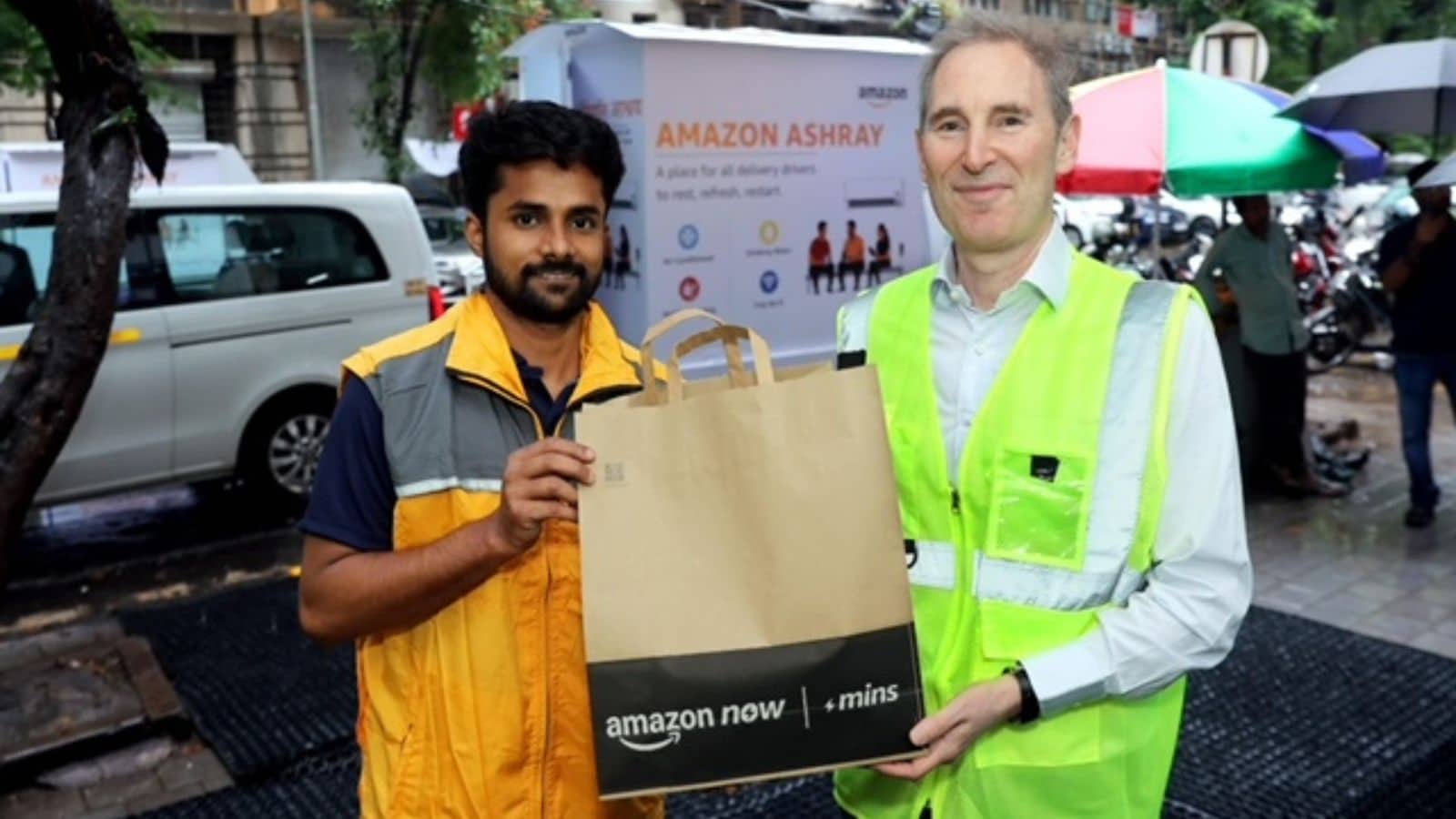
Amazon is pouring 300 million dollars into its quick commerce weapon, Amazon Now, in an aggressive bid to expand from 15 cities to over 300 across India. CEO Andy Jassy recently visited a micro-fulfillment center in Mumbai, championing a model where orders double every quarter and Prime members triple their buying frequency. But beneath the corporate optimization narrative lies a desperate rearguard action. Amazon, the company that taught the world to wait two days for a package, is burning capital to survive in a hyper-localized ecosystem it completely misjudged.
The primary query for global retail observers is whether a logistics empire built on massive, suburban fulfillment centers can successfully pivot to a street-by-street dogfight dominated by agile domestic incumbents. The short answer is no, not without destroying the very margin structures that made Amazon a trillion-dollar entity. In India, local giants Blinkit and Swiggy Instamart, alongside the venture-backed Zepto, already operate thousands of dark stores. They have turned instant gratification into a basic utility, forcing Amazon to play an expensive game of catch-up on foreign turf.
The Geography of Miscalculation
For a decade, the standard e-commerce playbook relied on hub-and-spoke logistics. Large warehouses situated outside municipal borders held millions of distinct inventory units, dispatching them via trucks to local sorting hubs, and finally to delivery vans. This methodology works perfectly when consumers plan their purchases 48 hours in advance.
It fails utterly when a consumer expects a carton of milk, a phone charger, and a fresh avocado to arrive before their morning coffee cools.
Domestic upstarts understood this shifting reality before Seattle did. Blinkit alone commands nearly half the local market share, operating over 2,200 dark stores tailored specifically to high-density urban pockets. Walmart-backed Flipkart has rapidly built out its Flipkart Minutes footprint to 1,000 micro-hubs. Amazon enters this arena with roughly 500 micro-fulfillment sites. To achieve its promised 300-city coverage, the company cannot simply replicate its traditional infrastructure. It must rent expensive real estate inside crowded city centers, a logistical flip that upends its long-term cost efficiencies.
A hypothetical example illustrates the structural tension. If a traditional fulfillment center handles 100,000 orders a day with a broad inventory footprint, a neighborhood dark store can only hold around 10,000 specialized items. The real estate cost per square foot in downtown Mumbai or Bengaluru is multiples higher than on the industrial fringes. When an operator shrinks the geographic radius of a facility to guarantee a sub-20-minute delivery window, the labor and real estate expenses are compressed into a fraction of the order volume. The math is brutal, and it explains why the quick commerce sector has historically bled cash.
The Prime Subsidy and the Frequency Illusion
Jassy points to internal data showing that once a Prime member utilizes Amazon Now, their overall transaction frequency triples. This is a compelling metric for shareholders, but it obscures a deeper structural vulnerability.
+------------------+-----------------------+---------------------+
| Operator         | Estimated Dark Stores | City Footprint      |
+------------------+-----------------------+---------------------+
| Blinkit          | 2,243                 | 200+                |
| Swiggy Instamart | 1,143                 | 129                 |
| Flipkart Minutes | 1,000                 | 130+                |
| Amazon Now       | ~500                  | 15 (Expanding to 300|
+------------------+-----------------------+---------------------+
The increased frequency does not automatically translate to profitability. Traditional Prime loyalty was anchored on high-average-value baskets—electronics, apparel, home goods—where the shipping cost represented a small percentage of total revenue. Quick commerce consists mostly of low-margin groceries and convenience items. A consumer ordering a single bottle of shampoo and a loaf of bread creates a highly inefficient delivery run.
Amazon is essentially using its marketplace profits to subsidize the high variable cost of ultra-fast grocery delivery. The hope is that by capturing the daily, high-frequency interaction, they prevent users from drifting into rival ecosystems for their larger, more lucrative purchases. It is a defensive moat disguised as an aggressive expansion strategy.
The Regulatory Wall and Driver Economics
The race for minutes has also collided with escalating regulatory scrutiny and labor realities. In January, government authorities instructed platforms to stop explicitly marketing "10-minute" turnarounds due to mounting public anxiety over courier safety on chaotic urban roads. The physical constraints of traffic, monsoons, and complex high-rise navigation mean that true ultra-fast delivery cannot be solved purely by software optimization.
In response, Amazon has packaged its logistical expansion alongside worker welfare initiatives like the Sammaan program and Ashray rest stations. While providing air-conditioned hubs and insurance coverage is a positive step for workforce retention, these measures add fixed overhead to an operational model that already operates on razor-thin margins.
Furthermore, the quick commerce battleground is shifting rapidly from metropolitan zones into smaller cities and regional hubs. In these regions, consumer habits diverge sharply from the urban elite. Buyers in smaller towns tend to build larger, value-conscious grocery baskets rather than ordering single items on impulse. This shifts the operational requirement away from pure speed toward broader catalog availability. Amazon believes its massive national supply chain gives it an advantage here, but local competitors are already entrenched, adapting their dark stores to regional inventory demands long before Amazon's micro-hubs even break ground.
The grand irony of the Amazon Now strategy is that the corporation is abandoning the centralized efficiencies that defined its global dominance to mimic the neighborhood mom-and-pop operations it originally sought to replace. By moving its inventory onto the local high street, Amazon is absorbing all the friction, real estate volatility, and localized risks of traditional retail. Whether this massive capital deployment will yield a sustainable business or merely fund an endless war of attrition remains the multi-billion-dollar question hanging over Seattle.
The era of effortless e-commerce growth is over, replaced by a grueling, capital-intensive battle for the final mile.