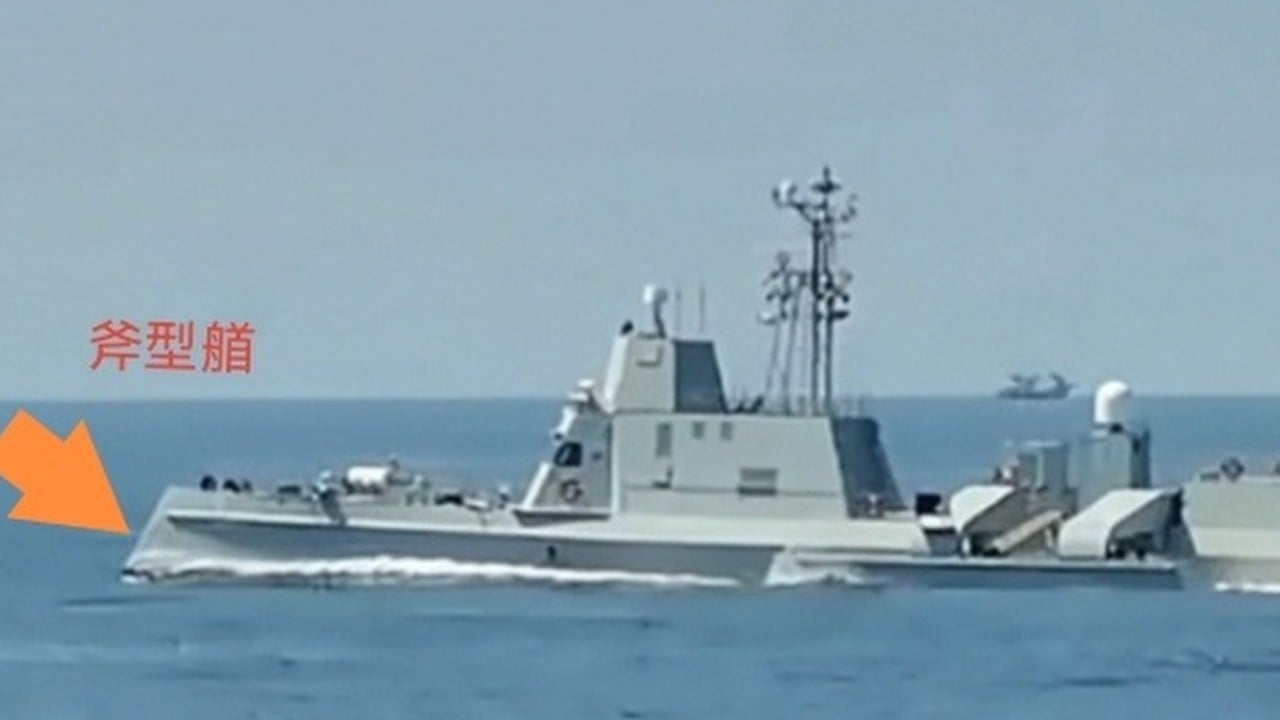
China is actively testing a wave-piercing stealth trimaran to solve a brutal geometric problem in modern naval warfare, trading traditional heavy armor for radical hydrodynamic speed, reduced radar visibility, and distributed firepower in contested waters. While conventional destroyers rely on sheer displacement and layered missile defenses to survive, this three-hulled warship slices directly through ocean swells rather than riding over them. That design choice allows a relatively small, lightly manned, or even autonomous vessel to maintain high speeds in rough seas while carrying out anti-submarine patrols, electronic warfare, or long-range missile strikes.
Most defense coverage treats vessels like this as isolated curiosities. They are not.
When satellite imagery and shipyard photographs first captured China’s experimental trimaran designs—ranging from earlier rescue and auxiliary hulls to newer, radar-evading combatant prototypes—the immediate reaction in Western defense circles was predictable. Analysts focused on the aesthetics. The sharp, angular tumblehome superstructure and the needle-like central bow look like something pulled straight from a science-fiction storyboard, inviting instant comparisons to the US Navy’s troubled Littoral Combat Ship program.
That comparison misses the operational reality of the Western Pacific. The United States built the Independence-class trimaran to project power into shallow coastal waters thousands of miles from home, an expeditionary mission that required modularity, long transit legs, and complex logistics. Beijing is building its unconventional fleet for the exact opposite purpose. China is optimizing for high-intensity, short-range denial inside the First Island Chain, where survival depends on hiding in plain sight, surviving first-strike salvos, and saturating an adversary’s sensors from dozens of unpredictable vectors at once.
The Physics of Slicing Through the Swell
To understand why naval architects keep returning to the wave-piercing trimaran despite its engineering headaches, you have to look at what happens when a conventional warship hits heavy weather.
A standard monohull ship rides over waves. Its flared bow generates buoyancy as it meets a swell, lifting the front of the vessel upward before gravity slams it back down into the trough. At 15 knots, that motion is uncomfortable. At 30 knots in Sea State 5, it is punishing. The violent pitching creates massive structural stress, degrades crew performance, limits helicopter operations, and burns fuel at an unsustainable rate. Worse, the constant up-and-down slamming throws up huge plumes of white water and exposes the flat underside of the hull, creating a bright, unmistakable signature on airborne radar.
A wave-piercing trimaran changes the hydrodynamic equation entirely. Instead of a wide, buoyant bow designed to ride up and over incoming water, the central hull features a fine, inverted, razor-like entry with minimal reserve buoyancy at the waterline. When the ship meets a wave, the bow cuts straight through the crest rather than climbing it.
Two slender outriggers—known as amas—flank the main hull, connected by a wide cross-deck structure. These outriggers sit slightly above or just grazing the calm waterline, providing transverse stability so the narrow central hull does not roll over. Because the main hull is exceptionally long and thin, wave-making drag drops dramatically at high speeds. The vessel achieves a high length-to-beam ratio that would be completely unstable in a single-hulled ship without massive ballast.
The operational payoff is immediate. A wave-piercing trimaran maintains high transit speeds in rough sea states where a conventional frigate of similar tonnage would be forced to throttle back to prevent structural damage. That stability also turns the wide cross-deck into an unusually steady platform for launching unmanned aerial vehicles, deploying towed sonar arrays, or operating vertical launch cells without the violent roll angles that plague narrow monohulls.
Why Stealth and Multihulls Rarely Mix
Achieving low observability on a trimaran is vastly harder than it looks on a shipyard rendering.
Radar stealth relies on controlling how electromagnetic waves bounce off a structure. Designers angle flat surfaces away from threat radars, eliminate right-angle corners that act as retroreflectors, and hide deck equipment behind flush panels. On a monohull like the American Zumwalt-class destroyer, the tumblehome design slopes the hull inward above the waterline, deflecting radar energy upward into the sky rather than back toward an enemy transmitter.
A trimaran complicates this geometry by introducing three separate hulls and the open tunnel between them. When radar waves enter the space between the central hull and the outriggers, they can bounce repeatedly between the vertical walls, creating a corner-reflector effect that amplifies the ship's radar cross-section from certain angles.
Chinese naval engineers have addressed this by carefully shaping the inner faces of the outriggers and the underside of the cross-deck to avoid perpendicular intersections. The superstructure sits low and integrates smoothly into the central spine, minimizing vertical mast structures and enclosing sensor arrays inside composite radomes. Exhaust gases—a massive giveaway for infrared sensors—are typically vented near the waterline or cooled and dispersed between the hulls to mask the thermal plume.
Even with these measures, a trimaran will never be completely invisible to low-frequency search radars or overhead satellites. It does not need to be. In naval warfare, stealth is rarely about total invisibility; it is about reducing the detection range just enough to break the enemy’s targeting chain, forcing an adversary to burn expensive missiles on uncertain tracks or exposing their own aircraft when they fly closer to get a positive visual or radar lock.
Lessons From the Littoral Combat Ship Trap
Whenever a navy unveils an unconventional hull form, veteran naval architects immediately ask two questions: how does it handle damage, and how much does it cost to maintain?
The US Navy learned the answers to both the hard way with the Independence-class Littoral Combat Ship. Built with an aluminum trimaran hull, the class suffered from severe galvanic corrosion when dissimilar metals met saltwater, cracked hull plating under sustained high-speed stress, and complex propulsion maintenance issues. Critics pointed out that the lightweight construction left almost no margin for surviving a direct hit from an anti-ship cruise missile. If a traditional steel destroyer takes a hit, watertight compartments and heavy structural framing give damage-control teams a fighting chance to keep the ship afloat. If a lightweight, high-speed trimaran takes a major hit to its cross-deck structure, the structural integrity of the entire vessel is immediately threatened.
China’s shipbuilding bureaucracy has spent the last two decades studying every single flaw in the American program.
The Chinese approach diverges from the US model in three critical ways. First, Beijing is not asking a single hull design to do everything through swappable "mission modules," a concept that proved logistically unworkable for the US Navy. Instead, Chinese shipyards build specialized variants tailored to narrow, specific roles—such as dedicated anti-submarine warfare (ASW) hunters or unmanned surface vessel (USV) motherships.
Second, China’s maritime geography changes the logistics equation. Operating within a few hundred miles of mainland ports like Zhanjiang, Yulin, or Ningbo means these vessels do not need transoceanic endurance or massive onboard spare-parts inventories. If a trimaran develops a propulsion fault or structural crack after a high-speed sprint in the South China Sea, it is hours away from a major drydock, not weeks.
Third, the integration of automation and unmanned systems fundamentally alters the risk calculation. A traditional warship carries hundreds of sailors, making the loss of a single hull a political and human catastrophe. Many of China’s newest unconventional hulls—including sleek trimaran prototypes spotted at yards in Guangzhou and Dalian—feature minimal crew spaces or are designed explicitly as optionally manned or fully autonomous platforms. When a vessel carries no crew, survivability becomes a matter of economics and attrition rather than human lives.
The Unconventional Fleet Ecosystem
The wave-piercing stealth trimaran does not operate in a vacuum. It is one piece of a much broader, deliberate experiment in fleet architecture happening across China’s coastal shipyards.
Over the past several years, commercial satellite imagery has revealed an astonishing variety of non-traditional hulls slipping down Chinese ways. Alongside conventional Type 055 cruisers and Type 052D destroyers, shipyards have launched semi-submersible arsenal ships, massive unmanned surface vessels, drone-carrying catamarans with wide flight decks, and sleek, low-profile fast attack craft.
To understand why Beijing is funding so many divergent designs simultaneously, look at the strategic problem facing the People’s Liberation Army Navy (PLAN). In any conflict over Taiwan or the South China Sea, the PLAN will confront an adversary with deep experience in long-range maritime strike, submarine warfare, and space-based reconnaissance. Concentrating all of China’s naval firepower into a handful of large, expensive surface combatants creates lucrative targets for American submarines and long-range stealth bombers.
The counter-strategy is distributed lethality backed by industrial scale.
By fielding dozens of smaller, fast, radar-evading trimarans alongside conventional destroyers, China complicates the targeting picture for opposing commanders. Suppose an enemy submarine or reconnaissance aircraft detects three radar contacts moving at 35 knots through rough seas near the Luzon Strait. One might be a full-sized frigate. The second might be a wave-piercing stealth trimaran armed with long-range anti-ship missiles. The third might be an unmanned trimaran decoy towing an electronic warfare suite that mimics the radar and acoustic signature of an aircraft carrier.
An opposing commander cannot ignore any of them. Engaging all three depletes scarce vertical launch cells on submarines and surface ships, forcing allied forces to expend multi-million-dollar weapons against lower-cost platforms while revealing their own firing positions.
The Anti-Submarine Warfare Angle
While missile strikes grab headlines, the quieter—and arguably more urgent—driver behind China’s trimaran testing is anti-submarine warfare.
For decades, the undersea domain has been the undisputed sanctuary of the US Navy and its allies. Nuclear-powered attack submarines operate with near impunity in waters where surface ships and aircraft would be quickly destroyed. Beijing knows this is its most glaring vulnerability. In a blockade or amphibious scenario, a handful of quiet submarines could devastate Chinese naval and merchant shipping before a single surface battle was fought.
Hunting submarines in the shallow, acoustically noisy waters of the East and South China Seas requires persistence and speed. A trimaran is uniquely suited for this grind.
Because the outriggers give the vessel a wide beam without the drag of a wide monohull, engineers can mount large, low-frequency sonar arrays or deploy deep-diving variable-depth sonars off the stern with minimal hydrodynamic interference. The ship’s stability in heavy weather allows it to keep towing those arrays when conventional patrol boats would have to reel them in and head for port. Furthermore, the wide central deck provides ample space to launch and recover unmanned underwater vehicles (UUVs) and medium-sized rotary drones equipped with dipping sonars and sonobuoys.
In a hypothetical patrol scenario off the eastern coast of Taiwan, a network of three or four unmanned stealth trimarans could form an acoustic picket line, maintaining continuous sonar coverage across a deep-water chokepoint for weeks at a time. Even if an adversary’s submarine detects and sinks one of the vessels, the cost is a fraction of a manned destroyer, and the remaining ships immediately vector maritime patrol aircraft and anti-submarine helicopters onto the submarine’s firing datum.
Engineering Trade-Offs and Hidden Vulnerabilities
Despite the advantages on paper, wave-piercing trimarans carry severe engineering compromises that no amount of state-backed funding can entirely erase.
The most obvious limitation is payload weight. Monohulls are remarkably efficient at carrying heavy loads because volume increases rapidly as you widen the hull. Trimarans achieve their speed by keeping the central hull razor-thin. If you try to pack heavy steel armor, massive fuel tanks, and dozens of large vertical launch cells into that narrow spine, the ship sits deeper in the water, increasing wetted surface area and destroying the very hydrodynamic efficiency that justified building a trimaran in the first place.
This creates a strict ceiling on firepower. While a Type 055 destroyer carries 112 large vertical launch cells capable of firing heavy ballistic and cruise missiles, a stealth trimaran of realistic size might carry only 8 to 16 cells, or rely on inclined box launchers tucked beneath retractable deck hatches. It is a scout, a picket, or a skirmisher—never a capital ship.
Structural fatigue is the second persistent threat. The cross-deck structure—the "wet deck" that bridges the gap between the main hull and the outriggers—experiences immense twisting and bending forces when the ship hits waves at an oblique angle. Over thousands of steaming hours, these torsional stresses cause micro-fractures in welds and composite joints. Navies that operate multihulls at high speeds have to inspect these structural junctions constantly, driving up lifecycle maintenance costs.
Maneuverability at low speeds presents a third headache. In open water at 30 knots, a trimaran tracks like a train on rails. Inside a crowded naval base or narrow channel with strong crosswinds, the long, narrow hulls resist turning, while the high freeboard acts like a sail. Without powerful bow thrusters and sophisticated digital flight-control-style rudder management, docking a large trimaran in a squall is a white-knuckle exercise for any bridge crew.
The Industrial Engine Behind the Experimentation
What separates China’s naval development from almost every other maritime power is not a secret technological breakthrough in fluid dynamics. Western naval architects have understood the math behind wave-piercing multihulls for decades; companies like Austal in Australia and defense contractors in Europe and the United States pioneered many of the commercial and military applications.
The difference is industrial velocity and risk tolerance.
In the United States or Europe, introducing a radical new hull form requires years of congressional hearings, environmental reviews, multi-billion-dollar prototyping contracts, and intense public scrutiny over every cost overrun. A single failed sea trial can trigger cancellations and career-ending audits.
China operates a state-directed maritime-industrial complex where commercial shipbuilding dwarfs the rest of the world combined. Chinese shipyards build more commercial tonnage in a single year than the United States has built since World War II. That commercial dominance subsidizes military innovation. Yards can cut steel on an experimental stealth trimaran, push it through accelerated sea trials in the Yellow Sea, identify structural flaws, and immediately roll those lessons into a second, modified hull eighteen months later—all without a single public budget debate.
This iterative cycle treats warships less like generational investments and more like evolving hardware platforms. If an unconventional hull proves too fragile or expensive to maintain, it is quietly relegated to auxiliary duties, coastal patrol, or target testing, while resources shift immediately to the next prototype waiting in the drydock.
Redefining What a Warship Looks Like
For over a century, naval power has been measured by counting large, recognizable silhouettes: battleships, aircraft carriers, cruisers, and destroyers. Defense analysts could track a nation's maritime ambitions simply by watching drydocks for the unmistakable keels of major combatants.
China’s testing of wave-piercing stealth trimarans signals that this metric is breaking down. The future of contested littoral warfare does not belong exclusively to 10,000-ton floating fortresses bristling with phased-array radars. It increasingly belongs to a fractured, asymmetric ecosystem of fast, low-observable, specialized hulls designed to confuse sensors, absorb losses, and strike from unexpected angles.
Whether these trimarans ultimately become a permanent backbone of the People’s Liberation Army Navy or remain niche specialists for anti-submarine and electronic warfare, their presence on the water already achieves a critical strategic objective. Every allied naval planner looking at satellite imagery of China's shipyards now has to build sensors, software, and weapons capable of finding and killing targets that slice beneath the waves rather than riding over them—forcing an expensive adaptation before a single shot is ever fired.