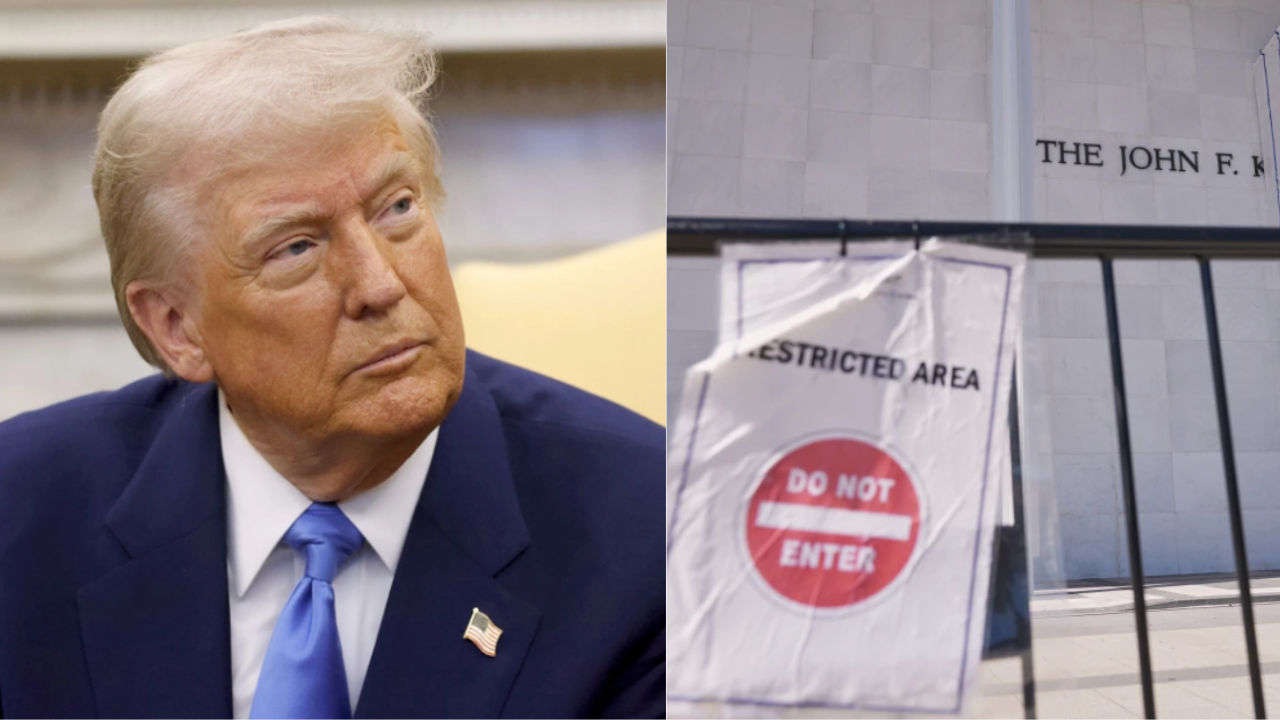
A congressional oversight battle has erupted over the governance of the John F. Kennedy Center for the Performing Arts, following a formal demand by a federal lawmaker for the release of nearly 200 internal text messages. The dispute centers on accusations of political interference, board restructuring, and executive decision-making at the nation’s premier cultural institution during Donald Trump’s presidency. According to congressional oversight filings and public statements from lawmakers involved in the inquiry, the demand seeks to uncover whether private communications between White House officials, board appointees, and center leadership bypassed standard institutional protocols.
The numbers tell a stark story. Nearly 200 private text messages now sit at the center of a high-stakes standoff over transparency, federal funding, and the boundaries of executive influence in American arts institutions.
To understand why a stack of text messages from a performing arts center has triggered a formal legislative inquiry, you have to look beyond the headlines. Cultural institutions in Washington rarely stay purely cultural for long. They are symbols of national prestige, magnets for federal appropriations, and battlegrounds for competing visions of public patronage. When executive branch authority collides with the tradition of artistic independence, the resulting friction leaves a paper trail—or, in the modern era, an encrypted digital trail.
The Anatomy of an Oversight Demand
Congressional oversight of federally supported institutions is neither new nor unusual, yet the mechanics of this particular request highlight a distinct shift in how lawmakers investigate executive branch influence. According to statements released by the requesting lawmaker’s office, the nearly 200 text messages were identified through preliminary document productions and whistleblower disclosures tied to the Kennedy Center's administrative operations.
Text messages occupy a notoriously gray area in federal recordkeeping and institutional governance. Unlike formal emails routed through government servers or official board minutes archived by general counsel, personal mobile messages frequently sit outside standard Freedom of Information Act (FOIA) architectures.
The Kennedy Center operates under a unique hybrid structure. Established by Congress in 1958 as a bureau of the Smithsonian Institution, it is governed by a Board of Trustees whose members are appointed by the President of the United States for six-year terms, alongside ex officio members from Congress and the Cabinet. While the center relies heavily on private philanthropy and ticket sales for its artistic programming, it receives millions of dollars annually in federal appropriations specifically earmarked for the maintenance, security, and operation of the physical memorial.
That federal appropriation is the legal hook. Because taxpayer funds sustain the building and its infrastructure, Congress retains broad statutory authority to audit, investigate, and demand records related to how the institution is managed. When lawmakers suspect that official business, personnel decisions, or board directives were conducted via private text threads rather than transparent institutional channels, they treat those messages as public records subject to legislative scrutiny.
Why Cultural Governance Became a Political Flashpoint
For decades, an unwritten truce governed the Kennedy Center. Presidents from both parties appointed major donors, political allies, and entertainment figures to the Board of Trustees, and those appointees largely deferred to the professional artistic directors on matters of programming and institutional management.
That truce fractured during the Trump administration. From the outset of his first term, friction emerged between the White House and the cultural establishment, most visibly surrounding the annual Kennedy Center Honors. Several honorees publicly announced they would boycott the traditional White House reception, prompting President Trump and the First Lady to skip the gala ceremony altogether—breaking a decades-long precedent of presidential attendance.
Beneath the surface of those public snubs, a more consequential struggle was taking place inside the boardroom. Critics and Democratic lawmakers argued that traditional norms of nonpartisan stewardship were being eroded by aggressive board appointments and behind-the-scenes pressure regarding institutional priorities. Conversely, supporters of the administration contended that elite cultural institutions had drifted out of step with mainstream American taxpayers and required ideological balance and stricter fiscal accountability.
The controversy deepened as questions emerged over how certain executive decisions were reached. According to critics of the administration's approach, informal backchannels began replacing formal board deliberations. Supporters and defenders of the trustees pushed back against that characterization, maintaining that informal communication among board members and administration officials is standard practice across every presidential administration and reflects normal advisory coordination rather than improper interference.
The Legal Mechanics of Private Messages in Public Institutions
The demand for nearly 200 text messages exposes a recurring vulnerability in modern governance: the gap between statutory recordkeeping laws and how powerful people actually communicate.
Under the Federal Records Act and the Presidential Records Act, officials are legally obligated to preserve communications that document official government business. However, the Kennedy Center’s hybrid status complicates the enforcement of those statutes. Because the center is administered as a quasi-independent trust rather than a traditional executive agency, its internal communications do not always fall neatly under standard executive branch archival rules.
Lawmakers pressing for the messages argue that when presidential appointees or White House liaisons use personal devices to coordinate institutional policy, board votes, or personnel changes at a federally chartered memorial, those communications cannot be shielded behind claims of private correspondence.
Legal scholars who specialize in congressional oversight note that executive privilege and institutional autonomy are frequently invoked to resist such subpoenas or document demands. Yet courts have consistently held that Congress possesses wide latitude to investigate matters tied to federal appropriations, provided the inquiry serves a valid legislative purpose—such as evaluating whether existing statutory guardrails around the Kennedy Center’s governance need to be tightened.
The Counter-Argument Over Institutional Independence
While proponents of the investigation frame the demand as a necessary check on executive overreach, critics of the inquiry raise an entirely different constitutional and practical concern.
If Congress can routinely compel the production of private text messages between trustees and executive branch officials at a cultural institution, what happens to candid deliberation? Board governance relies on the ability of trustees to debate sensitive personnel matters, fundraising strategies, and artistic risks without fearing that every off-the-cuff remark will be leaked to the press or dissected in a partisan committee hearing.
Republicans and defenders of the trustees have argued that aggressive document demands risk chilling voluntary service on national cultural boards. Prominent philanthropists and business leaders—the very people whose donations keep the Kennedy Center solvent—may think twice before accepting a presidential appointment if their personal phones can become targets of congressional dragnet requests whenever the political winds shift on Capitol Hill.
There is also the question of selective scrutiny. Critics of the inquiry point out that previous administrations maintained close, informal ties with Kennedy Center leadership without facing demands for hundreds of private text messages. From their perspective, the oversight push looks less like a neutral defense of institutional norms and more like political theater aimed at relitigating battles from the Trump era.
Financial Stakes Behind the Curtain
To understand the real leverage in this dispute, follow the money. The Kennedy Center is not merely a theater complex; it is a massive financial enterprise with an annual operating budget exceeding $250 million.
While the federal government covers capital repairs, utilities, and security for the presidential memorial—typically allocating tens of millions of dollars per year through the Interior, Environment, and Related Agencies appropriations bill—the artistic programming is funded by earned revenue and private contributions.
This dual funding model creates a delicate ecosystem. Major corporate sponsors and individual benefactors underwrite symphonies, theater productions, and educational outreach programs on the assumption that the institution remains insulated from raw partisan warfare. When the Kennedy Center becomes the subject of prolonged congressional investigations and headlines about secret text messages, development officers face an immediate headache.
Donors dislike unpredictability. A prolonged battle over board communications threatens to alienate philanthropists across the political spectrum—some out of concern over executive interference, others out of frustration with congressional politicization.
Furthermore, the annual appropriations process gives lawmakers a direct mechanism to enforce compliance. Even without issuing a formal subpoena, senior members of oversight and appropriations committees can signal that future federal funding for facility upgrades or operational support will face heightened scrutiny if the requested communications are withheld.
What Happens When Backchannels Become the Record
The emergence of nearly 200 text messages as a focal point of a congressional investigation underscores a broader transformation in Washington accountability. Over the past decade, investigations into everything from municipal governance to national security have increasingly hinged on encrypted apps, SMS threads, and personal email accounts.
When officials move sensitive discussions onto text messaging platforms, they often assume a level of informality that belies the permanence of digital metadata. Even when messages are deleted from a handset, records frequently survive on carrier logs, cloud backups, or the devices of other participants in a group thread.
In the case of the Kennedy Center, the existence of these nearly 200 messages suggests that key conversations regarding the center’s direction were occurring outside the formal architecture of board meetings and official memoranda. Whether those texts reveal actionable breaches of governance rules or simply reflect the blunt, unfiltered shorthand of political operatives and trustees remains the central question driving the congressional demand.
If the messages show coordinated efforts to bypass statutory board procedures or apply improper political pressure on programming and staffing, lawmakers will have concrete ammunition to propose legislative reforms to the Kennedy Center Act. Conversely, if the texts contain routine logistical chatter and political venting, the disclosure could embarrass the individuals involved without uncovering any legal violation.
The Precedent for Federal Cultural Institutions
The outcome of this standoff will reverberate well beyond the marble walls overlooking the Potomac River. Washington is home to an entire constellation of federally chartered or supported cultural entities, including the Smithsonian Institution, the National Gallery of Art, and the National Endowments for the Arts and Humanities.
Each of these organizations operates under a carefully calibrated balance between public accountability and artistic freedom. They rely on federal appropriations to survive, yet their credibility depends on the perception that curatorial and programming decisions are insulated from ideological coercion.
By demanding nearly 200 private text messages tied to the Kennedy Center’s leadership, lawmakers have tested the boundaries of how deeply Congress can peer into the informal communications of a cultural trust. Establishing a clear standard for when private communications become public oversight material will shape how future trustees, White House liaisons, and cultural executives conduct business—forcing every participant in Washington's cultural sphere to treat every text message as a potential exhibit in a congressional hearing.