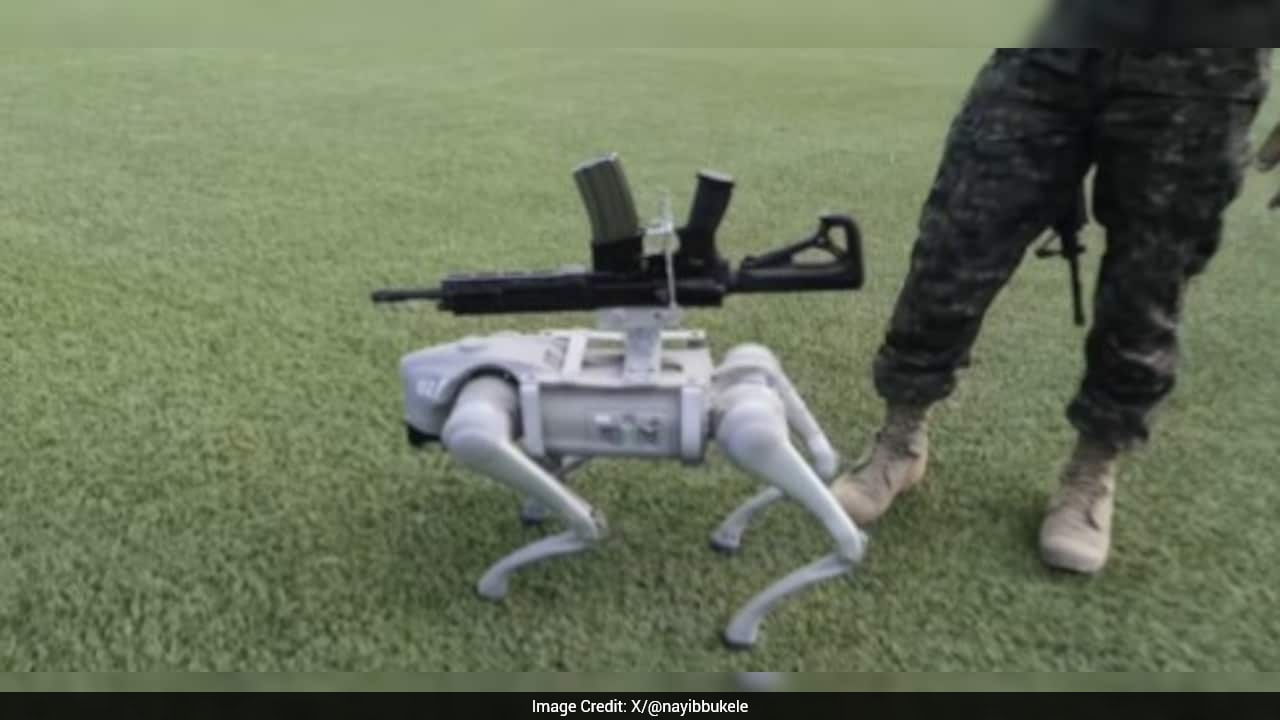
Viral footage circulating across social media shows four-legged robotic platforms equipped with mounted rifles operating inside a stadium in Port-au-Prince, deployed alongside Salvadoran security personnel assisting the multinational mission in Haiti. The clips, shared widely on platforms like X and Telegram, depict commercial-style quadruped robots—visually resembling off-the-shelf hardware modified with weapon mounts—moving across concrete concourses and open turf under remote human control. While online commentators immediately framed the images as the arrival of autonomous killer machines, the operational reality on the ground in Haiti is far more pragmatic, experimental, and legally murky.
For decades, military hardware followed a predictable trickle-down path. Billion-dollar defense contractors built bespoke systems for superpowers, and smaller nations bought the surplus twenty years later. That pipeline is broken. What is happening in Port-au-Prince represents a fundamental shift in how mid-sized and smaller militaries acquire asymmetric capabilities. Instead of waiting for traditional defense procurement cycles, El Salvador’s security apparatus—operating under a deployment mandate to support Haiti’s beleaguered police and the Kenyan-led Multinational Security Support (MSS) mission—appears to have turned directly to commercially available robotics, strapping kinetic payloads onto machines originally designed for warehouse inspections and university research labs. In similar news, we also covered: Inside the Jeffrey Epstein Autopsy Dispute That Refuses to Die.
Anatomy of an Improvised Combat Platform
Look closely at the frame geometry and gait mechanics in the stadium footage. These are not Boston Dynamics Spot units, which are strictly governed by corporate terms of service prohibiting weaponization and armed deployment. Rather, the chassis design aligns closely with Chinese-manufactured commercial quadrupeds—specifically platforms akin to the Unitree Go1, Go2, or B-series models that have proliferated across global consumer and industrial markets.
Anyone with a corporate credit card and an import license can buy these base units online for a fraction of the cost of a single tactical armored vehicle. The barrier to entry is practically nonexistent. Once acquired, converting an inspection robot into a mobile firing platform requires minimal engineering expertise. Technicians fabricate a basic Picatinny rail mount, bolt it to the dorsal payload bay, attach a standard infantry carbine or submachine gun, and wire a simple servo actuator to the trigger mechanism. Reuters has also covered this fascinating issue in extensive detail.
The result is a remote-controlled weapon station with legs.
Operators control these units via handheld tablets or modified gaming controllers over encrypted or semi-encrypted radio frequencies, relying on onboard front-facing cameras and LiDAR sensors for navigation and target acquisition. There is no artificial intelligence making life-or-death decisions here. The machine cannot identify a gang member from a stadium groundskeeper on its own. Every step, every turn of the chassis, and every pull of the mechanical trigger requires a human operator sitting behind a screen, likely stationed inside an armored command post or behind cover hundreds of meters away.
Why Commercial Hardware Wins on the Ground
Traditional tracked bomb-disposal robots have existed in military inventories for over thirty years. They are heavy, slow, and notoriously bad at climbing stairs or navigating rubble. A legged platform changes the geometry of urban movement.
In a dense, fractured environment like Port-au-Prince—where armed coalitions control critical infrastructure, block roadways with burning barricades, and occupy multi-story concrete structures—wheeled vehicles become instant targets for ambushes and improvised explosive devices. A quadruped robot weighs roughly the same as a medium-sized dog. Two soldiers can lift it out of the back of a pickup truck, set it on the pavement, and send it up a narrow stairwell or across debris-strewn stadium bleachers where armored personnel carriers cannot fit.
If a gang sniper destroys the robot with a well-placed shot from a .50-caliber rifle, the deploying force loses a few thousand dollars of replaceable electronics. Nobody writes a letter to a grieving mother. Nobody organizes a repatriation ceremony. That cold calculus explains why armed quadrupeds are suddenly appearing in conflict zones from Eastern Europe to the Caribbean.
The Strategic Logic Behind El Salvador’s Haitian Gamble
To understand why El Salvador brought experimental armed robotics to a Haitian stadium, you have to look at San Salvador’s domestic security doctrine and its broader geopolitical ambitions. Under President Nayib Bukele, El Salvador transformed its military and police forces into an aggressive, media-savvy internal security machine. The administration built its international brand on high-visibility tactical dominance, utilizing sleek promotional videos, specialized infantry units, and strict territorial control to dismantle domestic street gangs.
Exporting that brand to Haiti serves multiple purposes. First, it positions El Salvador as a proactive regional security provider willing to step into a crisis that larger Western powers have largely avoided committing ground troops to solve. Second, it provides Salvadoran forces with live-fire operational testing in an urban insurgency environment without exposing their infantry to high casualty rates.
Haiti is not a conventional warzone. Since the assassination of President Jovenel Moïse in 2021, heavily armed syndicates—most notably the Viv Ansanm coalition—have seized roughly eighty percent of the capital. They possess military-grade weaponry trafficked largely from the United States, deep knowledge of local alleyways, and zero regard for international humanitarian norms. For foreign troops arriving in Port-au-Prince, every patrol is an exercise in vulnerability.
Stadia and large public complexes often serve as forward operating bases, logistics hubs, and helicopter landing zones during stabilization missions. Securing the perimeter of a massive concrete bowl with dozens of entry tunnels, tiered seating, and blind corners requires hundreds of infantrymen standing watch around the clock. By deploying armed quadrupeds to patrol concourses and clear interior corridors, commanders can multiply their surveillance and suppression reach while keeping human personnel inside fortified positions.
The Psychological Factor
Warfare in urban environments is as much about perception as it is about ballistics. Armed gangs in Port-au-Prince rely heavily on intimidation, social media broadcasts, and the projection of invincibility to maintain control over neighborhoods.
When a four-legged machine carrying an assault rifle rounds a concrete corner in dead silence, it disrupts the psychological equilibrium of an adversary accustomed to fighting human patrols. Even if the robot’s actual combat effectiveness is limited by battery life and radio interference, its presence forces fighters to hesitate. Hesitation in close-quarters battle is fatal. Furthermore, leaking the footage online serves as a deliberate information operation aimed at both local gangs and international observers, signaling that the rules of engagement in Port-au-Prince have shifted.
Where the Hardware Fails in the Real World
Strip away the dramatic camera angles and viral hype, and commercial weaponized robot dogs suffer from severe operational limitations that military planners rarely advertise. Having covered defense technology from testing ranges in the Mojave to active conflict zones, the gap between a controlled demonstration and sustained combat is always measured in broken gears and dead batteries.
Battery endurance remains the primary bottleneck. Most commercial quadrupeds run on high-density lithium-ion packs capable of sustaining thirty to ninety minutes of continuous movement. Add the weight of a steel rifle mount, a loaded magazine, additional optical sensors, and a heavy-duty radio transceiver, and that runtime drops precipitously. In the tropical heat and humidity of Haiti, lithium batteries degrade faster and overheat under heavy motor loads. A squad cannot rely on a robot for a six-hour patrol when the machine requires a battery swap every forty minutes.
Then there is the problem of recoil and accuracy. Commercial quadrupeds are designed to maintain balance while walking over uneven terrain, not to absorb the sudden rearward kinetic impulse of a 5.56mm or 7.62mm rifle firing in semi-automatic or burst mode. Without specialized hydraulic dampening systems, firing a mounted weapon causes the robot’s legs to buckle or shift, throwing off follow-up shots. Watching early prototypes fire on test ranges often reveals a clumsy, vibrating chassis struggling to regain its footing after a three-round burst.
Electronic Warfare and Line-of-Sight Limits
The stadium environment seen in the viral video actually highlights a major technical constraint: line-of-sight communication. Concrete walls, rebar-reinforced floors, and corrugated metal roofs act as natural Faraday cages, rapidly attenuating standard Wi-Fi and radio control signals.
In an open stadium bowl, an operator can maintain a clear, low-latency video feed and responsive movement controls. Send that same robot deep into a subterranean locker room or three blocks away into a densely packed residential slum, and the signal drops. When connection is lost, most commercial units default to a safety protocol—either freezing in place or attempting to retrace their steps. A frozen, rifle-toting robot sitting in an alleyway becomes an immediate prize for any gang member willing to walk up behind it and throw a heavy blanket over its sensors.
While Haitian armed groups currently lack sophisticated electronic warfare jammers like those saturating the front lines in Ukraine, basic radio interference and signal degradation remain constant threats. Relying on commercial communication protocols in a contested urban environment is a gamble that works until the exact moment the terrain turns unfavorable.
The Gray Zone of International Export Controls and Arms Law
The appearance of modified commercial robotics in Haiti exposes a massive regulatory blind spot that governments and manufacturers have failed to close. For years, diplomats at the United Nations in Geneva have debated treaties governing Lethal Autonomous Weapons Systems (LAWS). Those negotiations focus heavily on futuristic, fully autonomous drones capable of selecting and engaging targets without human intervention.
Meanwhile, militaries and non-state actors have completely bypassed the treaty process by weaponizing off-the-shelf hardware that operates under basic human remote control.
Because these quadrupeds are sold as civilian inspection tools, educational platforms, or entertainment devices, they do not fall under traditional International Traffic in Arms Regulations (ITAR) or conventional munitions export controls. A company can ship hundreds of robotic chassis to a distributor in Latin America or the Caribbean with minimal end-user verification. Once inside the country, local military workshops handle the integration of lethal payloads entirely outside the oversight of the original manufacturer.
Manufacturers routinely include boilerplate clauses in their sales contracts forbidding the attachment of weapons. In practice, those clauses are unenforceable once the hardware leaves the shipping container. When a sovereign government decides to bolt a rifle onto a commercial robot for use in an international security mission, no software lock or terms-of-service agreement will stop them.
Accountability in a Multinational Mission
The deployment also raises uncomfortable questions regarding rules of engagement and legal accountability within the Haiti mission. The Multinational Security Support mission operates under a United Nations Security Council mandate, backed by funding and logistical support from the United States and other international partners.
Standard infantry tactics rely on visual identification, escalation of force, and the immediate presence of a soldier who can assess whether a figure holding a long object in a dark doorway is a combatant with an AK-47 or a civilian carrying a broomstick. Viewing a cluttered urban environment through a narrow, low-resolution camera lens mounted eighteen inches off the ground dramatically reduces situational awareness. Latency between the robot’s camera and the operator’s tablet—even a delay of two hundred milliseconds—can lead to catastrophic miscalculations during high-stress encounters.
If a remote-controlled quadruped opens fire inside a civilian structure in Port-au-Prince and kills an innocent bystander, determining responsibility becomes a legal maze. Does liability rest with the operator holding the controller, the Salvadoran commander who authorized the robotic patrol, or the broader multinational command structure overseeing the sector? Right now, clear public protocols governing the use of unmanned ground vehicles in urban policing and stabilization missions simply do not exist.
What Comes Next on the Ground
The footage from the Port-au-Prince stadium is not an isolated stunt. It is an early field test of a tactical model that will rapidly spread across Latin America, Africa, and the Middle East over the next twenty-four months.
As battery energy density improves and lightweight composite weapon mounts become standardized, armed quadrupeds will transition from perimeter security inside stadiums to active point-man roles during house-to-house clearances. Militaries with limited budgets and high sensitivity to troop casualties have discovered that commercial robotics offer an immediate, low-cost entry point into unmanned ground warfare.
Watch closely for how other contingents within the Haiti mission respond—and more importantly, how the gangs adapt. In asymmetric conflict, every new piece of technology triggers an immediate, low-tech countermeasure. Soon, fighters in Port-au-Prince will learn that commercial quadrupeds have blind spots directly behind their sensor arrays, that their exposed leg joints are vulnerable to cheap wire entanglements, and that a bucket of paint thrown over a LiDAR dome renders a ten-thousand-dollar machine completely blind. Until those countermeasures take hold, the concrete corridors of Haiti’s capital will remain a live proving ground for the democratization of robotic warfare.