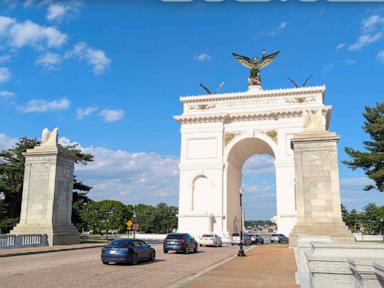
Veterans are asking a federal judge to block Donald Trump's proposed arch unless Congress explicitly authorizes the monument. That legal demand puts a seemingly straightforward question about public architecture squarely at the center of a much bigger constitutional clash over separation of powers, federal appropriations, and who gets to reshape the nation's capital. On paper, a monument project looks like a debate over aesthetics, site selection, or honoring service members. In reality, court challenges over unauthorized or contested federal monuments rarely turn on taste alone. They turn on statutory authority, funding rules, and whether a president can push a major physical landmark forward without legislative sign-off.
Anyone who has covered Washington fights over public space long enough knows how quickly a marble or bronze proposal turns into a proxy war. Monuments are permanent. Presidents are temporary. When a chief executive tries to stamp a lasting physical mark on the federal city without clear congressional backing, opponents reach for the fastest brake available in the system, and in the American legal order, that brake is often a federal court injunction. For a closer look into similar topics, we suggest: this related article.
Why Veterans Are Targeting Congressional Approval
When military veterans ask a judge to halt a monument pending congressional approval, they are usually arguing that the executive branch is stepping outside statutory boundaries. Federal construction and commemorative projects in the capital are governed by a dense web of laws, land-use rules, and appropriations restrictions. Congress guards its power of the purse jealously, even when lawmakers disagree with one another on almost everything else.
The core argument in disputes like this is rarely complicated to state, even when the legal briefs run to hundreds of pages. If the law requires congressional authorization or dedicated funding before a major project moves past planning or ground clearing, proceeding without it invites a legal challenge. Veterans carry distinct political and moral weight in these disputes because memorials and public honors are routinely framed around service and sacrifice. When veterans challenge a project, they force opponents to defend not just legal mechanics, but standing and legitimacy. For additional information on this issue, in-depth reporting can also be found at The New York Times.
Still, legal standing is where many high-profile lawsuits stumble. Not every citizen, or even every veteran, automatically has the legal right to sue over a government building plan. To convince a federal judge to step in, plaintiffs typically have to show a concrete, particularized injury that is traceable to the challenged action and likely to be redressed by a court order. Generalized objections to policy or spending rarely clear that bar on their own.
The Hidden Mechanics of Capital Monument Battles
Monument fights in Washington almost never start with a shovel in the ground. They start with drawings, site proposals, budget lines, and administrative steps that outsiders ignore until a lawsuit makes headlines. By the time a court filing lands on a judge's docket, years of quiet maneuvering over federal land, commemorative commissions, and budget authority have usually already happened.
In general terms, building anything significant on federal property involves overlapping layers of review. Agencies look at zoning and design standards, environmental or historic preservation rules, security perimeters, and funding sources. Even when supporters talk as if a leader can simply point to a spot and order construction to begin, real-world execution runs into contracting rules, accounting controls, and oversight bodies.
That friction is precisely why court battles matter. A preliminary injunction does not have to settle every constitutional question forever to change the trajectory of a project. Delay is leverage. If a judge pauses work while the court examines whether Congress approved the project, timelines slip, costs can shift, and political attention intensifies.
Consider a hypothetical example to see how those moving parts collide. Suppose an administration wants to erect a large ceremonial arch near a prominent federal corridor and relies on existing general accounts or private pledges rather than a fresh statute naming the structure. Critics sue, arguing that a landmark of that scale requires explicit congressional authorization under commemorative laws and appropriations rules. Even if the government argues that preliminary planning or preparatory steps are lawful, a judge scrutinizing the exact statutory text can force both sides to prove what authority already exists versus what still requires a vote on Capitol Hill.
Executive Ambition Meets the Power of the Purse
At the heart of this dispute is a tension that predates every modern president. Executives want speed, visibility, and legacy. Congress holds the constitutional authority to legislate and appropriate funds.
When presidents push ambitious initiatives through existing authorities rather than waiting for a contentious or gridlocked Congress, clashes follow. Sometimes the executive branch is on solid legal ground because an older statute already grants broad discretion. Other times, officials stretch a general provision farther than the text comfortably allows. Federal judges are left to draw the line between legitimate executive action and unlawful overreach.
How Courts Weigh Injunctions in Public Projects
Asking a federal judge to block a project before final judgment is a tall order. Courts treat preliminary injunctions as an extraordinary remedy, not a routine pause button.
Judges generally weigh four familiar factors before freezing government action:
- Likelihood of success on the merits, meaning whether the plaintiffs' legal theory about missing congressional approval is likely to prevail once the case is fully argued.
- Irreparable harm, meaning whether waiting until the end of the lawsuit would cause damage that money or a later ruling could not cleanly undo.
- Balance of equities, comparing the harm to the plaintiffs if the project goes ahead against the harm to the government and the public if it is halted.
- Public interest, which in disputes over federal landmarks includes both lawful governance and orderly public administration.
None of those four elements is a mechanical checklist. A judge can find serious legal questions and still deny an immediate freeze if the harm appears speculative or reversible. Conversely, if physical alteration, irreversible commitments, or clear statutory violations look imminent, a court may step in quickly.
What Plaintiffs Often Overlook
Veteran-led challenges command immediate media attention, yet winning in court takes more than moral force. Plaintiffs who focus almost exclusively on the symbolism of a monument risk losing on technicalities.
Courts care deeply about statutory text, administrative records, and procedural posture. If a lawsuit challenges a step that is still preliminary, or relies on a statute that does not actually bar the specific action being taken at that moment, the government has an easy opening to ask for dismissal. Even strong political arguments can fail if the legal hook is slightly off.
There is also a strategic risk for challengers. Going to court can rally supporters and freeze momentum, but it can also sharpen political pushback from proponents who frame the lawsuit as obstruction. Litigation is a blunt instrument; once filed, its pace belongs to the court calendar, not the news cycle.
Why This Clash Resonates Beyond One Structure
A fight over an arch is easy to picture, which is why the public grasps it immediately. An arch is concrete, imposing, and unmistakable. Yet the deeper stakes are institutional.
Every time a dispute tests whether the president can advance a major public project without explicit congressional approval, it shapes future precedents. If courts require tight, specific congressional sign-off, future administrations of either party face steeper hurdles when moving fast on physical projects or contested spending. If courts give broad latitude to executive interpretation, presidents gain room to maneuver when Congress stalls.
Gray areas abound in this territory. Statutes are often written in general terms decades earlier, leaving judges and lawyers to argue over whether old language covers new ambitions. Meanwhile, funding streams can be complex, involving multiple accounts, agencies, or outside contributions, making it harder for casual observers to tell where lawful flexibility ends and unauthorized action begins.
Watch how the court addresses the threshold questions of standing and statutory authority first, because those early rulings usually reveal whether the dispute will turn into a prolonged legal roadblock or fizzle on procedural grounds.