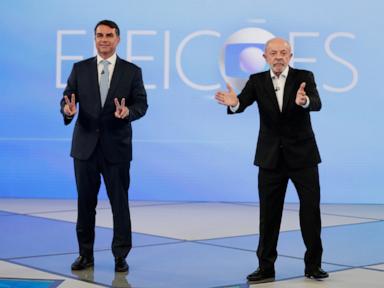
In the final presidential debate before Brazil's October 2022 runoff election, incumbent Jair Bolsonaro and former president Luiz Inácio Lula da Silva abandoned broad ideological manifestos to wage a street-level fight over the country's smallest, most decisive demographic. With roughly five percent of the electorate still undecided or considering blank ballots, both candidates spent over two hours on TV Globo attacking each other's governing records on corruption, pandemic management, and basic kitchen-table economics. Instead of presenting forward-looking legislative blueprints, the broadcast exposed a stark reality about modern Brazilian politics—elections are no longer won by convincing the nation, but by terrifying the shrinking sliver of voters who hate both options.
Most surface-level coverage of the Globo debate treated it like a conventional policy clash between a left-wing union icon and a right-wing populist. That reading misses the structural mechanics of what actually happened on that soundstage in Rio de Janeiro. By late October 2022, Brazil was locked in one of the most rigid political deadlocks in its democratic history. Polling averages showed Lula holding a single-digit lead, well within the margin of statistical anxiety, while Bolsonaro had outperformed first-round expectations by millions of votes. Neither man had any realistic chance of converting the other's base. The entire broadcast was engineered around negative partisanship and abstention engineering.
The Myth of the Undecided Brazilian Voter
When political analysts talk about undecided voters in a polarized race, they often imagine thoughtful moderates sitting at kitchen tables weighing tax brackets against environmental regulations. In Brazil's 2022 runoff, that voter barely existed.
The remaining persuadable bloc consisted largely of two distinct groups. First were low-income voters in the industrial southeast—particularly in states like Minas Gerais and São Paulo—who benefited from Bolsonaro's emergency cash transfers during the late stages of the campaign, yet remembered the economic expansion of Lula's 2003 to 2010 administration. Second were exhausted middle-class voters disgusted by both the Lava Jato (Car Wash) corruption scandals tied to Lula's Workers' Party and the institutional chaos, COVID-19 mortality rates, and inflammatory rhetoric of Bolsonaro's four years in office.
For this second group, the primary choice wasn't between Lula and Bolsonaro. It was between holding their nose at the ballot box or staying home—or casting a voto nulo (null vote), which in Brazil's mandatory voting system serves as an active protest.
Understanding that distinction changes how you watch the debate footage. Every insult thrown across the stage had a specific mathematical target. When Bolsonaro repeatedly labeled Lula an "ex-convict" and accused his party of looting state-run oil giant Petrobras, he wasn't trying to make middle-class voters fall in love with his administration. He was trying to make them too nauseous to vote for Lula, hoping they would nullify their ballots and lower the total valid vote threshold needed for an incumbent comeback.
Lula played the exact same game in reverse. Rather than detailing how he would navigate a deeply conservative Congress elected just weeks earlier, the former president hammered relentlessly on Bolsonaro's handling of the COVID-19 pandemic, which claimed nearly 700,000 Brazilian lives, and accused him of dismantling public health systems and ignoring the poor. Lula's objective was to remind hesitant voters why they wanted Bolsonaro out in the first place, overriding their lingering doubts about the Workers' Party's ethical track record.
How the Format Forced Direct Confrontation
TV Globo's debate producers knew that standard podium formats allow seasoned politicians to hide behind rehearsed talking points and run out the clock. To break that pattern, the network used an open-floor structure with strict time banks—giving each candidate 15 minutes per block to manage as they pleased during direct exchanges.
It worked. And it immediately exposed the tactical vulnerabilities of both men.
Without a moderator cutting off microphones every thirty seconds, the stage turned into a war of attrition over time management. Early in the broadcast, Bolsonaro burned through his allotted minutes aggressively, pursuing Lula around the stage and attempting to dominate the physical space—a classic strongman tactic meant to project vitality against his 77-year-old challenger. Lula, a veteran of every major presidential campaign since Brazil's return to democracy in 1989, initially absorbed the blows, conserving his clock so he could speak uninterrupted for several minutes at the end of the segment.
This asymmetrical pacing created moments of genuine political theater that no scripted rally could replicate. When a candidate runs out of time on live national television while their opponent still holds three minutes of uninterrupted airtime, the visual asymmetry is brutal. The silent candidate is forced to stand inches away, smiling tightly or shuffling papers, while their opponent delivers an unchallenged closing argument to tens of millions of viewers.
Kitchen-Table Economics Versus Moral Panic
Beneath the personal insults, the debate revealed a sharp divergence in how both campaigns defined economic security for working-class families.
Bolsonaro leaned heavily on immediate, tangible metrics. He pointed to Auxílio Brasil, the revamped welfare program he had expanded to 600 reais per month ahead of the election, alongside recent drops in fuel prices achieved through aggressive tax cuts on gasoline and diesel. His message to undecided voters was transactional and simple: money is in your pocket right now, inflation is cooling, and returning the Workers' Party to power will wreck the fiscal recovery.
Lula countered by anchoring his pitch in historical memory and structural purchasing power. He bypassed macroeconomic spreadsheets and talked about the price of beef, cooking gas, and the real value of the minimum wage—which had stagnated during Bolsonaro's term after rising consistently during the Workers' Party years. By framing Bolsonaro's 600-real stipend as an election-year bribe rather than a permanent guarantee, Lula sought to neutralize the incumbent's strongest argument among poorer households.
| Core Issue | Lula's Debate Framing | Bolsonaro's Debate Framing | Target Swing Demographic |
|---|---|---|---|
| Welfare and Income | Minimum wage purchasing power and affordable basic food staples | Expansion of Auxílio Brasil to 600 reais and temporary fuel tax cuts | Low-income families in Minas Gerais and the Southeast |
| Governance and Ethics | Democratic stability, institutional respect, and COVID-19 accountability | Anti-corruption stance, referencing Lava Jato and Petrobras scandals | Disillusioned middle-class and conservative-leaning moderates |
| Social Values | Protection of public education, healthcare access, and minority rights | Defense of family values, anti-abortion stance, and gun ownership | Evangelical Christians and socially conservative workers |
Whenever the economic argument tightened, Bolsonaro pivoted sharply toward culture-war grievances. He pressed Lula on abortion, gender ideology in schools, and drug legalization—issues designed to mobilize Brazil's rapidly growing evangelical voting bloc. For an undecided voter sitting on the fence in the suburbs of Rio or São Paulo, these questions weren't abstract policy debates; they were moral tripwires.
Lula, having learned from the missteps of previous left-wing campaigns, refused to take the bait on social liberalism. He flatly stated his personal opposition to abortion, framed it strictly as a public health issue for the legislature to decide, and accused Bolsonaro of lying to pastors and congregations to manufacture fear. It was a defensive crouch, entirely devoid of ideological purity, executed solely to stop bleeding evangelical votes in the final forty-eight hours.
The Structural Blind Spots Neither Candidate Touched
For all the shouting about corruption, democracy, and the cost of meat, the most revealing aspect of the final debate was what neither man dared to discuss honestly.
Brazil's next president—whoever won that Sunday—was walking into a fiscal trap. Bolsonaro's pre-election spending spree, combined with the constitutional spending cap (teto de gastos) that had already been breached multiple times, left the 2023 federal budget starved of discretionary funds. Maintaining the 600-real welfare payment, funding public healthcare, and keeping fuel taxes suppressed required tens of billions of reais that simply did not exist in the treasury without either raising taxes, blowing up the debt-to-GDP ratio, or cutting deeply into other programs.
Neither candidate explained where that money would come from.
Similarly, both men glossed over the sheer power of the Centrão—the sprawling, non-ideological bloc of transactional parties that controls the Brazilian Congress. In the October 2 first-round elections, conservative and Centrão lawmakers had cemented a commanding majority in both the Chamber of Deputies and the Senate. Any promise made on the Globo stage regarding tax reform, environmental enforcement in the Amazon, or judicial appointments would have to pass through a legislature that holds the power to paralyze—or impeach—a president who refuses to share ministries and budget control.
Admitting that reality on live television, however, would have punctured the illusion of presidential omnipotence that both campaigns relied upon. Undecided voters tune into a final debate looking for a savior or a protector, not a sober lecture on legislative gridlock and sovereign bond yields.
Why Regional Battlegrounds Mattered More Than National Polls
To understand the real stakes of the Globo broadcast, you have to look at the electoral map rather than national polling averages. Brazil elects its president by popular vote, meaning a vote in a sparsely populated northern state carries the exact same mathematical weight as a vote in downtown São Paulo.
In the first round, Lula had dominated the impoverished Northeast, winning states like Bahia and Pernambuco by overwhelming margins. Bolsonaro had swept the wealthier South, the agricultural Midwest, and the Amazonian North. The entire election came down to the populous Southeast, anchored by Minas Gerais—a massive, diverse state that has correctly backed the winner of every Brazilian presidential election since redemocratization.
Every rhetorical jab in that final debate was calibrated for Minas Gerais. When Lula spoke of restoring investments in infrastructure and supporting family agriculture, he was speaking directly to the interior towns of Minas. When Bolsonaro emphasized his alliances with popular local governors—including Minas Gerais Governor Romeu Zema, who had endorsed him after winning reelection in the first round—he was trying to borrow regional credibility to overcome his high personal rejection rates.
The Anatomy of a Modern Runoff
Watching the two-hour exchange unfold, one could see the exhaustion of a country that had been locked in a permanent election cycle since the 2013 street protests and the subsequent impeachment of Dilma Rousseff. The debate didn't produce a knockout punch. There was no single viral gaffe that collapsed either campaign overnight, nor was there a sudden moment of national reconciliation.
Instead, the broadcast functioned as a high-stakes stress test. Bolsonaro needed to prove he could stay disciplined for two hours without alienating moderate voters with erratic outbursts, while keeping his base energized enough to turn out in massive numbers. Lula needed to prove he possessed the physical stamina and mental sharpness to govern for four more years, while reminding tired voters that life felt more predictable during his previous terms.
Two days later, when the electronic ballot boxes closed across Brazil, Lula defeated Bolsonaro by 50.9 percent to 49.1 percent—a margin of just over two million votes out of more than 124 million cast. Over five million Brazilians still chose to cast blank or null ballots, while another 32 million abstained entirely. The final debate didn't bridge Brazil's divide; it simply convinced just enough reluctant voters to walk into the booth and pick the lesser of two deeply polarizing realities.