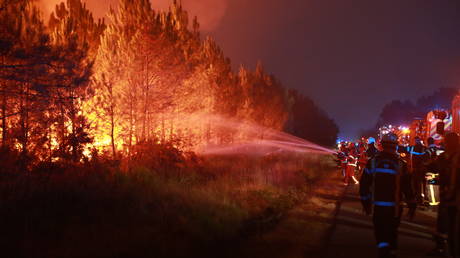
The pine forests of southern France are burning again, and the standard playbook of containment is failing to keep pace with an altered climate. Hundreds of residents and tourists have been forced to evacuate coastal sectors and inland valleys as fast-moving blazes tear through tinder-dry brush, fueled by erratic winds and consecutive heatwaves.
When the alarm sounds across the Mediterranean basin, the sequence is brutally predictable. Sirens wail through narrow village streets. Firefighting aircraft draw water from the sea in dangerous, low-altitude sweeps. Evacuation orders crackle over local radio frequencies while columns of black smoke blot out the summer sun. Yet beneath the immediate operational chaos lies a harsher structural reality. Europe is no longer experiencing ordinary seasonal fire cycles. The continent faces an accelerating environmental shift that outmatches traditional civil defense infrastructure.
The Anatomy of a Mediterranean Firestorm
Southern France occupies a unique geographical danger zone. The combination of intense solar radiation, prolonged drought, and the infamous mistral winds creates an explosive atmospheric cocktail. When dry winds sweep down from the north, they compress and dry out vegetation even further. Moisture levels in the soil and undergrowth plummet to levels typically associated with arid deserts rather than European agricultural regions.
For decades, local authorities relied on a reactive strategy. Position heavy assets near historical fire corridors, mobilize ground crews quickly, and rely on aerial bombardment with water and retardant. That system worked when weather anomalies were spaced years apart. Today, those anomalies form a continuous loop.
Ground crews report that fires now behave with unprecedented aggression. Flames do not merely crawl along the forest floor; they crown through the canopy, jumping firebreaks that historically stopped smaller blazes in their tracks. Embers are carried hundreds of meters ahead of the main front by turbulent winds, sparking spot fires that multiply the front lines faster than emergency coordinators can deploy personnel.
Infrastructure Under Strain
The human cost of these evacuations extends far beyond the immediate trauma of displacement. Coastal infrastructure in regions like the Var and the Bouches-du-Rhône swells every summer with millions of holidaymakers. Managing population influxes during peak tourism season is difficult under normal conditions. Doing so while highways are choked with smoke and evacuation corridors narrow to single-lane rural roads turns logistics into a nightmare.
Emergency shelters fill within hours. Local municipal budgets, designed to handle steady-state public services, absorb catastrophic expenses for emergency housing, temporary feeding stations, and veterinary support for displaced livestock and pets. The economic footprint of a single severe wildfire week ripples through the regional economy for months, dampening tourism revenue and imposing long-term recovery costs on communities that have little fiscal cushion.
+-------------------------------------------------------+
| TYPICAL EVACUATION BOTTLENECKS                        |
+-------------------------------------------------------+
| 1. Narrow access roads blocked by tourist traffic     |
| 2. Sudden wind shifts cutting off primary escape routes |
| 3. Overwhelmed municipal emergency shelters           |
| 4. Communication network failures due to power loss   |
+-------------------------------------------------------+
Civil protection agencies face an institutional dilemma. Do they prioritize defending rural hamlets built among dense pine plantations, or do they concentrate forces around critical infrastructure such as electrical grids, water treatment plants, and major transport arteries? Every choice leaves someone exposed.
The Policy Gap Between Prevention and Suppression
For years, European Union agricultural subsidies and national forestry policies favored timber production and rural depopulation management over active land stewardship. Forests that were once actively grazed by sheep and goats or cleared by small landowners for firewood have grown dense and continuous. Without grazing animals to suppress underbrush, organic fuel accumulates year after year.
Experts have repeatedly warned that vegetation management must take precedence over reactionary firefighting. Controlled burns during cooler months, creating wider buffer zones around vulnerable settlements, and diversifying tree species away from monoculture pine plantations are essential steps. Yet these measures require sustained political will and long-term funding streams that rarely survive short political election cycles.
Municipalities often lack the legal authority or financial resources to compel private landowners to clear brush around remote properties. When an owner abandons a rural plot, it transforms into an unmanaged fuse leading directly to neighboring homes.
Shifting Paradigms in Emergency Response
Technology offers some tactical advantages, but it cannot substitute for ground-level transformation. Thermal imaging drones now map fire perimeters through thick smoke, providing incident commanders with real-time data feeds. Predictive modeling software attempts to forecast fire spread based on wind vectors and humidity indexes.
However, technology only highlights the widening gap between available resources and environmental reality. When wind gusts exceed eighty kilometers per hour, even the most sophisticated aerial fleet remains grounded for safety reasons. Ground firefighters are left to confront walls of heat with hoses and hand tools, battling an enemy that operates on physics, not algorithms.
The psychological toll on these professionals is mounting. Firefighters across the Mediterranean report chronic exhaustion. Seasons that once lasted two peak summer months now stretch from early spring into late autumn. The boundary between professional duty and personal burnout blurs as crews rotate from one emergency zone to the next without adequate recovery periods.
The Road Ahead for Vulnerable Regions
As the climate continues to warm, the question is no longer whether southern Europe will burn, but how adaptation strategies will evolve to prevent catastrophic loss of life. Insurance models are already shifting. Property underwriters are introducing steep premiums or withdrawing coverage entirely in high-risk zones, leaving homeowners stranded between astronomical costs and defenseless properties.
Local populations are slowly organizing independent defense networks, sharing equipment, and training residents in basic defense techniques before professional help arrives. This decentralized approach points toward a future where communities must sustain themselves during the crucial initial hours of a disaster when official services are stretched to their absolute limits.
The smoke clearing over the French countryside reveals a landscape fundamentally altered by heat and neglect. Until structural changes match the scale of the threat, the sirens will continue to sound every summer, and the evacuation orders will remain a routine part of Mediterranean life.