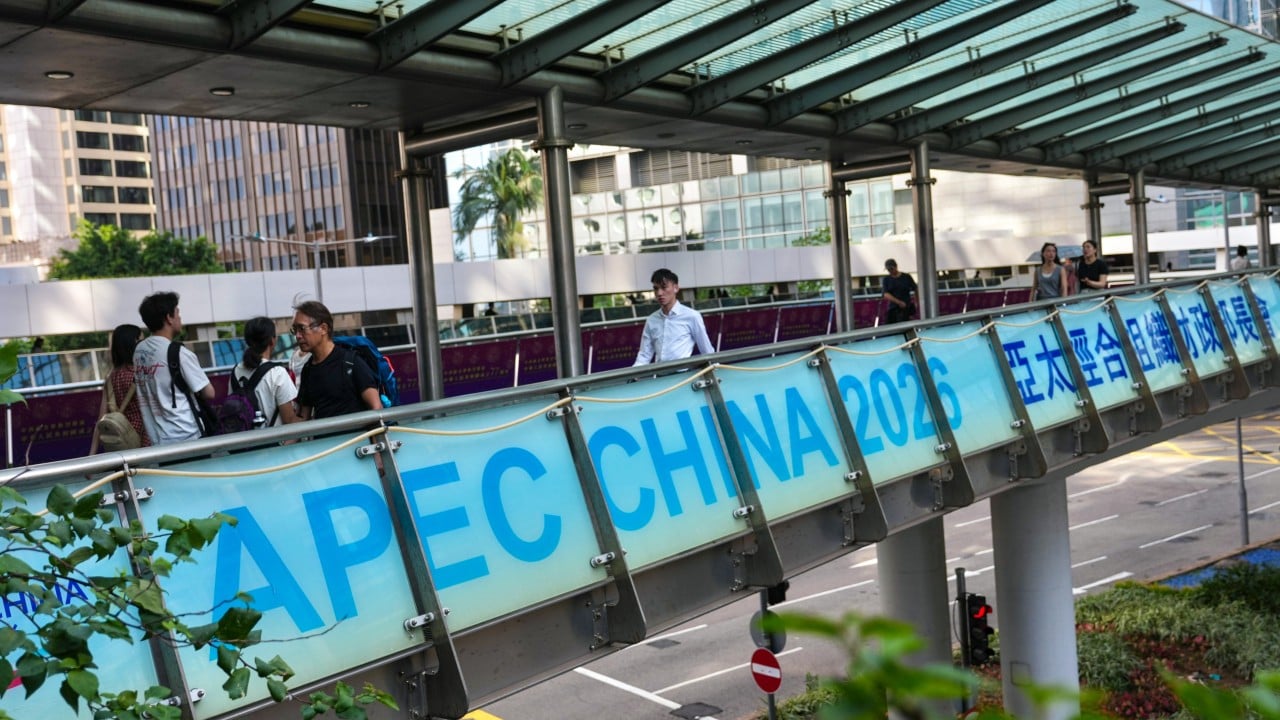
When roughly 500 delegates and accompanying guests converge on Hong Kong for the Asia-Pacific Economic Cooperation Finance Ministers' Meeting—or route through the city's airport and rail links on their way across the border to Shenzhen—the official press releases read like a triumph of regional diplomacy. Look closer. Beneath the welcoming speeches and cultural tours lies a high-stakes audition to prove Hong Kong still owns the financial and legal plumbing of Asia, even as mainland hubs try to absorb its functions.
Five hundred visitors is a rounding error in a city that handles tens of millions of travelers a year. Yet during APEC's 2026 calendar in China, those finance ministers, central bank officials, senior delegates, and transit passengers carry outsized weight. Hong Kong is not merely hosting a ministerial gathering or acting as a convenient airport gateway to the main APEC summitry in Shenzhen. It is trying to lock in its role as the indispensable clearinghouse, legal arbiter, and capital bridge for a fractured Asia-Pacific economy. For an alternative view, consider: this related article.
Why Five Hundred Delegates Matter More Than Headcount
Surface-level coverage loves big numbers. A delegation count around 500 sounds neat, manageable, and easy to summarize in a morning brief.
It also misses the point. In high-level economic diplomacy, influence rarely scales linearly with crowd size. When finance ministries and senior officials gather under the APEC banner, the real currency is access—five minutes with a counterpart from another economy, a quiet calibration on cross-border payment friction, or a signal about where long-term capital feels safe. Related analysis on this matter has been provided by Financial Times.
Hong Kong officials have treated the APEC Finance Ministers' Meeting—held in the city during China's APEC host year—as a showcase of institutional credibility. For years, skeptics in London, New York, and Singapore have asked whether Hong Kong's distinct legal and financial architecture still gives it an edge over mainland rivals. Putting international finance officials on the ground gives the city a live stage to answer that question in person.
A summit headcount measures logistics. Who sits at the table—and what contracts, rules, and habits survive after the motorcades leave—measures power.
At the same time, Hong Kong has leaned into its geography as a transit conduit for APEC participants heading to Shenzhen's business and leaders' events. Airlines and border operators rolled out coordinated transfers linking Hong Kong International Airport and cross-boundary rail routes with Guangdong. On paper, that is pure convenience. In practice, it tests whether two very different systems can function as a single regional engine without tripping over borders, licensing, and regulatory friction.
The Shenzhen Shadow and the Greater Bay Area Test
You cannot read Hong Kong's APEC moment honestly without looking thirty kilometers north. Shenzhen served as the focal point for major APEC gatherings in November 2026, including the CEO Summit and the Economic Leaders' Meeting.
That creates a subtle tension. Shenzhen is China's poster child for rapid industrial scaling, hardware engineering, and tech commercialization. Hong Kong is a deep-water capital market built on common law, convertible currency mechanics, international arbitration, and global banking links.
Complementary Strengths or Quiet Rivalry
Official commentary insists the two cities complement one another cleanly. Shenzhen builds and scales; Hong Kong finances, insures, and arbitrates.
There is real truth in that division of labor. A manufacturer in the Pearl River Delta that wants global institutional investors, cross-border project finance, or neutral dispute resolution under common law often finds Hong Kong's toolkit hard to replicate domestically.
Still, friction is built into the geometry. Every time a mainland city hosts flagship regional summits or builds out cross-border financial zones, executives ask a sharp question: is Hong Kong still the primary gateway, or is it becoming a specialized spoke?
Consider a hypothetical example to see how that trade-off plays out on the ground. Suppose a mid-sized clean-energy equipment maker near Shenzhen wants to expand across Southeast Asia and Latin America. Its factory floor and supply chain sit in Guangdong, where engineering talent and component suppliers are dense. Yet when international lenders or overseas utilities review multi-year supply agreements, they frequently push for governing law, dispute forums, and treasury settlement structures they already trust—precisely the areas where Hong Kong tries to differentiate itself. If cross-border rules remain clunky or overly bureaucratic, companies either pay extra friction costs or route deals through rival financial centers.
| Dimension | Hong Kong Advantage | Structural Friction Point | What Delegates Watch |
|---|---|---|---|
| Legal and Dispute Systems | Common law tradition and established international arbitration reputation. | Cross-border enforcement and jurisdiction boundaries require careful structuring. | Whether legal certainty holds up for complex cross-border deals. |
| Capital and Markets | Deep international investor base, global banking access, and financial depth. | Global rate shifts and geopolitical caution can slow cross-border issuance. | Appetite for regional infrastructure, green finance, and trade settlement. |
| Physical and Border Links | Major long-haul aviation hub with ferry, rail, and road links to Shenzhen. | Dual-plate vehicle rules, customs checks, and security cordons add transit time. | Door-to-door reliability when moving between airport, city, and mainland venues. |
| Regional Positioning | Bridges international finance with mainland industrial scale. | Competition from regional hubs and shifting trade barriers test neutrality. | Whether multilateral trade talk translates into practical business rules. |
What Happens to Trade, Capital, and Travel Beyond the Headlines
APEC is not a binding treaty machine. It operates on consensus, voluntary commitments, and policy dialogue across 21 member economies. Anyone expecting sweeping legal overhauls from a single ministerial meeting or delegate arrival wave is setting themselves up for disappointment.
What does move is attention, signaling, and incremental rule-making. During China's APEC cycle, themes like openness, digital economy cooperation, supply-chain resilience, and trade facilitation have dominated speeches. Business leaders who sit through these sessions rarely take grand slogans at face value. They listen for clues on customs clearance, payment rails, cross-border data rules, and mobility.
Even practical travel mechanics tell a story. Adjustments to APEC Business Travel Card stay rules in China—extending maximum stays for eligible cardholders from 60 days to 90 days per visit starting November 1, 2026—signal a deliberate effort to make regional business movement less rigid. Small administrative shifts like that matter far more to a regional exporter or project financier than a glossy summit banner.
The Logistics Reality Behind the Glamour
Travelers routing through Hong Kong toward APEC events have had to plan around real-world operational constraints rather than brochure promises. Cross-boundary travel between Hong Kong and Shenzhen is fast on paper, yet border formalities, vehicle quotas, and summit road restrictions can turn a short hop into a multi-hour schedule puzzle.
Savvy executives do not treat transit as an afterthought. They verify exact station names, build buffer time into border handovers, and keep backup routing in mind when security cordons tighten. A missed connection in APEC week is not just an annoyance; it can erase an entire day of bilateral meetings.
Overlooked Risks and Gray Areas
Cheerleaders of summit diplomacy tend to treat visibility as victory. A veteran observer knows better.
Hosting or serving as a staging ground for high-profile economic gatherings brings scrutiny as much as applause. Visiting officials and corporate chiefs arrive with their own anxieties: supply-chain fragmentation, tariff and export-control uncertainty, uneven regional growth, and questions over how global standards will divide along geopolitical lines. A welcoming banquet does not dissolve those pressures.
There is also a domestic expectation gap to watch. Local businesses in Hong Kong—from hotels and restaurants to legal, accounting, and financial advisory firms—naturally hope international delegations translate into steady billings and foot traffic. Some will see real upside, especially professional service teams advising on cross-border transactions. Others will find that a short-term wave of official visitors produces more photo opportunities than immediate retail windfalls.
Nor is Hong Kong's role guaranteed by history alone. Financial centers earn their keep every quarter. If regulatory clarity, market liquidity, and cross-border connectivity stay sharp, Hong Kong remains a vital bridge for Asia-Pacific commerce. If friction rises without clear commercial payoff, capital and deal flow will adapt quickly.
How to Read the Next Phase Like an Insider
If you are tracking APEC's footprint in Hong Kong—whether as an investor, corporate strategist, or policy watcher—skip the ceremonial summaries and watch three concrete indicators over the coming months.
First, look at cross-border deal and advisory flow connecting Hong Kong with mainland and ASEAN counterparties. Speeches about openness are cheap; syndicated loans, green bond issuances, joint ventures, and arbitration filings tell you whether institutions are actually committing balance sheets.
Second, track practical friction points in trade, payments, and mobility. Watch how smoothly cross-border arrangements operate for executives, suppliers, and regional firms moving between Hong Kong, Shenzhen, and wider Asia-Pacific markets.
Third, pay attention to follow-through after the cameras pack up. Summits create temporary momentum; durable competitiveness depends on predictable rules, credible institutions, and commercial usefulness long after the 500 delegates head home. Audit every grand regional promise against the actual friction it removes for a business moving money or goods across a border tomorrow.