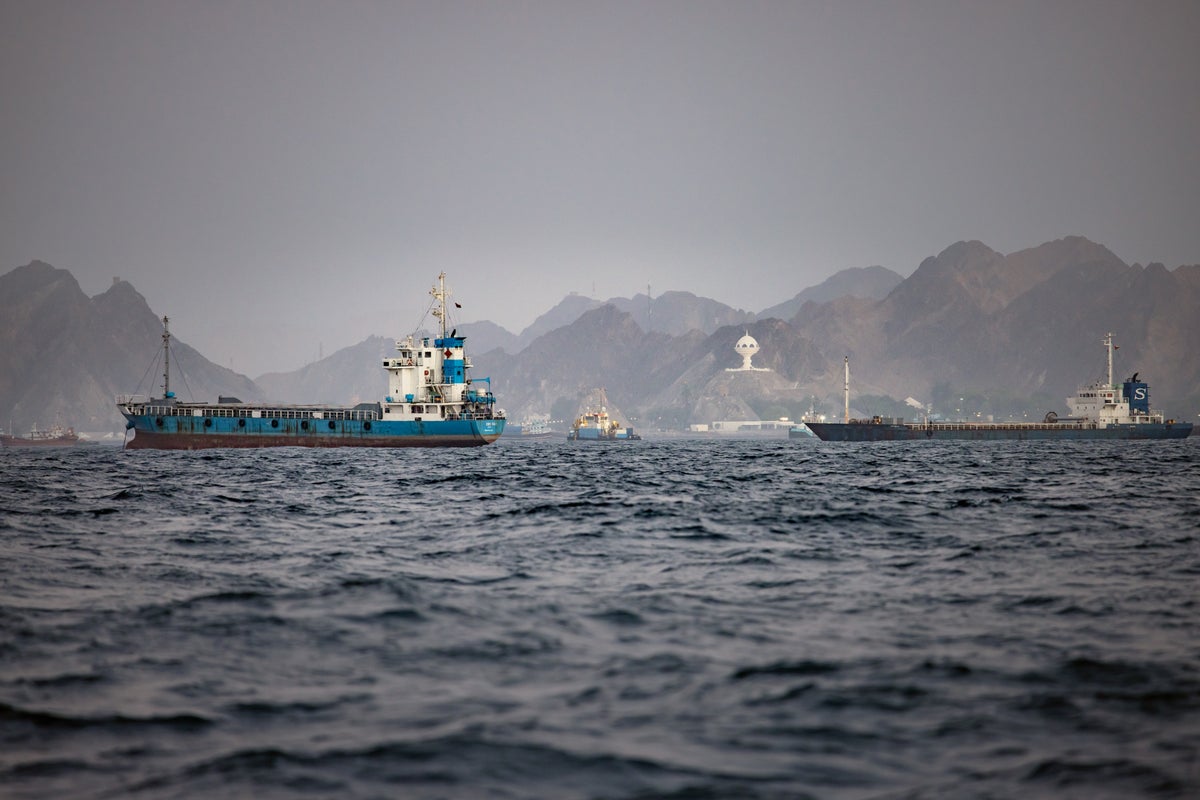
The fragile diplomatic breakthrough in Switzerland evaporated in less than twenty-four hours. Commercial maritime traffic through the Strait of Hormuz collapsed on Sunday, plunging from twenty-six vessels to just five after Iran ordered a sudden re-closure of the critical energy chokepoint. While official statements from Washington attempt to project calm, tracking data paints a far grimmer picture of an immediate, synchronized retreat by international shipping firms. The brief, three-day rebound in crossings following the June 18 interim memorandum of understanding has completely stalled, stranding global energy markets in a dangerous state of limbo.
This sudden paralysis is not merely a diplomatic hiccup. It represents a fundamental breakdown in the mechanics of international maritime law and military enforcement. Shipowners are refusing to rely on American security guarantees when the threat of Iranian mines, drone swarms, and satellite spoofing remains an active reality. The reality on the water contradicts the confident public declarations of Western officials. If you liked this piece, you might want to look at: this related article.
The Arithmetic of Interdiction
Five ships. That was the entire volume of traffic willing to risk the world's most vital energy corridor over a twenty-four-hour window. Three of those vessels were Very Large Crude Carriers transporting Saudi crude and fuel oil toward Asian markets, operating with their transponders open but their crews on high alert. The rest of the commercial market chose to drop anchor outside the danger zone or execute abrupt mid-transit turnarounds.
Hormuz Vessel Crossings (June 20-21, 2026)
=========================================
Saturday, June 20:   26 vessels
Sunday, June 21:      5 vessels
Traffic Drop:        -81%
Marine tracking data confirms that the few vessels still moving through the corridor are mostly dark, state-linked, or heavily discounted hulls willing to assume extreme liability. Neutral commercial tonnage has vanished from the water. The quick reversal proves that international shipping cannot be turned on and off like a faucet by political decree. Insurance markets dictate the flow of global trade, and right now, those markets are flashing red. For another perspective on this event, refer to the recent coverage from Associated Press.
War risk insurance premiums have stabilized at astronomical heights, demanding between one and three percent of a vessel’s total hull value just for a single transit. For a modern supertanker, that translates to millions of dollars in upfront fees before a single drop of oil is delivered. Shippers are realizing that the interim peace deal signed in Geneva lacked the institutional teeth to protect commercial assets.
The Lebanon Leverage and the Swiss Breakdown
Tehran’s decision to reactivate the blockade hinges on a calculated legal and military strategy. By explicitly tying the freedom of navigation in the Persian Gulf to ongoing Israeli military operations against Hezbollah in southern Lebanon, Iran has successfully transformed local land conflicts into an international maritime problem. The Iranian military command claims that Western intelligence turned a blind eye to targeted strikes that violated the first clause of the newly signed memorandum of understanding.
The diplomatic framework was built on quicksand from the beginning. Western negotiators treated the Strait of Hormuz as an isolated economic asset that could be traded for sanctions relief. Iranian strategists viewed the waterway as their ultimate asymmetric weapon, an irreplaceable insurance policy against foreign intervention. When strikes continued in Lebanon, Tehran pulled the trigger on the blockade without hesitation.
This creates a severe structural dilemma for the United States. Vice President JD Vance argued on television that American forces maintain total control and that the Iranian military infrastructure had been effectively neutralized during the spring campaign. The tracking data proves otherwise. It does not matter if the Pentagon declares the channel open if no commercial captain is willing to steer a ship into it.
The Invisible Arsenal Retaining Control
Iran does not need a conventional blue-water navy to enforce its will over the thirty-mile-wide strait. The spring conflict demonstrated that swarm tactics combined with modern electronic warfare can overwhelm standard naval escorts. Hundreds of heavily armed fast attack craft remain hidden along the jagged coastlines of Qeshm and Hormuz islands, ready to deploy at a moment's notice.
The true deterrent is the subsurface threat. Defensive mining operations conducted by the Islamic Revolutionary Guard Corps Navy during the height of the crisis have left an unknown number of tethered and bottom mines scattered throughout the shipping lanes. Even though a multinational demining effort was hastily assembled, the clearance operation is slow, tedious, and incomplete. One undetected mine can trigger a catastrophic environmental disaster and permanently freeze global shipping for months.
"A naval escort provides excellent defense against an anti-ship missile, but it cannot predict the exact location of a acoustic-influence mine resting on the seabed." — Anonymous Maritime Security Consultant, British P&I Club
Beyond physical weapons, electronic deception has emerged as a primary tool of interdiction. Merchant vessels operating near the Musandam Peninsula report severe Global Navigation Satellite System jamming and coordinated spoofing attacks. Ship navigation systems are frequently manipulated to show false positions, occasionally misdirecting commercial hulls directly into Iranian territorial waters where they face immediate seizure.
The Long Road and the Cape Alternative
The economic fallout of this second closure will hit harder because global supply chains have already burned through their safety cushions. During the initial phase of the 2026 crisis, the diversion of trade around the Cape of Good Hope was treated as a temporary emergency measure. Now, logistics firms must reconfigure their operations for a permanent reality of extended transit times.
- Extended Voyages: Sailing around Africa adds ten to fourteen days to a standard journey between Asia and Northern Europe.
- Fuel Consumption: Bypassing the Middle East burns thousands of tons of additional marine fuel per voyage, driving up structural transport costs.
- Container Scarcity: Longer journeys mean ships spend more time at sea, creating artificial container shortages at major manufacturing hubs.
Regional transshipment centers like Jebel Ali are facing severe bottlenecks. Cargo destined for the broader Middle East is stranded in ports that lack the storage capacity for prolonged delays. Land-based alternative routes, such as trucking networks across Saudi Arabia to western ports, are functional but lack the sheer volume capacity required to replace the lost maritime trade lanes.
The international energy market is uniquely vulnerable to this disruption. While regional pipelines can divert a fraction of Saudi and Emirati crude toward the Red Sea, those systems cannot handle the massive volume of liquefied natural gas produced by Qatar. The complete halt of Qatari gas shipments removes a massive slice of global supply from the market, guaranteeing volatile price spikes as winter storage deadlines approach in the West.
The fundamental truth of the 2026 Hormuz crisis is that international trade routes require absolute predictability to function efficiently. The reliance on fragile, short-term political agreements has left the global economy exposed to constant blackmail along its most sensitive maritime artery. Until a security architecture can be established that separates commercial transit from regional proxy warfare, the Strait of Hormuz will remain an unusable corridor, regardless of what politicians claim from the safety of dry land.