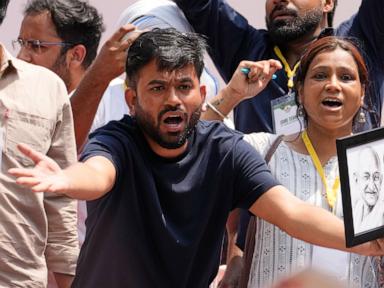
The sound of stainless steel spoons striking metal plates used to be a symbol of collective gratitude in India. Today, it has been repurposed into a deafening roar of political dissent. Outraged by systemic corruption, structural inefficiencies, and a recent string of high-profile examination leaks, student activists and opposition groups across India have taken to the streets. Their primary target is the Union Education Minister, whose resignation they are demanding through highly coordinated, noisy demonstrations. What began as localized campus anger has transformed into a national spectacle, highlighting a profound crisis of trust in the country's centralized examination and employment infrastructure.
The immediate trigger for the unrest involves deep-seated vulnerabilities within the National Testing Agency (NTA). This body oversees massive standardized tests that determine the futures of millions of aspiring doctors, engineers, and academics. When irregularities and paper leaks forced the cancellation and rescheduling of key national exams earlier this year, the fragile compact between the state and its youth fractured. For a generation that views these grueling exams as their sole ticket to upward mobility, the administrative failure felt like a direct theft of their future. For a different look, see: this related article.
The Anatomy of the Plate Banging Protest
To outsiders, the act of banging plates—known locally as thali bajana—might look like a chaotic outburst. It is actually a deliberate, highly symbolic piece of political theater. During the global pandemic, the ruling administration urged citizens to beat plates on their balconies to show solidarity with frontline workers. By turning this exact gesture against the government, the opposition has pulled off a sharp piece of political judo. They are using the state's own visual and auditory vocabulary to broadcast its perceived failures.
The demonstrations have been spearheaded by fringe and mainstream student outfits alike, including satirical groups colloquially dubbed the "Cockroach Party" by critics and internet meme-makers due to their resilient, ubiquitous presence in campus politics. These groups have seized on the public's deep exhaustion. On the streets of New Delhi, Patna, and Lucknow, the rhythmic clanging of kitchenware serves a dual purpose. It drowns out official government press briefings while providing an undeniable, low-cost soundtrack for television cameras and social media algorithms. Related insight regarding this has been provided by USA Today.
The strategy works because it democratizes protest. You do not need a printed banner or a megaphone to participate; you only need to step outside your door with an item from your kitchen. This simplicity has allowed the movement to spill out of elite university campuses and into working-class neighborhoods where families have poured their life savings into their children’s exam preparation coaching.
A Broken Meritocracy and the Coaching Factory
To truly understand why a compromised exam can cause such widespread civil unrest, one must look at the sheer scale of India's testing industrial complex. Every year, more than two million students sit for single-day exams that distribute a painfully limited number of seats in prestigious public institutions. The competition is brutal. Fractions of a percentage point separate those who secure a stable career from those who face underemployment.
This hyper-competition has birthed a multi-billion-dollar coaching industry, centered in hubs like Kota in Rajasthan. In these towns, teenagers spend up to sixteen hours a day in claustrophobic classrooms, memorizing formulas and test-taking strategies. The pressure is notoriously immense, often taking a devastating toll on mental health.
When a paper leaks, the entire system collapses.
[National Exam Attempted] ➔ [Paper Leaked/Sold] ➔ [Exam Cancelled] ➔ [Years of Prep Wasted]
A single leak does not just delay a test. It invalidates years of grueling labor and financial sacrifice by the country's poorest families. Richer candidates can afford another year of coaching fees and rent in a test-prep hub. Poorer candidates simply run out of money and time. The anger on the streets is fueled by the realization that the system is not a pure meritocracy; it is highly vulnerable to wealthy syndicates capable of buying leaked answer keys before the exam booklets even arrive at rural testing centers.
The Institutional Cover Up
The official response to the crisis followed a predictable, bureaucratic script. Initially, ministry officials denied any widespread systemic breach, attributing the anomalies to isolated local cheating incidents in far-flung states. Only when local police forces intercepted physical evidence of leaked papers and arrested members of organized cheating rings did the federal government pivot, eventually handing the investigation over to central detective agencies.
This reluctant, piecemeal acknowledgment of the problem has destroyed public confidence. The demand for the education minister’s resignation is not merely about assigning blame for a single logistical failure. It is an indictment of an entire administrative philosophy that has consistently favored centralized control over transparent, accountable governance. By consolidating multiple independent university entrance exams into monolithic national tests, the ministry created a single point of failure. When that single point cracked, it compromised the entire higher education calendar nationwide.
Critics argue that the National Testing Agency was handed too much responsibility too quickly, without the independent oversight or digital infrastructure required to secure tests of this scale. The reliance on external, private testing centers—often understaffed and poorly monitored—created lucrative opportunities for local tech operators and corrupt officials to compromise computer systems or leak physical question papers during transit.
The Limits of Political Satire
While the loud, plate-banging tactics have successfully dominated the news cycle, they also expose the limitations of contemporary opposition politics in India. Satirical movements and symbolic noise are highly effective at capturing short-term public attention. They are far less effective at forcing systemic policy reform.
The government has largely dug in its heels. Yielding to demands for a high-profile resignation is viewed by party strategists as a sign of weakness that could embolden opponents ahead of crucial state-level elections. Instead of replacing leadership, the administration has opted for structural damage control. They have introduced stricter anti-cheating legislation with severe jail terms and heavy financial penalties for paper leakers.
These legal measures, however, miss the fundamental point. Heavy penalties are only effective if the enforcement mechanisms are completely free from political interference and local corruption. Passing a new law does very little to secure a vulnerable server in a rural testing center or stop a compromised courier from opening a box of exam sheets in the middle of the night.
The Real Cost of Economic Stagnation
Beneath the immediate outrage over the leaked exam papers lies a much larger, structural crisis involving the Indian economy. The desperation surrounding these exams is a direct symptom of a severe shortage of high-quality, formal-sector jobs for educated youth.
India's economy has grown rapidly in terms of raw GDP, but this growth has not translated into sufficient white-collar employment. Culturally, security remains the ultimate prize. A government job or a seat in a state medical college offers a lifetime of stability, societal respect, and protection from market volatility. As a result, millions of overqualified graduates find themselves trapped in a cycle of permanent preparation, taking the same exams year after year because the broader market offers no viable alternatives.
When these few, highly coveted pathways are revealed to be rigged or incompetent, the psychological blow is devastating. The clanging of plates in the streets is the sound of that collective desperation boiling over. It represents the frustration of a demographic dividend that feels less like an economic asset and more like a volatile, overlooked mass of anxious young people left stranded outside the doors of a broken system.