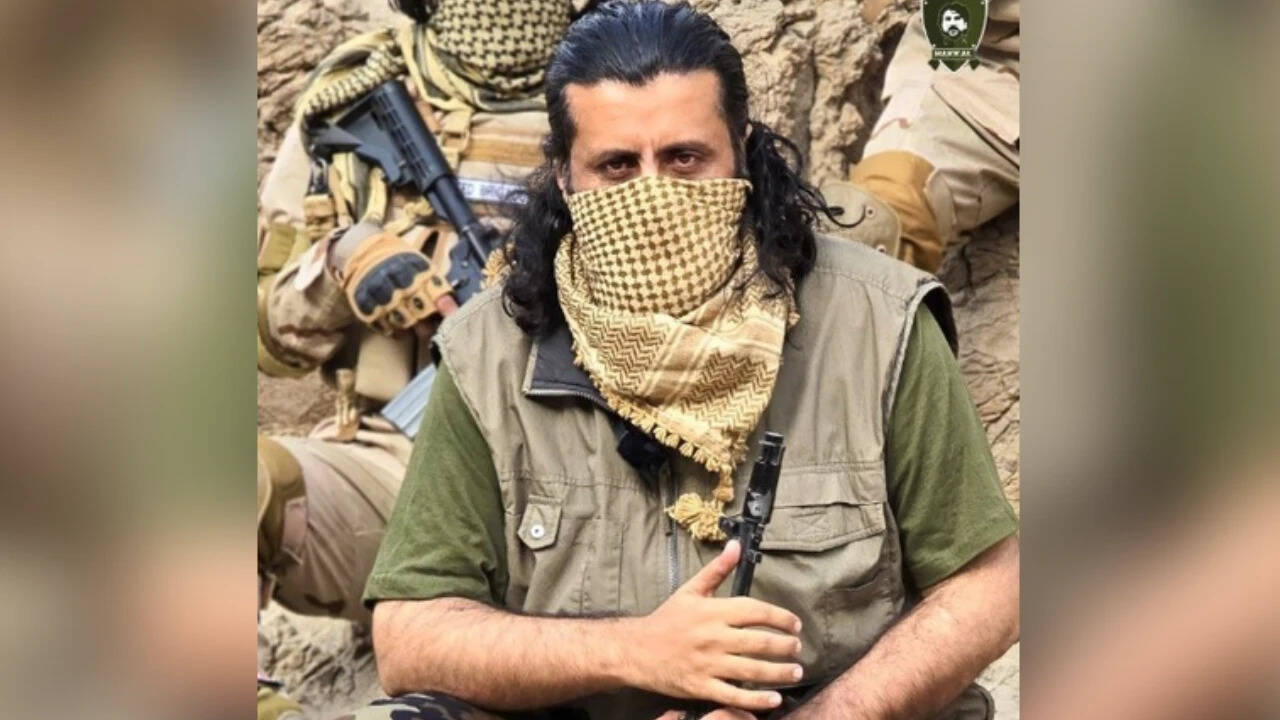
Rumors and intelligence reports suggesting that a former Pakistan Army officer has taken command of the Balochistan Liberation Army mark a dangerous turning point in South Asia's longest-running insurgency. If verified, this leadership shift means the separatist movement is no longer relying solely on tribal elders or radicalized students to wage its guerrilla war. Instead, the group is drawing directly from the tactical playbook, institutional memory, and organizational discipline of the very military it fights. For Islamabad, the threat is no longer just an external insurgency on the periphery; it is an enemy that understands the state's command structure from the inside out.
For decades, the conflict in Balochistan followed a predictable rhythm. Scattered tribal militias would ambush frontier patrols, blow up gas pipelines, and retreat into the rugged, unforgiving terrain of southwestern Pakistan. The state would respond with heavy-handed clearance operations, checkpoints, and mass arrests. That cycle is breaking down. Over the last several years, the Balochistan Liberation Army (BLA) has transitioned from a fragmented collection of local fighters into a centralized, media-savvy, and tactically sophisticated militant network.
The emergence of a former military officer at the helm—or within the highest strategic tiers of the organization—explains how that transformation accelerated so rapidly. You do not learn how to coordinate multi-pronged assaults on hardened naval bases or orchestrate synchronized strikes across an entire province from reading guerrilla manuals online. You learn it at a staff college.
The Anatomy of a Defection
To understand how an officer trained to defend the Pakistani state ends up leading an insurgency against it, you have to look at the geography and politics of recruitment. The Pakistan Army has historically been dominated by officers from Punjab and Khyber Pakhtunkhwa. In an effort to foster national integration and counter narratives of marginalization, the military spent the last two decades actively recruiting young men from Balochistan into its cadet colleges and officer ranks.
The strategy was sound on paper. Bring the periphery into the center, give Baloch youth a stake in the state apparatus, and the separatist appeal will wither.
In practice, it created an acute identity crisis for a subset of those recruits. Officers returning home on leave confronted the stark reality of economic underdevelopment, enforced disappearances, and heavy military policing in their own districts. When personal loyalty to a uniform collides with deep-seated ethnic grievances, the fracture can be total. A defector from the regular army does not just bring a rifle to the mountains; they bring knowledge of radio frequencies, convoy protocols, intelligence-gathering blind spots, and standard operating procedures for counterinsurgency sweeps.
Why Institutional Memory Matters in Guerrilla Warfare
Most insurgent groups fail because they cannot scale. They start with high ideological motivation, execute a few dramatic attacks, and then collapse under the weight of their own logistical incompetence or internal tribal rivalries.
A trained military officer approaches rebellion as an administrative and logistical problem rather than a romantic cause. Under professionalized leadership, several critical shifts occur within a militant group:
- Compartmentalized Cell Structures: Traditional tribal militias fight alongside cousins and neighbors. When one fighter is captured, the entire network unravels under interrogation. Military-trained commanders enforce strict operational security, ensuring that individual cells do not know the identities or locations of adjacent units.
- Logistics and Supply Chains: Guerrillas starve without predictable supply lines. Former officers understand how to cache weapons, manage covert funding channels, and rotate fighters out of active combat zones before exhaustion degrades their effectiveness.
- Target Selection: Instead of wasting ammunition on low-level police outposts, a professionalized command targets strategic chokepoints. Attacking major infrastructure, foreign engineering convoys, and high-security military installations forces the state to spread its troops thin guarding static assets, surrendering the initiative to the insurgents.
From Tribal Resistance to Modern Asymmetric Warfare
The Baloch insurgency has gone through five distinct waves since 1948, when the princely state of Kalat was annexed into Pakistan. The first four waves were led predominantly by feudal tribal chieftains—the Marris, Bugtis, and Mengals. Those uprisings were fierce, localized, and ultimately containable. If the state co-opted, exiled, or eliminated the tribal sardar, the rebellion lost its head and withered away.
The current fifth wave, which began in the early 2000s, fundamentally altered that dynamic. Leadership shifted away from hereditary landlords to an educated, middle-class vanguard. Figures like Allah Nazar Baloch, a former medical doctor, and Bashir Zeb, a former student activist, stripped the movement of its feudal baggage and reframed it as a modern national liberation struggle.
Putting a former army officer in charge represents the logical, if terrifying, next phase of this evolution. The ideological foundation was built by doctors and students; the operational execution is now being refined by career soldiers.
Consider the tactical complexity of recent BLA operations, particularly those carried out by its elite suicide wing, the Majeed Brigade. In past decades, Baloch militants avoided suicide bombings, viewing them as a tactic belonging to religious extremists rather than secular nationalists. That taboo is completely gone. More importantly, the execution of these attacks shows hallmarks of formal military planning. Fighters no longer simply drive a vehicle packed with explosives into a gate. They use assault teams equipped with thermal optics, night-vision gear, and captured NATO-standard rifles to breach perimeters, hold buildings for days, and inflict maximum attrition on elite counterterrorism units sent to clear them.
The Information War and Propaganda Discipline
Walk through the digital footprint of the BLA today, and you will not find the grainy, chaotic footage typical of amateur militias. You will find high-definition body-camera video, multi-angle drone reconnaissance, and crisp press releases issued in English, Urdu, and Balochi within minutes of an attack.
This is another signature of professional military thinking. Modern commanders understand that kinetic action on the ground is wasted if you lose the narrative battle in the press. By releasing helmet-cam footage showing insurgents methodically clearing rooms or ambushing armored vehicles, the group achieves two strategic goals simultaneously. First, it humiliates the state security apparatus and erodes public confidence in the military's ability to guarantee stability. Second, it serves as a potent recruitment tool for disaffected youth across Balochistan, projecting an image of competence, discipline, and inevitability.
The state's traditional response—imposing media blackouts and restricting journalists from traveling to conflict zones—backfires in this environment. When independent reporters cannot verify what happened during a clash in Turbat or Mach, the BLA's media wing becomes the sole source of visual evidence.
The China Factor and Strategic Vulnerability
None of this happens in a geopolitical vacuum. Balochistan is the geographic linchpin of the China-Pakistan Economic Corridor (CPEC), a multi-billion-dollar network of highways, energy pipelines, and the deep-water port of Gwadar. For Beijing, Gwadar represents a vital strategic outlet to the Arabian Sea, bypassing the vulnerable Strait of Malacca. For Islamabad, CPEC is the economic lifeline meant to pull the country out of chronic debt and stagnation.
For the BLA, those billions of dollars in foreign investment are a massive target painted across their homeland.
The insurgents view Beijing not as a neutral economic partner, but as a colonial enabler propping up Islamabad's control over Baloch resources—specifically gold, copper, and natural gas. By targeting Chinese engineers, consulates, and infrastructure projects, the BLA leadership achieves maximum geopolitical leverage with minimal manpower. Every time a convoy of foreign workers is hit, Beijing demands tighter security, insurance premiums skyrocket, and project timelines stall.
A former Pakistan Army officer leading the BLA knows exactly how much pressure this puts on Rawalpindi. The Pakistani military establishment stakes its institutional legitimacy on its ability to protect foreign assets and maintain internal order. When the insurgency forces the army to deploy entire divisions just to guard a single port city or a stretch of highway, the insurgents are winning a war of economic attrition without ever needing to capture and hold territory.
The Gray Areas of Intelligence and Attribution
In a conflict shrouded in censorship and psychological warfare, separating verified fact from propaganda is notoriously difficult. Reports identifying a former military officer as the new operational chief of the BLA carry massive implications, yet they also sit squarely in the murky gray area of regional intelligence operations.
Both sides have reasons to manipulate the narrative around leadership changes.
For the BLA, claiming that decorated or formally trained officers have defected to their ranks is a massive psychological victory. It signals to other Baloch personnel serving in the Frontier Corps, police, and regular army that switching sides is both viable and prestigious. It sows paranoia within the military's own barracks, forcing commanders to question the loyalty of soldiers standing right next to them.
Conversely, Pakistani intelligence agencies have a long history of framing domestic insurgencies as externally engineered conspiracies rather than homegrown political failures. Islamabad routinely accuses India's Research and Analysis Wing (RAW) of funding, training, and directing Baloch separatists from safe havens across the border in Afghanistan or Iran. Highlighting a rogue former officer allows state narrative managers to portray the insurgency as an aberration driven by individual treason rather than a systemic grievance shared by millions of citizens.
Whether the individual in question is a formal commander-in-chief or a senior tactical advisor, the operational reality on the ground remains unchanged. The tactics have already shifted. The weaponry has already upgraded. The coordination has already reached a level that exceeds anything seen in previous decades.
Why Kinetic Force Alone Cannot Solve This
History offers a grim warning to states that try to defeat professionalized insurgencies purely through military escalation. When an insurgent group develops institutional memory, killing or capturing a single leader rarely ends the threat. If the current BLA chief is eliminated tomorrow, the training pipelines, cell structures, and logistical networks they put in place will survive. Another commander will step into the slot, armed with the same playbook.
For decades, Islamabad has treated Balochistan primarily as a security problem rather than a political one. Billions of rupees have been poured into fencing borders, building cantonments, and expanding paramilitary forces. Meanwhile, basic governance remains broken. Provincial elections are widely viewed by locals as stage-managed affairs that install compliant politicians with zero genuine authority. Resource royalties fail to trickle down to local communities, leaving vast stretches of the province without reliable electricity, clean water, or functional schools.
You cannot bomb an idea out of existence, and you certainly cannot out-maneuver a guerrilla force led by men who graduated from your own military academies if you refuse to address the political fuel feeding their recruitment. Until the state addresses the core grievances of political representation, economic equity, and the rule of law, the mountains of Balochistan will continue to absorb every battalion sent into them—and turn a few of the state's own soldiers against it in the process.