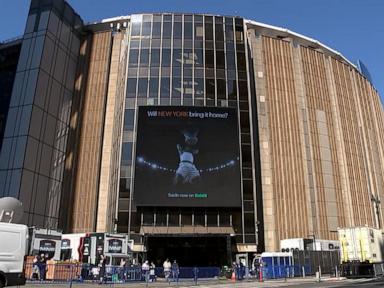
The New York Knicks are two wins away from ending a 53-year championship drought, but the real battle tonight isn't on the hardwood. It is happening in the corridors beneath Seventh Avenue. As Madison Square Garden prepares to host Game 3 of the NBA Finals against the San Antonio Spurs, law enforcement is quietly confronting a multi-layered security emergency. Local news broadcasts have focused heavily on standard warnings regarding crowd control and rowdy fans, but interviews with municipal officials and counterterrorism experts reveal a far more complex threat matrix.
A mass stabbing at Penn Station just hours ago sent six people to the hospital directly beneath the arena. Add to that a confirmed presidential visit, a citywide influx of counterfeit syndicates, and a massive surge in coordinated cyber attacks targeting stadium infrastructure, and the situation becomes critical. The NYPD and federal intelligence agencies are no longer just monitoring standard sports celebrations. They are actively trying to prevent a systemic breakdown of public safety at the world's most famous arena.
The Convergence of Threats Beneath Seventh Avenue
Local media outlets spent the weekend flashing footage of rowdy fans climbing light poles and vendor carts following New York’s dramatic Game 2 victory. Seventeen arrests and an assaulted police officer made for compelling television. They do not, however, represent the true operational headache facing the NYPD.
The immediate catalyst for the current high-alert status is the Sunday evening stabbing inside the Penn Station transit hub, located immediately below the Garden's floorboards. The proximity is not merely geographical; it is structural. Madison Square Garden sits directly on top of the busiest transportation cavern in North America. A security breach or violent incident in the subterranean train tunnels instantly compromises the arena above.
A high-ranking municipal security consultant, speaking on the condition of anonymity, explained that the transit hub functions as a massive, uncontrollable funnel. Thousands of fans, commuters, and tourists mix in tight spaces where traditional perimeter security cannot be established. When a violent incident occurs downstairs, the panic alone can disrupt the intricate ingress and egress protocols designed for the 19,000 fans heading up to the arena.
The Logistics of a High Profile Target
Securing a modern arena is difficult under normal circumstances. Securing Madison Square Garden during its first NBA Finals appearance since 1999, while the sitting president is in attendance, requires an entirely different playbook.
The Secret Service has established a temporary national special security event perimeter around the 31st Street to 33rd Street corridor. This tier-one protocol changes how the surrounding neighborhood functions.
- Subterranean Sweeps: K-9 units and explosive ordnance disposal teams have been conducting continuous sweeps of the Amtrak, Long Island Rail Road, and New York City Subway platforms directly beneath the arena.
- Airspace Restrictions: The FAA has instituted a temporary flight restriction over Midtown Manhattan, covering drone activity, which local police fear could be used for surveillance or worse.
- Physical Barricades: Concrete truck-attenuator vehicles have blocked off Seventh and Eighth avenues, transforming the commercial zone into a fortified compound.
The presence of high-profile political figures dramatically alters the behavior of local bad actors. It turns a sporting event into a global stage for protest, disruption, and malicious actors looking to exploit the spotlight. Law enforcement is forced to split its focus between basic crowd management and sophisticated counterterrorism protocols.
The Virtual Front Line
While tactical units line the streets outside, a quiet conflict is being waged in the digital realm. Stadiums are no longer just concrete structures; they are massive, interconnected digital networks. Madison Square Garden relies heavily on automated systems to manage everything from digital ticketing and point-of-sale commerce to the actual environmental controls of the arena.
According to cybersecurity analysts tracking municipal infrastructure threats, high-profile sporting events see an average 400% spike in malicious cyber activity during championship series.
Threat Vector          | Operational Impact               | Primary Target
-----------------------|----------------------------------|---------------------------
Distributed Denial of  | Freezes digital ticketing        | Ingress gates, fan mobile
Service (DDoS)         | scanners, creating massive       | applications
                       | bottlenecks outside the arena.   |
-----------------------|----------------------------------|---------------------------
Point-of-Sale Malware  | Intercepts financial data at     | Luxury suite vendors,
                       | merchandise stands, disrupting   | concession systems
                       | millions in revenue.             |
-----------------------|----------------------------------|---------------------------
Industrial Control     | Targets HVAC, lighting, and      | Stadium operations back-
System Probing         | internal communications.         | end infrastructure
A coordinated DDoS attack on a digital ticketing platform is not just an inconvenience for fans; it is a major public safety hazard. When 10,000 people are suddenly stranded on the sidewalk because optical scanners cannot validate tickets, crowd density reaches dangerous levels. It creates a soft target outside the security perimeter, directly on the streets of Manhattan.
The Underworld Economy of Championship Sports
The threat isn't limited to digital attacks and physical violence. The financial stakes of the 2026 Finals have attracted highly organized criminal enterprises specializing in intellectual property theft and financial fraud.
During the Game 2 watch parties, NYPD officers arrested an individual carrying a loaded firearm who was actively distributing counterfeit merchandise. This was not an isolated incident of a street vendor selling bootleg t-shirts. Federal investigators have long established that counterfeit rings operating at major sporting events are frequently tied to larger, more organized criminal networks.
These operations utilize sophisticated supply chains to flood the venue's perimeter with look-alike passes, fake merchandise, and cloned credential badges. The introduction of cloned credentials poses a severe risk to internal arena security. If a malicious actor can successfully replicate a vendor or media badge, the entire physical security perimeter is compromised. Security personnel at the inner gates are currently operating under a dual-verification system, manually checking digital chips against physical holofoil IDs to mitigate this precise vulnerability.
The Limits of Predictable Policing
The traditional law enforcement response to a high-stakes game is simple: increase visibility. Hundreds of blue uniforms will line the streets, and flashing lights will illuminate every corner of Midtown.
This approach has its limitations. Visible policing is highly effective at stopping spontaneous bar fights or keeping drunk fans off vendor carts. It is far less effective against a bad actor who has spent weeks studying the physical limitations of Madison Square Garden's infrastructure.
The NYPD's decision to reverse its initial ban on outside watch parties has complicated matters significantly. By allowing thousands of ticketless fans to congregate directly outside the arena, the city has created an unpredictable, fluid environment. Balancing the public's desire to celebrate a historic sporting moment with the cold realities of modern threat mitigation is an imperfect science. The department is relying heavily on plainclothes officers embedded within the crowds to spot anomalous behavior before it escalates into a wider panic.
Tonight's game is a major milestone for New York sports culture, but the real metric of success will not be found on the scoreboard. It will be measured by the silent execution of a massive, multi-agency security operation designed to keep an increasingly volatile environment from fracturing.