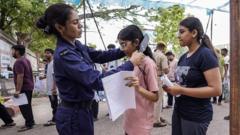
On June 21, 2026, more than 2.2 million aspiring doctors across India walked into examination centers under a security apparatus resembling a military occupation. The National Eligibility cum Entrance Test, or NEET-UG, was being re-conducted after a devastating paper leak forced the cancellation of the initial May 3 exam. To safeguard the test, the government deployed 200,000 officials, enforced biometric face-scanning, utilized military aircraft for transport, and implemented a nationwide block on the messaging app Telegram. Yet this overwhelming show of force cannot obscure the structural rot within India's hyper-competitive education system, where a massive coaching industry and sophisticated criminal syndicates exploit an administrative structure incapable of handling the sheer volume of candidates.
Treating a national examination like a counter-insurgency operation ignores the root of the problem. Paper leaks in India are not merely security lapses. They are highly profitable market responses to an extreme imbalance between supply and demand.
The Mathematical Impossibility of Fairness
The numbers governing the medical entrance exam reveal an inescapable truth. Roughly 2.2 million candidates are competing for just over 100,000 undergraduate medical seats. Less than half of those seats are in affordable government colleges. The rest are in private institutions where fees are prohibitively high for the average Indian family.
This means that fewer than three percent of applicants will achieve their dream of becoming a doctor through the public system. When the margin between a career in medicine and academic failure comes down to a fraction of a percentage point, the incentive to cheat ceases to be an individual moral failure. It becomes an organized market.
Syllabus mastery is no longer enough to guarantee a seat. This reality has fueled a shadow education market valued in the billions of dollars. Towns like Kota and Sikar have transformed into massive coaching hubs, factories designed to drill teenagers for up to 16 hours a day. When parents are already spending their life savings on coaching institutes, paying an illicit broker for a leaked question paper becomes a calculated risk rather than a unthinkable crime. During the aborted May cycle, reports emerged of papers selling on the black market for up to five million rupees, equivalent to over $50,000. For affluent families, this is simply an alternative entry fee.
A Broken Supply Chain of Trust
The National Testing Agency was established to standardize admissions and eliminate local corruption. Instead, it has concentrated vulnerability. By centralizing the testing process for multiple major national exams, a single breach now compromises millions of futures simultaneously.
The journey of a question paper from an author's mind to a student's desk involves dozens of human touchpoints. For the June 21 retest, authorities resorted to putting paper setters and translators into literal isolation at a secret facility, stripping them of internet access and phones. But the vulnerabilities multiply once the papers leave lockdown.
- Printing and Logistics: The NTA frequently relies on external, outsourced commercial printers. This creates an immediate weak point where poorly paid staff face immense financial temptation.
- Physical Transport: Papers must travel across thousands of miles to reach over 500 cities. Even with GPS tracking and paramilitary escorts, transit involves temporary storage in local bank vaults and school strongrooms.
- The Human Factor: Hundreds of thousands of temporary, low-paid invigilators and center coordinators manage the actual test day. A single compromised coordinator with a smartphone camera can invalidate an entire national cycle within seconds.
Investigation into the May leak pointed directly to this decentralized vulnerability. The Central Bureau of Investigation arrested a chemistry lecturer acting as a regional kingpin, proving that the leak was not a sophisticated digital hack, but an old-fashioned inside job.
The Digital Echo Chamber
While the leaks happen in physical rooms, distribution has gone completely digital. The government's temporary ban on Telegram ahead of the retest highlights the official panic over encrypted communication. The Ministry of Electronics and Information Technology even forced the app to disable its message-editing feature, aiming to stop scammers from retroactively modifying posts to create fake proof of leaks after the fact.
This digital enforcement is largely performative. Banning a single app ignores the broader reality of internet infrastructure. If a paper is photographed, it spreads across dozens of alternative platforms, decentralized private networks, and signal groups within minutes. The technology does not create the leak; it merely accelerates the contagion.
The Real Cost of Military Grade Testing
The psychological toll on the candidates has become secondary to the political need for face-saving measures. Critics point out that forcing 18-year-olds to navigate multiple layers of frisking, metal detectors, AI camera surveillance, and biometric checks hours before a life-defining exam fundamentally distorts the purpose of education.
The intense pressure has already led to tragic outcomes, with Indian media reporting multiple student suicides following the cancellation of the May exam. Students spend years preparing for a single three-hour window, only to see their efforts erased by administrative incompetence and institutional greed.
The administrative response has been to add more time to the test duration and increase the physical presence of security forces. This approach confuses movement control with integrity. You can surround an exam center with armed guards, but if the paper was photographed inside a printing press or a local strongroom three days prior, the security at the school gates is nothing more than theater.
India’s medical entrance crisis will not be solved by turning schools into high-security compounds or blocking communication platforms. Until the state addresses the acute shortage of medical seats, breaks the monopoly of the centralized testing format, and enforces strict criminal liability on the outsourced entities handling sensitive material, the integrity of its education system will remain compromised. Security cannot manufacture trust where the system itself is structurally broken.