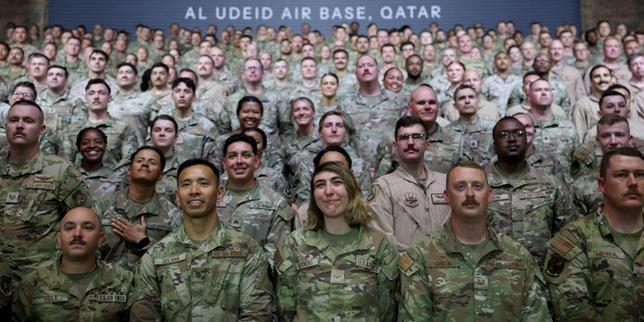
The strategic architecture of American power in the Middle East has run into a hard, physical ceiling. For half a century, vast forward installations across the Persian Gulf functioned as operational anchors, deterring regional adversaries while projecting air and naval dominance across critical maritime chokepoints. Today, those same sprawling facilities—from Al Udeid Air Base in Qatar to Camp Arifjan in Kuwait—have turned into static liabilities. The rapid proliferation of low-cost autonomous drones and high-velocity precision missiles has fundamentally inverted the cost exchange of modern warfare, transforming multi-billion-dollar military compounds into lucrative targets that exhaust defensive inventories faster than global supply chains can replace them.
[Image of hydrogen fuel cell]
The Economic Asymmetry Threatening Forward Presence
Maintaining an expansive military footprint in West Asia relies on an implicit premise: host nations trade operational basing rights for an ironclad U.S. security umbrella. Yet, recent regional escalations have exposed a math problem at the core of integrated air defense.
When salvo attacks combine hundreds of inexpensive, long-range attack drones with heavy ballistic volleys, defending a fixed installation requires firing interceptors that cost orders of magnitude more than the attacking munitions. A single Patriot PAC-3 interceptor carries a price tag in the low millions. A ground-launched attack drone can be assembled for a fraction of that figure.
+-------------------------------------------------------------------+
|                        THE COST-EXCHANGE GAP                      |
+-------------------------------------------------------------------+
| Attacker: Attack Drones & Massed Missiles                          |
| Unit Cost: ~$10,000 - $50,000 per drone                           |
+-------------------------------------------------------------------+
| Defender: Surface-to-Air Missile Interceptors                      |
| Unit Cost: ~$2,000,000 - $4,000,000 per interceptor               |
+-------------------------------------------------------------------+
During sustained operational surges, defense magazines face immediate depletion risks. Air base defenses spend high-end missile stocks to intercept low-tier aerial threats simply because allowing those strikes to land threatens parked aircraft, radar arrays, and fuel storage farms. Industrial production timelines for sophisticated air defense interceptors span years, whereas drone assembly lines can operate continuously at scale.
The core issue isn't a lack of technological sophistication on the part of Western systems. It is simple math.
Fixed Coordinates in an Era of Mass Saturation
Concrete runways do not move. Neither do hardened aircraft shelters, maintenance hangars, or satellite communication hubs.
For decades, targeting these assets required state-level intelligence, surveillance, and reconnaissance capabilities alongside expensive long-range bombers or sophisticated ballistic missile fleets. Commercial satellite imaging, cheap GPS guidance systems, and open-source intelligence have permanently removed that sanctuary. Every static building, radar dome, and fuel repository from Jordan to Oman has its exact coordinates indexed.
- Radar Vulnerability: Early-warning and tracking radar arrays present massive, un-hardened visual and electromagnetic signatures.
- Logistical Chokepoints: Aviation fuel depots, maintenance bays, and ammunition storage facilities are localized targets where damage halts base flight operations entirely.
- Runway Saturation: Disruption does not require total destruction; cratering a runway with submunitions grounds wing sorties just as effectively as destroying aircraft on the ramp.
When saturation attacks launch simultaneously from multiple vectors, air defenses hit a physical bottleneck. Fire control radars possess a finite capacity for simultaneous tracking and engagement. Once incoming salvo volumes exceed target-tracking thresholds, leakage occurs. In a operational theater where a single penetrating warhead can disable a phased-array radar or ignite an unhardened fuel storage area, even high interception rates fail to preserve operational readiness.
The Geopolitical Divergence Between Host Nations and Washington
Beyond kinetic vulnerabilities, the strategic utility of forward bases suffers from growing political friction between Washington and host capitals.
Persian Gulf monarchies initially welcomed U.S. military bases as insurance against external aggression and internal instability. However, host nations increasingly view these installations as magnets for regional conflict rather than sources of protection. During recent military escalations, multiple Gulf governments restricted U.S. forces from utilizing their soil to launch offensive sorties against regional targets, seeking to shield their own critical civilian infrastructure—desalination plants, liquefied natural gas terminals, and commercial ports—from retaliatory strikes.
This creates a paradoxical posture for military planners. Washington maintains tens of thousands of service members across regional facilities, yet operational commanders face strict diplomatic constraints on how and when those forces can deploy.
If forward-deployed bases cannot serve as platforms for offensive power projection during high-intensity crises due to local political sensitivities, their primary remaining function shifts entirely to self-defense. At that stage, maintaining a static footprint yields diminishing returns relative to the defensive resources required to protect it.
Agile Combat Employment and the Dispersal Solution
Recognizing the fragility of massive "super-bases," defense strategists have pivoted toward doctrine centered on Agile Combat Employment (ACE). The objective is straightforward: abandon sole reliance on predictable, centralized hubs in favor of a network of smaller, dispersed, and austere locations.
Instead of concentrating two squadrons of multi-role fighters at a single, highly visible airbase, ACE operations break units into smaller elements that operate temporarily out of civilian airfields, highway strips, or remote landing pads.
By constantly shifting locations and operating with minimal ground footprints, forces complicate an adversary's targeting cycle.
TRADITIONAL FORWARD FOOTPRINT:
[Heavy Central Hub Base] ---> High Value Target / High Defense Load

DISPERSED ACE FOOTPRINT:
[Austere Landing Strip A]  \
[Austere Landing Strip B]  ---> Distributed Forces / Complex Targeting Matrix
[Austere Landing Strip C]  /
Yet, dispersed operations introduce severe logistical hurdles. Small teams operating out of remote locations require rapid resupply of fuel, precision ordnance, spare parts, and specialized maintenance equipment.
Without robust, hardened, and decentralized logistics chains, scattered air assets rapidly run out of sorties. Furthermore, short-range point defense systems must follow these dispersed teams, diluting air defense coverage across dozens of sites instead of concentrating protection over one or two primary airfields.
Dispersal reduces vulnerability to massed salvo attacks, but it exacts a heavy tax on operational tempo and maintenance efficiency.
Re-Engineering Deterrence Beyond Concrete and Steel
The era of relying on massive, fixed installations as primary deterrence nodes in contested environments has reached its conclusion. Forward presence remains a vital diplomatic signal, but as a military strategy against adversaries equipped with mass precision weaponry, it demands a fundamental redesign.
Future force posture will require a radical shift toward lower-cost directed energy defenses, autonomous point-defense interceptors, uncrewed logistics platforms, and mobile, low-signature basing structures. Until military planners fully adapt to the realities of offensive salvo economics, fixed bases will continue to operate under an unsustainable paradigm: providing operational capability in peacetime, while serving as high-risk bullseyes the moment hostilities commence.