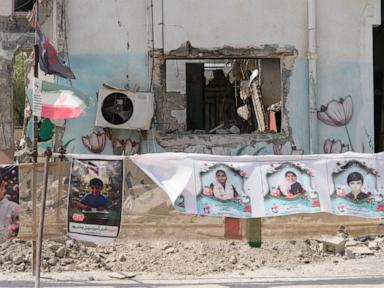
The bright blue gate of the Shajareh Tayyebeh school in Minab still bears the cheerful paint of its civilian past: an outline of Iran's map, oversized colored pencils, and faded portraits of literary and scientific icons. Today, that gate opens onto a devastating monument. When the United States and Israel launched coordinated military operations across Iran on February 28, 2026, a strike hit the two-story elementary school in southern Iran, killing more than one hundred students, teachers, and staff. Months later, the gutted facility has been officially transitioned into a war memorial, serving as a haunting testament to the immediate human cost of the conflict while the geopolitical apparatus behind the strike remains largely silent.
For decades, military analysts have tracked how modern air campaigns transition from high-altitude strategic targeting to the messy, localized tragedy of urban collateral damage. Yet few incidents in recent history match the instantaneous devastation recorded at Minab. Local documentation and independent investigations indicate that the strike demolished a massive portion of the building, leaving classrooms frozen mid-lesson. Desks remain half-buried under shattered concrete, and ceilings have pancaked downward, catching notebooks and backpacks in the debris.
The political and institutional aftermath reveals a profound information vacuum. Months after the explosion, the United States administration has refrained from directly accepting responsibility for the strike, and the Pentagon has withheld the release of its internal investigative findings. This institutional opacity has created an unbridgeable chasm between the observable physical evidence on the ground and official military accountability. Open-source imagery analysis and independent reporting from organizations like the Associated Press have pointed directly to the use of U.S.-manufactured ordnance, yet the formal acknowledgment required for legal or moral restitution remains absent.
Minab's ordeal highlights the grim reality of dual-use proximity in modern warfare. Situated in Hormozgan province, the school property previously functioned as a military structure over a decade prior to the incident and sat in geographic proximity to the Sayyid al-Shuhada military complex, which houses regional naval headquarters for the Islamic Revolutionary Guard Corps. However, at the time of the February strike, the facility operated exclusively as a civilian elementary institution split between boys and girls on separate floors. The failure of targeting systems to account for the conversion and civilian occupancy of such structures exposes critical vulnerabilities in pre-strike intelligence validation.
The transformation of the Shajareh Tayyebeh campus into a war museum was spearheaded by local authorities, including Hormozgan Governor Mohammad Ashouri Taziani, as a deliberate effort to preserve the physical wreckage from being cleared away or forgotten. Visitors stepping past the front entrance now navigate a dual reality. Rows of bright, joyful photographs depicting children at birthday parties and school events transition abruptly into stark black banners of mourning.
Just outside the town limits, a dedicated section of Minab's primary cemetery has expanded to accommodate the rows of victims. Families walk quietly across designated plots marked on artificial turf, tending to graves that hold young students, female educators, administrators, and family members who rushed to the scene. Local officials note that recovery efforts were complicated to the point that several bodies remained unrecovered weeks after the initial impact.
The trauma inflicted upon Minab refuses to remain isolated in the past. Recent escalations along Iran's southern coast, marked by additional strikes impacting civilian infrastructure including a wedding gathering, have continually routed new waves of wounded civilians into the town's local hospital. Each fresh influx strains emergency medical capacity and revives the collective grief of the February attack.
By freezing the school ruins in their devastated state, the community has constructed an enduring physical indictment. It stands as a permanent fixture against the sanitization of aerial warfare, ensuring that the faces of the children lost on the first day of the conflict remain visible to anyone willing to look past the official silence.