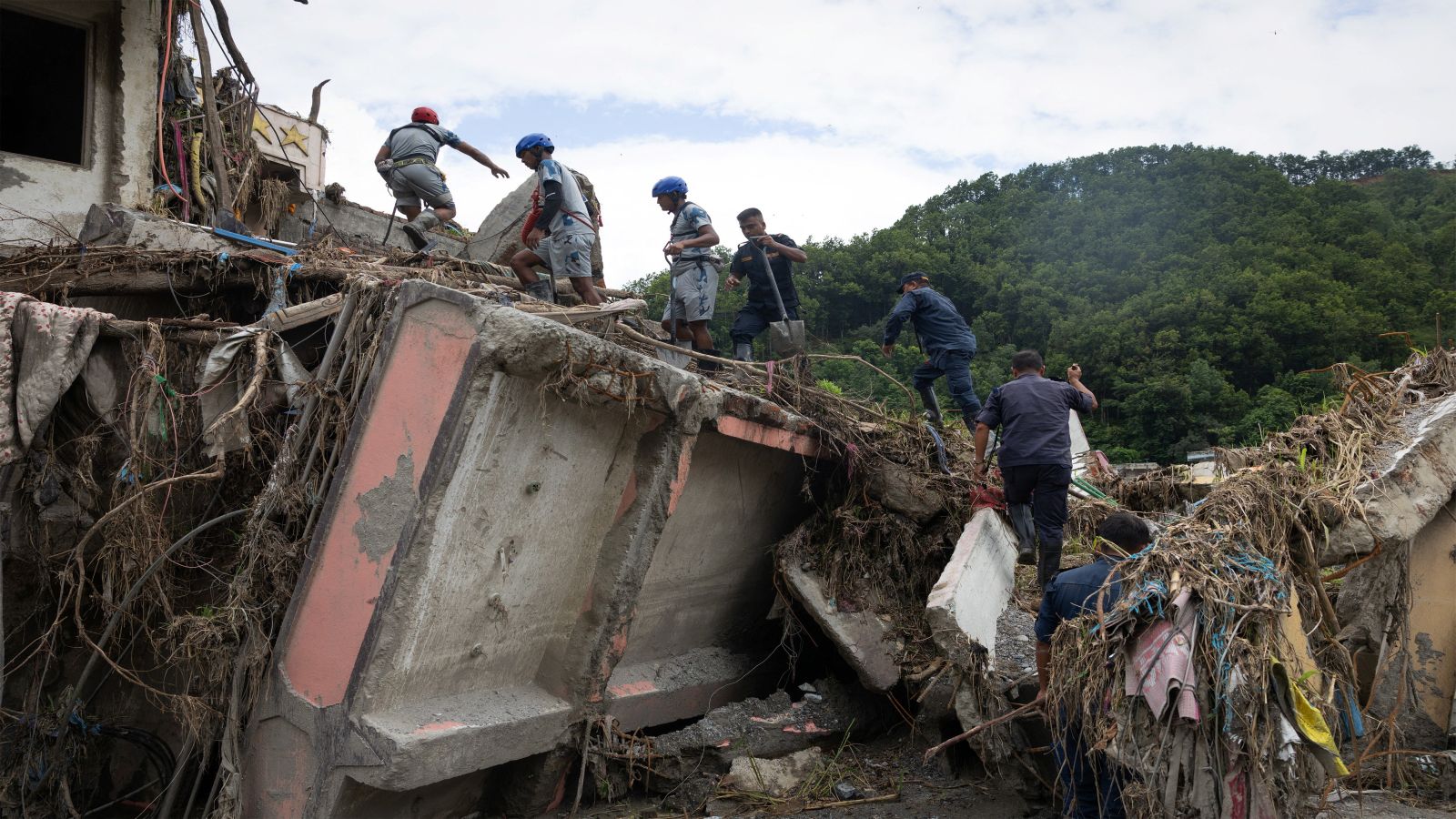
Ten days after an apocalyptic wall of mud and water tore through the Bhotekoshi river basin, the official death toll in Nepal has climbed past 1,300 while nearly 5,000 individuals remain unaccounted for. The catastrophe, triggered by a massive glacial and rock collapse near the border with Tibet on August 26, transformed mountain valleys into concrete-like sludge. Amid the grim geometry of mass graves and overwhelmed morgues, rescue operations have entered a desperate second week.
The crisis involves more than just standard riverine overflow. It represents a total structural failure of high-altitude ecosystems under climate pressure, catching rural settlements and massive infrastructure projects completely unawares. As international specialists from India, China, South Korea, and the United States comb through the wreckage, the operation has shifted from standard emergency response to a grueling subterranean excavation.
The Subterranean Battlegrounds
Attention has concentrated heavily on the dozen hydro-engineering projects scattered across the country's turbulent river corridors. Approximately 900 construction and operations personnel went missing in these zones, with roughly 500 believed trapped inside labyrinthine underground tunnels.
These tunnels acted as concrete traps. When the glacial outburst sent millions of cubic meters of slurry hurtling down the gorges, the entry portals functioned as natural funnels. High-pressure water mixed with heavy boulders, sealing exits and packing interior chambers with dense debris.
Miracles do occur in the rubble, though they remain statistically rare. Joint teams of domestic military personnel and foreign disaster technicians pulled a Chinese worker alive from a 225-meter tunnel at the Upper Trishuli-1 project after more than a week underground. In a separate operation in Nuwakot, a 64-year-old local woman was extracted from her half-buried home just as her relatives began final mourning rituals, having survived ten days in an air pocket beneath hardened silt.
These extractions provide emotional fuel for exhausted crews, yet the physical reality inside the tunnels grows more grim by the hour. Oxygen levels deplete, structural integrity deteriorates, and water pockets threaten secondary collapses.
The Logistics of Identification
Finding the missing is only half the battle for disaster response units. Recovered bodies present an unprecedented logistical nightmare for forensic teams.
Submerged in abrasive glacial silt for days or weeks, a significant portion of the recovered dead are severely decomposed or fragmented. Local authorities report that hundreds of bodies have been pulled from rivers miles downstream from their points of origin, making visual identification nearly impossible.
Morgues across central districts reached total capacity within the first forty-eight hours. To prevent public health hazards, authorities initiated emergency protocols, burying over a thousand unidentified victims in mass graves after extracting DNA profiles.
Families now queue outside district police offices and specialized medical centers in Kathmandu to submit genetic samples. This centralized matching process offers the only reliable path to closure for thousands of households whose members vanished without a trace during the morning hours of the avalanche.
Cascading Failures and Vulnerable Infrastructure
The physical geography of the Himalayas makes rapid response exceptionally difficult. More than forty major bridges were sheared off or completely submerged during the initial surge. Roadways carved into cliff sides have collapsed into chasms, isolating entire village clusters from mechanical aid.
Relief delivery relies heavily on rotary-wing aircraft, but unpredictable weather patterns frequently ground air support. Heavy monsoon rains and secondary blockages continue to plague the region. In the Gorkha district, the Namrung Khola river temporarily dammed before bursting its banks, sending a secondary flash flood that swept away remaining suspension bridges and forced immediate evacuations along downstream banks.
This vulnerability exposes a fundamental flaw in regional development models. The rapid expansion of high-yield hydropower installations along narrow river corridors brought economic investment, but it also concentrated large numbers of workers directly inside high-risk geological pathways. When the upper glacier gave way, the design safety margins of these engineering assets proved inadequate against an unmitigated wall of glacial mass.
International appeals, including a multi-million-dollar emergency push coordinated through the United Nations, aim to stabilize tens of thousands of displaced residents currently sheltered in temporary camps. Yet temporary shelters cannot substitute for permanent housing or restore the agrarian economies wiped out beneath layers of stone and mud.
The operation continues under blowing whistles and heavy excavation machinery in the river basins. Teams listen intently for faint sounds beneath the gray crust, working against the clock as the physical window for human survival closes entirely.