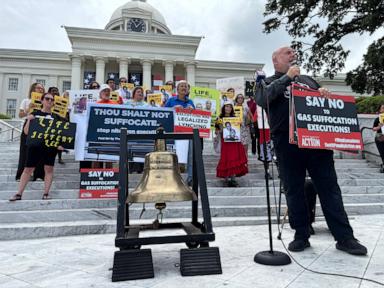
The modern execution chamber was supposed to be clinical, quiet, and legally bulletproof. Instead, Alabama has turned it into an unpredictable laboratory. The state’s aggressive legal scramble to salvage its nitrogen hypoxia execution protocol is not merely a localized procedural dispute; it represents the fracture point of America's capital punishment apparatus. By appealing to the U.S. Supreme Court after a federal judge permanently blocked the execution of death row inmate Jeffery Lee, Alabama is trying to preserve a method that federal jurists have now explicitly labeled unconstitutionally cruel.
The core issue is no longer whether a state has the right to execute, but whether it can force a condemned person to undergo several minutes of conscious suffocation under the guise of progress.
On Tuesday, U.S. District Judge Emily Marks issued a permanent injunction barring Alabama from using its nitrogen gas protocol to execute Lee. This ruling followed a dramatic reversal by a three-judge panel of the 11th U.S. Circuit Court of Appeals. The appellate court took the lower court’s own factual findings and applied a harsher, more realistic constitutional calculus. The courts determined that Alabama’s protocol inflicts "severe air hunger" and profound emotional and physical distress for a period of one to three minutes before an inmate loses consciousness. Under the Eighth Amendment, this multi-minute window of acute panic constitutes an intolerable risk of serious harm.
The Reality of Air Hunger
For years, proponents of nitrogen hypoxia sold the method as a peaceful alternative to lethal injection. The narrative was simple. Nitrogen is an inert gas; breathe it in, pass out quietly, and die without pain.
That narrative collapsed under the weight of expert testimony and eyewitness accounts from the eight executions carried out using this method across Alabama and Louisiana since early 2024.
When a human being is forced to breathe pure nitrogen through a sealed respirator mask, the body does not simply slip away. The brain possesses highly sensitive chemoreceptors that detect oxygen deprivation and carbon dioxide shifts. When oxygen drops precipitously while the individual remains conscious, it triggers a primal survival mechanism known as air hunger.
Expert testimony presented during a three-day bench trial in Montgomery detailed this phenomenon. Air hunger activates the deepest survival instincts of the brain. It generates an overwhelming sensation of suffocation, accompanied by intense anxiety, physiological stress, and acute panic. The district court recognized that many individuals experience air hunger as something far worse than physical pain because it is directly tied to the terror of drowning or choking while entirely helpless.
Eyewitnesses to Alabama’s early experiments with nitrogen gas, including spiritual advisers who stood inches from the condemned, reported seeing inmates heave against their restraints, gasp frantically, and convulse for minutes before going still. The 11th Circuit noted that counting to 60 or 180 seconds might seem brief on paper, but experiencing conscious suffocation for that duration is a constitutional eternity.
The Paradox of the Firing Squad Alternative
To challenge an execution method successfully under current Supreme Court precedent, an inmate cannot simply prove that the state's chosen method is cruel. They must also provide a feasible, readily available alternative.
Jeffery Lee offered an alternative that highlights the strange, cyclical history of American capital punishment: the firing squad.
Judge Marks ruled that the firing squad is feasible and significantly reduces the substantial risk of serious harm posed by nitrogen gas. She noted that Alabama could easily obtain the necessary rifles, ammunition, and specialized training, and could modify existing space at Holman Prison to accommodate the method.
This creates a stark judicial paradox. A federal court has essentially determined that shooting an inmate through the heart with high-velocity rifles is more humane and less unconstitutionally cruel than the state's newly minted, high-tech gas protocol.
Alabama has resisted this shift. State officials argue that the firing squad is not an authorized method under state law, which currently permits lethal injection, electrocution, and nitrogen hypoxia. However, the court found that the state failed to provide a legitimate penological reason to reject the firing squad when faced with the constitutional deficiencies of its nitrogen mask system.
The Collapse of Judicial Override
The litigation surrounding Jeffery Lee also unearths an older, deeply controversial chapter in Alabama’s judicial history. Lee was convicted for his role in a 1998 robbery that left two people dead. At his trial, the jury weighed the evidence and voted 7 to 5 to recommend a sentence of life imprisonment without the possibility of parole.
Under a unique statutory mechanism known as judicial override, the trial judge chose to ignore the jury’s recommendation and unilaterally imposed the death penalty.
Alabama was the last state in the nation to abandon this practice, officially outlawing judicial override in 2017. The repeal, however, was not retroactive. Inmates like Lee remained on death row despite having a jury explicitly reject their execution. This legacy of judicial overreach creates an uncomfortable backdrop for Attorney General Steve Marshall’s current campaign to push forward with an experimental execution method.
Why Lethal Injection Failed
To understand why Alabama is fighting so desperately for nitrogen gas, one must look at the total breakdown of the previous standard: lethal injection.
For decades, three-drug cocktails were the default method across the United States. That system collapsed due to two main factors.
- Pharmaceutical Boycotts: European and domestic drug manufacturers banned the use of their products in executions, cutting off the supply of sodium thiopental and pentobarbital.
- botched Procedures*: Execution teams, often consisting of under-trained prison staff rather than medical professionals, routinely failed to establish intravenous lines.
Alabama gained national notoriety for a series of botched lethal injections where staff spent hours puncturing inmates' arms and groins in failed attempts to insert IV lines. The state briefly paused executions in 2022 to conduct a top-to-bottom review.
Nitrogen gas was supposed to be the escape hatch from this pharmaceutical and operational bottleneck. It required no medical expertise to find a vein, and the gas itself is widely available for industrial purposes. By declaring the nitrogen protocol unconstitutional, the federal courts have effectively trapped the state in a corner. If lethal injection is unviable due to supply chains and incompetence, and nitrogen is unconstitutional due to inherent cruelty, the state's capital punishment machinery grinds to a halt.
The Path to the Supreme Court
The Attorney General’s office quickly filed an appeal to the U.S. Supreme Court, seeking to overturn the permanent injunction. The state’s legal strategy hinges on a harsh but accurate reading of past Supreme Court opinions. The Constitution does not guarantee a painless death.
The conservative majority on the high court has historically shown immense deference to state sovereignty in capital cases. They have repeatedly cleared the way for Alabama’s previous nitrogen executions to proceed, often over blistering dissents from the liberal minority.
The current legal battle is different because it rests on an explicit factual record established during a full federal trial. The 11th Circuit did not change the law; it accepted the lower court’s factual finding that nitrogen causes conscious, terrifying suffocation for up to three minutes, and ruled that this specific reality crosses the line into cruelty.
If the Supreme Court chooses to intervene and lift the injunction, it will have to explicitly declare that three minutes of conscious air hunger and panic is an acceptable cost for the state to exact. If the court refuses to intervene, Alabama’s premier execution method is effectively finished, forcing a broader re-evaluation of how, or if, the state can kill its citizens. The state is running out of options, running out of drugs, and now, running out of constitutional cover.


