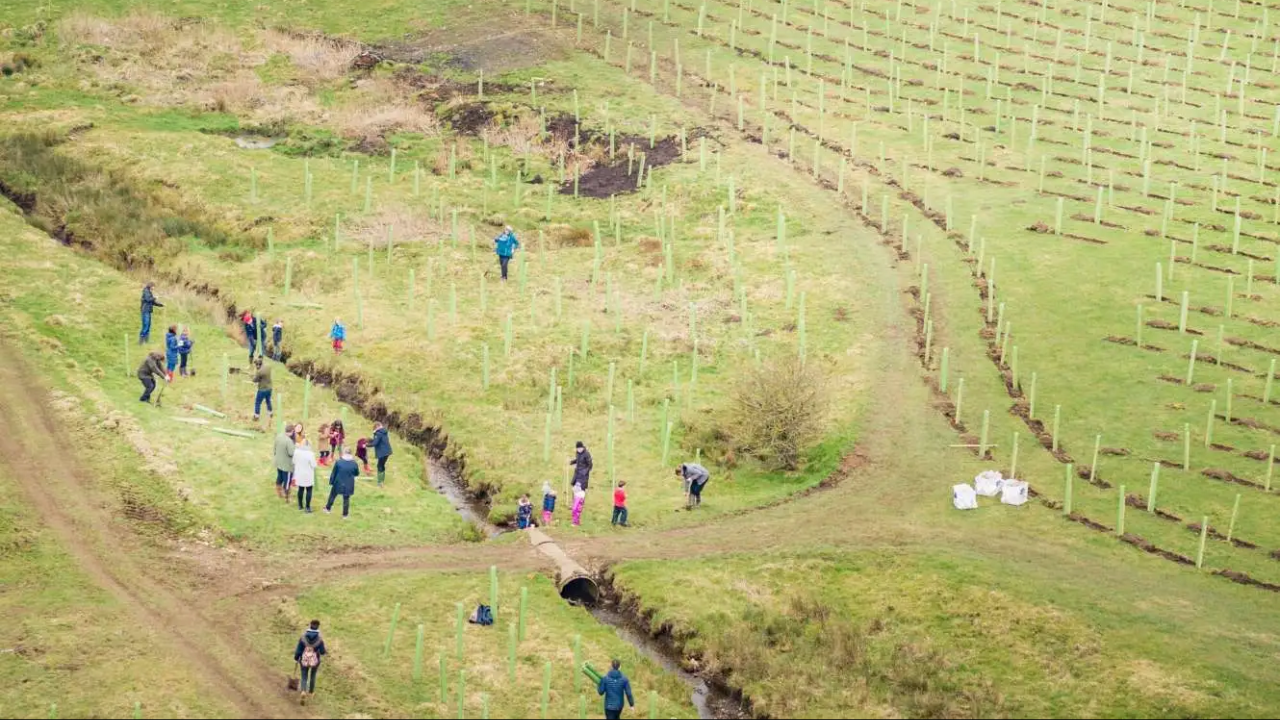
Four years ago, the dirt across two thousand five hundred acres of North Yorkshire felt the heavy, compacted weight of industrial monoculture pasture. Today, that same soil at the Broughton Sanctuary near Skipton breathes differently. Over three hundred and thirty thousand trees now puncture a horizon that was once aggressively managed for intensive sheep grazing. More than one thousand seven hundred species have been documented returning to the estate, creating a blueprint for ecological recovery that strips away the romantic varnish often applied to environmental journalism.
This is not an abstract philosophy exercise. It is a calculated, multi-million-pound land management pivot away from intensive agriculture toward a hybridized model of rewilding and regenerative farming. Anyone tracking European land use trends needs to understand what happened here, because the results challenge every cynical assumption about how quickly nature can rebound when human intervention shifts from chemical dominance to structural facilitation.
The Mechanics of the Recovery
To grasp the magnitude of the change across this historic English estate, one must look below the surface. Soil compaction is the silent killer of agricultural land. Decades of heavy livestock trampling and artificial fertilizers turn topsoil into something resembling brick, choking out subterranean microbial communities and sealing out rainwater.
Estate managers did not simply walk away and hope for the best. True environmental restoration requires active management in its early phases. Conservation teams removed seventeen kilometers of interior fencing to let wildlife roam without artificial boundaries. They brought in fifty-seven Riggit Galloway cattle, alongside small numbers of Dales ponies, roe deer, and iron-age pigs.
These animals are not here for commercial beef production in the traditional sense. They are ecosystem engineers. The rooting behavior of the pigs breaks open compacted clay, exposing dormant seedbanks that have lain hidden for generations. Meanwhile, the cattle graze without chemical wormers or routine medications, depositing organic matter that feeds dung beetles, which in turn pull nutrients back into the dirt.
The botanical response was immediate. Species like bird's-foot trefoil, creeping cinquefoil, and common eyebright reappeared in the freshly disturbed earth. When you stop treating soil like a chemical manufacturing plant, it remembers how to function.
The Return of the Apex Predators and Raptors
The most striking metric from the recent estate audit is avian recovery. All five native British owl species now inhabit the sanctuary. Short-eared owls, absent as breeding residents for decades, have established nests following an explosion in the small mammal population.
This is a direct consequence of structural changes in the flora. By allowing rank, unmanaged grasses to accumulate instead of keeping pastures shaved to the root by dense sheep stocking, the estate created a labyrinth for field voles. Voles attract kestrels, peregrine falcons, and barn owls. Nesting boxes installed by specialists recorded dozens of healthy chicks reaching maturity even through volatile weather patterns, proving that food web integrity repairs itself rapidly once the foundational layer of insects and rodents stabilizes.
Yet, this transformation exposes a stark economic friction point that mainstream reports often gloss over. Transitioning twenty-five hundred acres out of intensive agricultural subsidies means confronting local food security concerns and cultural inertia. Farming communities in the Yorkshire Dales have farmed sheep for centuries. Asking them to embrace rewilding requires economic proof, not just ethical appeals.
The Financial and Structural Realities
Projects of this scale cannot survive on philanthropy alone. Funding came primarily through government mechanisms like the Trees for Climate program, administered via the White Rose Forest. Planting nineteen native broadleaf species across four hundred hectares acts as a natural flood management system. By slowing water runoff before it hits the River Aire valley, the sanctuary protects downstream urban infrastructure in Leeds and Skipton from catastrophic weather events.
This turns environmental stewardship into municipal infrastructure defense. Instead of spending millions on concrete flood walls downstream, investing capital upstream into natural water retention and beaver-engineered wetland scrapes yields a higher return on investment for taxpayers. The beaver family reintroduced to the estate has done more to engineer stable watercourses in four years than a team of civil engineers could achieve with heavy machinery.
Still, the model faces distinct vulnerabilities. Extended spring droughts, such as the one recorded across northern England, temporarily suppress vole reproduction, sending ripple effects straight up the raptor food chain. Nature is resilient, but it is not immune to broader climatic volatility. Restoring an ecosystem does not insulate it from a warming planet; it merely gives the local flora and fauna a fighting chance to adapt.
The Path Forward
The next ten-year phase for the Broughton Sanctuary involves deeper interventions. Plans include reintroducing the harvest mouse, expanding native scrub cover, and systematically stripping out invasive non-native species like rhododendron from older woodlands.
The success of these two thousand five hundred acres serves as an uncomfortable mirror for traditional landowners across Europe. It demonstrates that intensive farming models are a choice, not an absolute economic necessity. When private capital, government woodland initiatives, and ecological pragmatism align, the land responds with an astonishing velocity of life.
The old ways of managing the countryside are colliding with an intractable ecological debt. North Yorkshire just proved that paying down that debt is entirely possible.