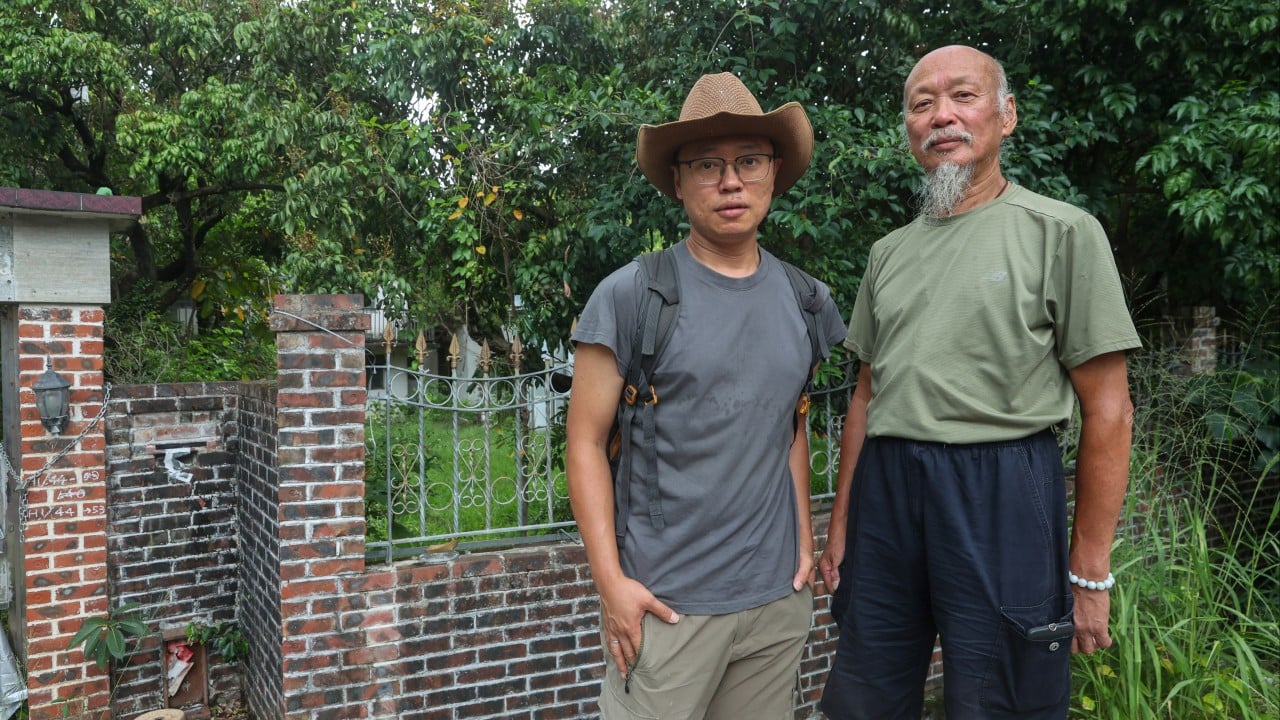
A quiet war of attrition is playing out along Hong Kong’s northern frontier, where the global financial hub’s high-density urban future is crashing directly into its deeply rooted rural past. The government's ambitious Northern Metropolis mega-project aims to house millions and anchor a tech-driven integration with Shenzhen, but the immediate casualty is a network of centuries-old villages. In places like Yick Yuen Tsuen in Tuen Mun, long-time residents facing imminent eviction are turning to unconventional, desperate measures to preserve what little they can. Ken Mak, a local villager slated for displacement, recently launched an "adopt a tree" initiative to save dozens of mature fruit trees planted by his grandfather before government bulldozers clear the land.
This grass-roots campaign highlights a glaring, systematic flaw in Hong Kong’s massive urban renewal strategy. While bureaucrats calculate compensation packages and housing estates in square meters, they consistently fail to account for the irreplaceable ecological and cultural capital embedded in the New Territories. The forced relocation of rural communities does not just displace people; it erases a living, generational connection to the land that high-rise public housing blocks simply cannot replicate.
The Illusion of Public Interest Rehousing
The official narrative surrounding the Northern Metropolis frames the clearance of these villages as a necessary sacrifice for the greater good of Hong Kong's housing crisis. Government agencies point to modern public rental housing units and cash allowances as fair compensation for those uprooted. Yet, for lifelong villagers, this exchange is fundamentally unequal.
[Traditional Village Living]            [High-Rise Public Housing]
- Generational land ties                 - Uniform, vertical units
- Open-air agriculture & canopy          - Strict space limitations
- Communal, horizontal networks          - Isolated urban grid
The transition from a horizontal, open-air community to a vertical, highly regulated urban flat breaks social safety nets that have existed for decades. Elderly residents, who rely on the daily rhythms of tending small plots and interacting with neighbors across low-rise alleyways, frequently experience severe psychological distress when moved to dense urban high-rises.
Furthermore, the eligibility criteria for rehousing are notoriously rigid. Families often find themselves disqualified from nearby public housing estates due to bureaucratic technicalities regarding household income thresholds or proof of continuous residence. This forces split-family arrangements and pushes vulnerable individuals into the private market, where they frequently end up in the city's notorious subdivided flats. The policy aims to solve a housing crisis, but for the people living in the path of development, it frequently creates a new one.
The Ecological Ledger No One is Balancing
Beyond the human toll lies a significant environmental deficit that the government's "sponge-city" rhetoric fails to address. The Lands Department treats village structures and surrounding flora as mere obstacles to be cleared during site formation. Trees like those on Mak's ancestral plot—mature lychee, longan, and wampee trees—provide immediate microclimate cooling, carbon sequestration, and local biodiversity habitats.
Independent ecological assessments show that mature village canopies can lower localized maximum temperatures by up to 6°C. When these areas are bulldozed and replaced by concrete foundations, that natural cooling effect vanishes completely. The government promises to plant new saplings once construction concludes, but a newly planted sapling takes decades to match the ecological output of a mature tree.
The "adopt a tree" bid is a heroic but deeply flawed fallback measure. Uprooting, transporting, and replanting mature fruit trees requires specialized arboricultural expertise and significant funding. Without institutional support, the survival rate of transplanted trees drops sharply. By shifting the burden of environmental preservation onto cash-strapped, evictee volunteers, the state effectively abdicates its responsibility toward urban conservation.
Bureaucratic Inflexibility and the Missing Middle Ground
The core structural failure of the Northern Metropolis rollout is the complete absence of a middle ground between total preservation and total demolition. Land policy in Hong Kong operates on a binary model. The government either declares an area a protected country park or resumes it entirely for high-density development.
+-------------------------------------------------------------------+
|               HONG KONG LAND RESUMPTION PARADIGM                  |
+-------------------------------------------------------------------+
|  CURRENT MODEL:                                                   |
|  [Rural Village] ----> [Total Clearance] ----> [High-Rise Blocks]  |
|                                                                   |
|  PROPOSED INTEGRATION MODEL:                                      |
|  [Rural Village] ----> [In-Situ Preservation]                     |
|                        [of Low-Rise Green Pockets]                |
|                        ----> [Integrated Urban Canopy]            |
+-------------------------------------------------------------------+
Urban planners could easily integrate existing village infrastructure, historic trees, and low-rise layouts into the blueprints of the new mega-district. Doing so would create diverse, climate-resilient urban spaces that honor the history of the New Territories. Instead, the current strategy favors a blank-slate approach. Sizable land parcels are granted to consortia for collective development because it is cheaper and faster to clear everything first and design from scratch.
This short-term economic efficiency comes at a massive long-term cost. It strips the Northern Metropolis of any distinct cultural identity, turning it into a sterile extension of the existing urban sprawl. The resistance mounted by villagers like Mak is not merely an emotional reaction to losing a home. It is a rational, frantic defense of a sustainable way of life that is being systematically erased by an inflexible planning apparatus.
The bulldozers arriving in Tuen Mun this month will clear more than just older homes and fruit trees. They will permanently dismantle a distinct piece of Hong Kong's cultural heritage, proving that the city has yet to learn how to build its future without destroying its past.