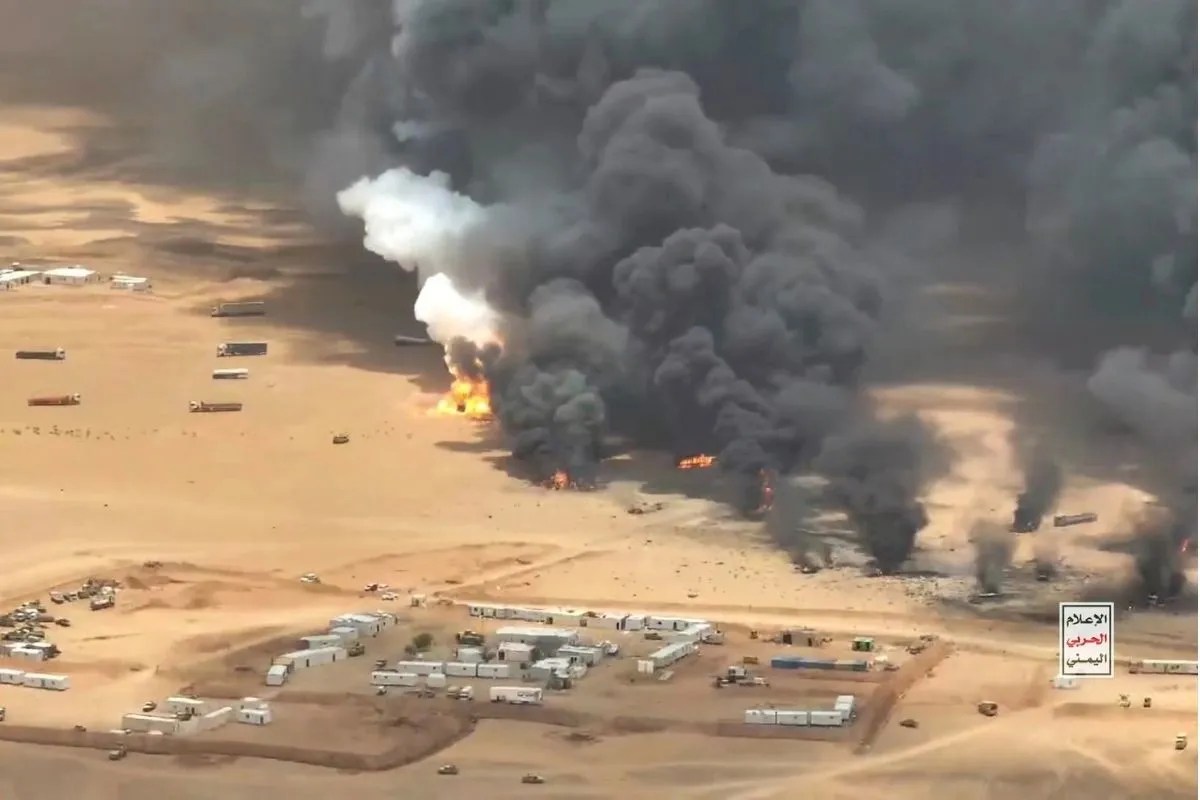
The smoke rising near the perimeter of King Khalid International Airport was not merely the aftermath of a localized military interception. It was a structural rupture in the security architecture of the Arabian Gulf. When ballistic missiles and explosive drones began piercing the airspace above Riyadh, breaching the protective umbrella that the Saudi-led coalition spent decades constructing, the illusion of insulated economic transformation vanished overnight.
For years, foreign reporting on the kingdom treated regional hostilities as a contained border skirmish. Wire services filed brief dispatches about interceptions over empty desert spaces, projecting an image of high-tech defense mechanisms operating with quiet surgical precision.
The reality unfolding on the tarmac of the capital's primary aviation hub is far messier. Consecutive strikes, culminating in terminal damage, flight suspensions, and tragic civilian casualties, have forced a brutal reckoning across corporate boardrooms and diplomatic missions.
The Limits of Modern Interception Architecture
Air defense is often framed in absolute terms by state media. Batteries of Patriot and advanced surface-to-air systems are described as impenetrable shields.
Yet defense analysts looking at telemetry data and ground impacts recognize a sobering constraint of physics and economics. A defensive posture relies on asymmetric math. A low-cost loitering munition or an upgraded ballistic variant costs a fraction of the interceptor missile required to stop it.
When sustained salvos target high-value civilian infrastructure like King Khalid International Airport or adjacent energy nodes, the strain on supply chains and battery reload cycles escalates exponentially.
The October strikes demonstrated that even when air defense units successfully neutralize incoming threats, falling debris or saturation tactics can yield catastrophic ground-level consequences.
Terminal concourses designed for seamless passenger transit transformed into evacuation zones. Major international carriers reacted swiftly, suspending routes as risk assessments plummeted. Insurance underwriters, whose calculations dictate the flow of global commerce, immediately reassessed regional risk premiums. A hub airport cannot function as a global crossroads if the ground beneath commercial aircraft is treated as a strategic artillery range.
The Strategic Calculus of the Houthi Escalation
To understand why Riyadh has become a recurring target, one must examine the shifting military capacity and strategic incentives of the Houthi movement in Yemen. Long dismissed by early coalition planners as a disorganized militia, the group has evolved into a force fielding indigenous ballistic missiles and long-range cruise capabilities.
Their operational tempo is no longer reactive. By bringing the war directly to the doorstep of the Saudi capital, the movement applies severe political and economic pressure on the kingdom's leadership.
Economic diversification plans depend entirely on investor confidence, foreign talent acquisition, and uninterrupted tourism. Images of smoke billowing near financial districts and international flight corridors directly challenge the narrative of domestic stability.
When diplomatic channels stall and ground offensives in Yemen shift boundaries, strategic infrastructure deep inside Saudi territory becomes the primary pressure valve.
The timing of these campaigns correlates directly with broader geopolitical friction points across the Middle East. As multiple actors test red lines from the Red Sea to the Gulf, the security of civilian aviation has turned into a strategic pawn.
Foreign embassies in Riyadh have shifted from routine travel advisories to urgent operational alerts, advising citizens to minimize non-essential movements near transport hubs. This posture reflects a deep-seated anxiety among Western and Asian diplomats who watched civilian casualties mount from shrapnel and direct impacts.
The Diplomatic Trap and the Road Ahead
The leadership in Riyadh faces a narrow and punishing corridor of choices. Retaliation risks reigniting a full-scale regional conflagration that the kingdom has spent years attempting to exit through diplomatic engagement. Yet restraint risks signaling vulnerability, inviting further salvos from an adversary that views restraint as tactical weakness.
The security apparatus is now forced to adapt on multiple fronts simultaneously. Upgrading point-defense systems with directed-energy solutions or specialized close-in weapon systems is a multi-year engineering challenge.
Physical hardening of civilian terminals and fuel depots requires massive structural overhauls that disrupt daily operations. Meanwhile, the human cost continues to reverberate far beyond the Middle East. Families of expatriate workers, including victims from South Asia and various parts of the globe, are left demanding answers from consular offices as repatriation logistics unfold under emergency conditions.
The crisis at the capital's airport is not an isolated aviation mishap. It is a visceral reminder that modern geopolitical conflicts cannot be walled off from globalized economic centers.
As long as the underlying political settlements in Yemen remain unresolved, the skies above the Gulf will remain a high-stakes theater where technological sophistication meets unyielding tactical persistence. The sirens echoing near the perimeter fence have permanently altered how the world calculates safety in the heart of the Arabian Peninsula.