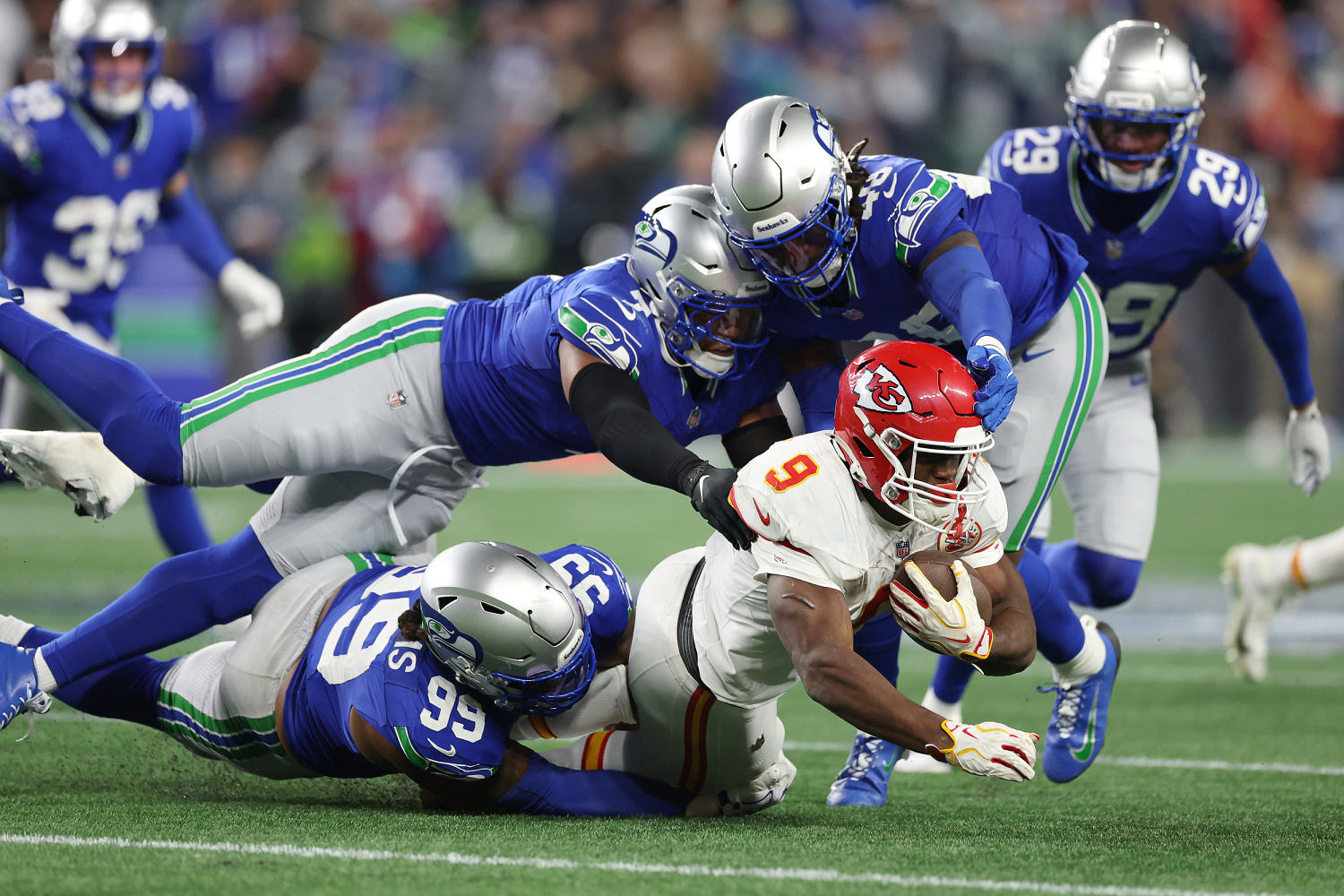
When the Seattle Seahawks defense held Patrick Mahomes and Kenneth Walker III to three points in a 20-3 win on October 25, 2026, the result handed the Kansas City Chiefs their first loss of the season. More than a box-score shock, it exposed how a disciplined front and disciplined spacing can turn a high-octane offense into a stalled drive machine.
A surface recap calls it a blowout. Film and roster context tell a sharper story.
Walker walked back into Lumen Field wearing Kansas City red after spending his first four NFL seasons in Seattle—and after winning Super Bowl LX MVP honors in a Seahawks uniform following the 2025 postseason. Entering the night at an MVP pace of 133.0 rushing yards per game, he finished with 36 rushing yards on 14 carries and zero touchdowns, snapping an 11-game streak of at least 50 rushing yards including playoffs. Mahomes was held without a touchdown pass, marking just the second full game of his career in which Kansas City failed to score a touchdown.
Why the Box Score Only Tells Half the Story
Box scores love clean lines. Football rarely gives them.
Kansas City came into Seattle averaging 28 points per game and more than 400 yards per contest. Against Seattle, the Chiefs gained just 213 yards. That drop-off did not happen by accident, nor did it happen in a vacuum.
Watch enough NFL tape over three decades and you learn to separate schematic execution from personnel timing. Seattle's defense—coached under Mike Macdonald—played with sharp run fits and sideline-to-sideline pursuit. Safety Nick Emmanwori and linebacker Ernest Jones IV set a clear tone: stop Walker, shrink the field, and force Mahomes to earn every yard through tight windows.
Yet context matters just as much as scheme. Kansas City was also dealing with offensive absences, including Rashee Rice and Tyquan Thornton out of the lineup, leaving Mahomes leaning heavily on Xavier Worthy and Travis Kelce. Missing top-end perimeter threats changes how defenses play coverage. When a quarterback lacks his full menu of vertical and intermediate separators, defenders can sit on underneath routes and commit extra eyes to the run game without paying the usual deep-ball tax.
That does not excuse Kansas City's stagnation. It explains why a premier offense looked strangely cramped for four quarters.
How Seattle Bottled Up Kenneth Walker III
Stopping Kenneth Walker III requires more than hitting a gap. You have to take away his vision and lateral restart.
Walker thrives when he can press a crease, make a linebacker declare, and plant his foot to bounce outside. In Seattle, the Seahawks refused to let him get clean second-level angles. Defenders flowed fast to the perimeter and stayed disciplined in their lanes, turning potential 8-yard bounces into 2-yard gains.
Emmanwori put the mindset plainly after the game: holding Walker under 100 rushing yards was a personal and collective mission for the defense. When a defense treats a running back like a primary passing threat—assigning extra run-fit responsibility and rallying on first contact—the offense feels heavy. Every first down becomes a grind.
Consider a hypothetical example of how that shifts play-calling. If an offense expects 4.5 yards per carry on early downs, it can keep third-and-manageable open. When early runs gain 1 or 2 yards repeatedly, the playbook narrows, play-action loses teeth, and the defense pins its ears back on third down.
Seattle did not need exotic blitzes on every snap to create that friction. Sound gap integrity paired with fast pursuit did the heavy lifting.
Constraining Patrick Mahomes Without Losing Containment
Defending Patrick Mahomes has always been a geometry problem. Rush four recklessly and he slides out of the pocket to punish open grass. Drop everyone deep and he dinks-and-dunks down the field for ten minutes.
Seattle's approach leaned on discipline and speed in space. When Mahomes pulled the ball down to scramble, defenders did not panic or over-pursue past his launch point. Emmanwori noted afterward that chasing Mahomes down when he tried to run helped force him into a bad throw—a telling detail about how Seattle's athletic profile matched up on the edges.
Key Drivers Behind the 20-3 Result
- Early-down run suppression: Limiting Walker to 36 yards on 14 carries kept Kansas City out of comfortable second-and-short situations.
- Scramble containment: Keeping Mahomes from turning broken plays into explosive chains forced tougher throws under pressure.
- Offensive clock control: Seattle's offense converted 11 of 16 third downs and held the ball for nearly 36 minutes, punctuating the night with only two punts.
The Hidden Multiplier: Time of Possession and Third Downs
Great defenses still break if the offense cannot stay on the field. Ask any defensive coordinator who has watched his unit play 75 snaps in humid weather or loud road environments.
In this matchup, Seattle's offense gave its defense the ultimate gift: rest and field position. By converting 11 of 16 third downs and possessing the ball for nearly 36 minutes while punting just twice, Seattle tilted the entire rhythm of the game.
Think about what that does over four quarters. Kansas City's defense stayed on the field longer, while Kansas City's offense got fewer possessions to find rhythm. Even a great quarterback struggles to build momentum when he is watching the game from the bench for two-thirds of the night.
Game Snapshot at a Glance
| Metric or Factor | Observed Detail | Analytical Takeaway |
|---|---|---|
| Final Score | Seattle 20, Kansas City 3 | First Chiefs loss of the season |
| Chiefs Total Offense | 213 yards | Well below K.C.'s ~400+ yard entering pace |
| Kenneth Walker III | 14 carries, 36 yards, 0 TD | Ended 11-game streak of 50+ rush yards |
| Seahawks Third Downs | 11-for-16 (~36 min TOP) | Kept Seattle's defense fresh and K.C.'s offense waiting |
Overlooked Factors and Honest Caveats
Any honest breakdown has to weigh counter-arguments. One big game in October does not crown a dynasty or permanently break a perennial contender.
First, regular-season statements are snapshots, not verdicts. Kansas City entered the night at a high scoring clip and remained a serious postseason threat despite the loss. Offenses evolve across a 17-game schedule, especially once key skill players return or protections adjust.
Second, defensive dominance carries a hidden cost. High-effort, aggressive pursuit defenses demand heavy rotation and clean health along the front seven and secondary. One injury to a key tackler or coverage piece can turn a tight edge into a wide-open lane against a quarterback as sharp as Mahomes.
Third, narrative magnetism can distort evaluation. Facing a former teammate who just won Super Bowl MVP makes for compelling television. Yet coaches care less about revenge storylines than about replicable habits—tackling in space, communicating post-snap rotations, and winning situational downs.
What This Blueprint Means for Both Sides
For Seattle, the formula is clear but demanding: pair disciplined run fits with sustained offensive drives so the defense never plays exhausted. When the offense converts on third down, the entire roster plays taller.
For Kansas City, the lesson is equally straightforward: protect early-down efficiency, diversify target distribution when top wideouts are sidelined, and refuse to let a stingy front dictate tempo. One cold night in Seattle does not erase Mahomes's pedigree or Walker's explosiveness, but it proved that even the league's sharpest attacks stall when space disappears and the clock runs against them.