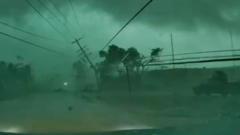
Dashcam footage capturing a tornado tearing down live power lines directly onto a moving car offers a terrifying glimpse into severe weather hazards. When high winds hit utility corridors, drivers face instant entrapment inside thousands of volts of live electricity. The immediate physical danger is severe, but the structural vulnerabilities that lead to these events are rarely discussed. Understanding how power grids fail during extreme weather events, how high-voltage electricity behaves around passenger vehicles, and what critical survival steps prevent electrocution can mean the difference between life and death on the road.
Every year, severe convective storms rip through regional electrical infrastructure. Overhead distribution lines, often mounted on aging wooden utility poles, are particularly susceptible to severe downdrafts and tornadic winds. When a vortex hits a transmission corridor, the structural integrity of the line degrades in milliseconds. Cables snap under dynamic load stresses, bringing down live wires, transformers, and heavy timber poles across active roadways.
For an unsuspecting driver, this situation turns a commuter vehicle into a potential electrical hazard in an instant.
The Physics of Vehicle Electrocution and the Faraday Cage Effect
A common misconception among motorists is that rubber tires act as an insulator against downed power lines. Rubber does provide resistance at lower voltages, but high-voltage distribution lines carry anywhere from 4,000 to over 34,000 volts. At those energy levels, the dielectric strength of standard tire rubber is completely bypassed. Electricity easily arc-flashes across the tire surface or burns straight through the material to reach the ground.
What actually protects passengers inside a trapped car is the Faraday cage effect.
Modern automobiles are constructed with conductive steel and aluminum exterior shells. When a live conductor falls across the roof or hood, the electric charge travels along the outside metallic frame of the vehicle, dispersing down into the earth through the tires or moisture on the ground. The interior cab remains at a uniform electrical potential.
Danger arises when a person attempts to break that enclosed potential.
The Thermal Hazard Inside the Cabin
While the interior occupant is shielded from direct electrocution, secondary risks materialize immediately.
- High-current electrical arcing generates extreme thermal energy, capable of igniting vehicle body paint, structural glass seals, and engine fluids within seconds.
- Molten aluminum and copper can drip from the overhead line onto the windshield, compromising the cabin structural integrity.
- Rubber tires subjected to direct electrical currents heat up rapidly from the inside out, leading to tire fires or explosive structural failures.
The vehicle protects you from high voltage, but it slowly succumbs to extreme thermal load. Managing this paradox requires calm execution of critical emergency protocol.
Structural Vulnerabilities in Overhead Grid Infrastructure
The recurring nature of these roadway emergencies highlights a broader systemic problem. Electrical grid architecture across vast stretches of suburban and rural roadways relies heavily on overhead radial distribution.
Grid operators face immense financial and logistical hurdles when upgrading these systems. Direct burial of utility lines costs roughly five to ten times more per mile than overhead construction. In rocky terrain or high-water-table regions, underground distribution becomes even more cost-prohibitive. As a result, millions of miles of medium-voltage power lines remain completely exposed to severe atmospheric events.
Automated line reclosers present another hidden danger to motorists trapped under fallen infrastructure.
A recloser is essentially a high-voltage circuit breaker equipped with automatic timing logic. When a branch or fallen pole causes a temporary fault, the recloser shuts off power for a split second, then automatically re-energizes the line to check if the fault has cleared. If a downed wire rests on a vehicle, a recloser may attempt to energize that wire two or three times over a 60-second window before finally locking out.
A vehicle that appears safe and unpowered one second can suddenly become live again without warning.
How to Survive a Downed Power Line Incident
Surviving an encounter with active electrical infrastructure requires immediate counterintuitive action. Standard instinct tells a driver to exit a damaged, burning, or crushed vehicle immediately. In a high-voltage scenario, stepping out normally is often fatal.
Step 1 Stay Inside the Vehicle
Unless an active, unmanageable fire threatens the passenger compartment, your safest location is inside the car. Do not touch the metal frame, window controls, or gear shifter. Keep hands folded in your lap and instruct all passengers to remain completely still. Call emergency services immediately and inform dispatchers that you are trapped under live utility wires.
Step 2 Recognize Ground Gradient Voltage
When a high-voltage wire touches the earth, electricity flows outward through the soil in concentric rings, similar to ripples in a pond. The electrical potential is highest at the point of contact and drops off as distance increases.
This difference in potential creates a dangerous phenomenon called step potential.
If a person steps out of a vehicle and puts one foot near the car and one foot a yard away, high voltage travels up one leg, through the body, and down the other leg due to the voltage differential in the soil.
       [Vehicle with Fallen Wire]
                  ||
             ( Point of Contact )  <-- 13,000 Volts
            /        |        \
           (   Zone 1: 9,000V  )
          /    /     |     \    \
         (    ( Zone 2: 5,000V  )    )
        /    /   /   |   \   \    \
       (    (   ( Zone 3: 0V  )   )    )  <-- Earth Ground
Step 3 The Emergency Exit Jump Strategy
If the vehicle catches fire and remaining inside is no longer an option, you must execute an emergency exit jump to avoid bridging the electrical path.
- Open the door fully without touching any metal exterior trim.
- Stand on the door sill without leaning against the outer frame or frame pillars.
- Jump clean off the vehicle landing with both feet together. Do not hold onto the door or body while jumping.
- Land firmly on both feet simultaneously without losing balance, stumbling, or touching the car with your hands.
- Shuffle away keeping both feet flat on the ground and touching each other continuously. Slide your feet forward slowly without ever lifting one foot off the ground or taking long strides.
- Move at least 50 feet away from the vehicle and wire before breaking the shuffle stance.
Utility Response Protocols and System Upgrades
Utility companies employ specialized physical isolation procedures before first responders can safely approach a scene involving downed distribution lines. When an emergency call reaches the grid operations center, controllers must manually locate the feeder line on their Supervisory Control and Data Acquisition (SCADA) interface.
Grid dispatchers open line switches upstream to physically air-gap the damaged circuit. Only after visual confirmation from field linemen or automated feedback telemetry can emergency crews approach the vehicle with rescue equipment.
This verification process takes time. For trapped motorists, those tens of minutes feel like hours.
Modern grid modernization projects are slowly integrating fast-acting sensor arrays known as synchrophasors. These micro-PMUs (phasor measurement units) detect instantaneous phase shifts, sudden voltage sags, and open-phase events within milliseconds. By pairing advanced sensors with rapid automated trip mechanisms, modern smart grids can cut off power to a falling wire before it even hits the asphalt, substantially reducing the risk of fire and electrocution for drivers caught in the path of severe weather.
Until smart grid technology reaches every mile of public roadway, the responsibility for survival rests entirely on driver awareness and strict adherence to electrical safety protocols. Never assume a fallen wire is dead, never touch a metallic object in contact with a line, and treat every downed cable as an active, lethal hazard.