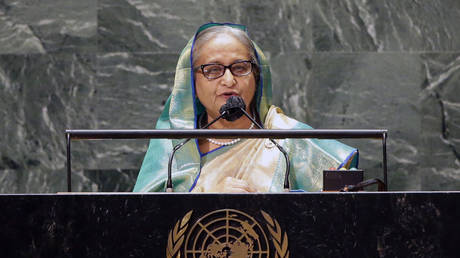
Two years after a helicopter whisked her out of Dhaka as crowds breached the gates of Ganabhaban, Sheikh Hasina broke her prolonged public silence from an undisclosed location in New Delhi. For fifteen years, she ruled Bangladesh with an iron grip, transforming from a democracy champion into an autocrat whose administration crumbled under the weight of student-led street protests. Her virtual address to international media and supporters marked a calculated return to the geopolitical chessboard. She claims her ouster was never an organic student movement, but rather a foreign-backed regime change operation.
The stakes of this narrative war extend far beyond one woman’s political legacy. South Asia’s geopolitical alignment hangs in the balance as Dhaka navigates its post-Hasina reality under an interim administration.
The Anatomy of the 2024 Upheaval
To understand Hasina’s return to the microphone, one must dissect the events of July and August 2024. What began as a localized pushback against civil service job quotas metastasized into a nationwide rebellion. Mainstream accounts portray a spontaneous uprising of youth unwilling to tolerate democratic backsliding any longer. Hasina rejects this framing entirely.
According to her recent statements, external actors and organized domestic factions hijacked legitimate grievances from day one. She argues that her administration sought compromise through the courts and open dialogue, only to face an escalating, single-point demand for total capitulation.
"July 2024 was not a peaceful student movement from the beginning," Hasina stated during her address, pointing to coordinated violence aimed at forcing a constitutional vacuum.
Skeptics dismiss her narrative as the standard playbook of a deposed dictator dodging accountability. Yet, intelligence analysts note that the speed with which the movement transitioned from localized campus friction to systemic state paralysis suggests a high degree of structural organization.
Economic Fragility and the Shadow of Radicalism
Hasina’s camp has weaponized Bangladesh's current economic struggles to undermine the credibility of the interim administration. Industrial output has contracted, foreign exchange reserves remain under immense pressure, and factory closures have rippled through the textile sector. Business owners associated with the previous regime have fled or gone underground, leaving a massive vacuum in the country's commercial backbone.
Concurrently, her son and former advisor, Sajeeb Wazed Joy, raised alarms regarding the resurgence of radical elements.
- The Security Shift: The rollback of strict counter-terrorism measures has allowed previously suppressed extremist networks to regain footing.
- Minority Persecution: Reports of attacks on Hindu temples, churches, and minority community leaders have intensified regional anxieties, particularly in New Delhi.
- Geopolitical Realignment: Ties between Dhaka and Islamabad have thawed visibly, triggering strategic alarm bells across India’s eastern frontier.
These developments complicate the narrative that Bangladesh has cleanly transitioned into a stable liberal democracy. Instead, the country is grappling with profound polarization, institutional decay, and an uncertain secular identity.
The December Return Threat
Perhaps the most provocative element of Hasina’s reappearance is her vow to return to Bangladesh by December. Facing numerous criminal charges, including allegations tied to the violent suppression of the 2024 protests, a physical return seems fraught with immediate detention or worse.
"They may jail me, they may kill me, but I still have to return," she declared, invoking the legacy of her father, Sheikh Mujibur Rahman, who was assassinated alongside most of her family in the military coup of 1975.
Whether this pledge is a genuine intent or a tactical maneuver to keep her fragmented Awami League party unified remains unclear. The party has been battered by mass arrests, asset freezes, and an official ban under anti-terrorism provisions. Without Hasina’s vocal presence, the political apparatus risks permanent dissolution. By setting a timeline for her comeback, she forces her supporters to choose between active resistance and quiet acquiescence.
The battle for Bangladesh's soul is far from settled. The interim government must prove it can deliver economic stability and security without slipping into authoritarian habits of its own. Meanwhile, Hasina waits across the border, betting that the passage of time and mounting public frustration will pave her path back to Dhaka.