The American energy transition has a hidden backdoor. For a decade, the rush to deploy clean energy across the United States has relied on an unexamined dependency on Chinese-made hardware. Now, federal regulators are preparing to pull the plug, sparking an intense clash between national security officials and the clean energy lobby.
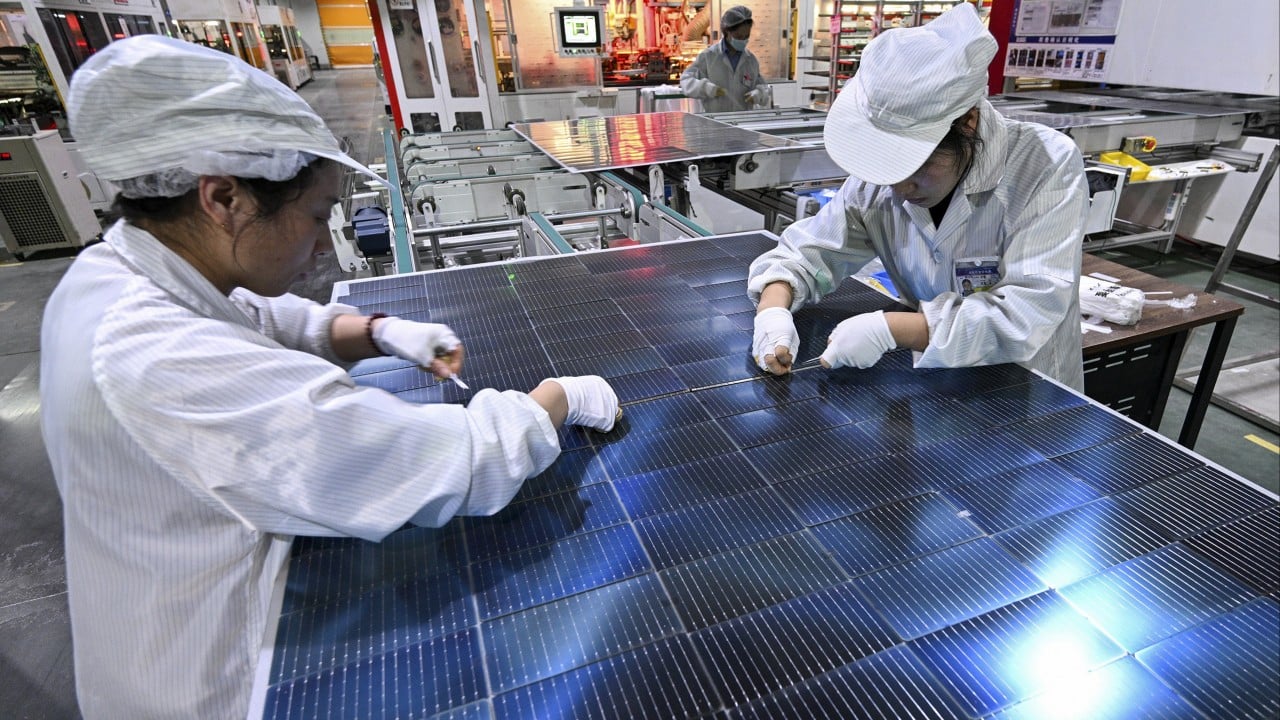
The Federal Communications Commission is quietly drafting an emergency rule to block imports of foreign-made smart inverters. These devices serve as the brain of any modern solar installation, converting direct current from solar panels into alternating current used by the power grid. Security hawks argue that leaving the control systems of America's power grid in the hands of foreign adversarial state-linked entities is madness. Solar developers counter that an abrupt ban will freeze billions of dollars in active projects and derail climate mandates.
This conflict is not just about trade or tariffs. It is a fundamental struggle over sovereign control of infrastructure.
The Kill Switch in the Backyard
Most people see solar panels when they look at a solar farm. They do not notice the small boxes mounted on the racks underneath. These are the smart inverters, and they do far more than manage electrical currents. They are internet-connected computers that communicate constantly with centralized networks to balance voltage, manage battery storage, and report production data.
Dominating this market are Chinese industrial titans, most notably Sungrow Power Supply and Huawei. Their rise was fueled by aggressive pricing and massive manufacturing scale, driving Western competitors out of business or into specialized niche markets. Today, these components represent roughly 10% of the cost of a utility-scale solar project.
National security agencies became alarmed when investigators began inspecting the physical circuitry of imported hardware. Last year, federal experts stripping down grid-connected equipment discovered undocumented communication devices tucked inside several Chinese solar power inverters. These rogue components were completely absent from official product specifications and technical manuals. They were capable of transmitting data back to external networks without the knowledge of the utility operators.
The threat shifted from theoretical to concrete during a little-publicized contract dispute in late 2024. A Chinese manufacturer, Ningbo Deye Technology, remotely deactivated several operational inverters deployed within the United States. The company did this during a commercial disagreement with an American counterparty. The sudden shutdown proved that foreign entities possess the capability to reach past domestic firewalls and disable pieces of the American energy matrix at will.
A recent confidential industry assessment conducted by Strider Technologies revealed that over 85% of surveyed American utilities are currently using inverter equipment built by companies with documented ties to the Chinese government or military. If a geopolitical crisis over Taiwan or trade routes escalates, those connected devices could serve as distributed instruments for asymmetric warfare. A coordinated signal could disrupt voltage stability across entire regional transmission networks, triggering cascading blackouts that would take weeks to repair.
The Financial Shockwave
The domestic clean energy sector is utterly unprepared for an immediate supply chain rupture. Power developers have spent years modeling project economics based on cheap, abundant imported components. Eliminating Chinese suppliers from the equation overnight will trigger a massive capital shock.
When an energy company designs a 500-megawatt solar array, every piece of equipment is mapped out years in advance. Inverters are not interchangeable commodities. They require precise engineering integration with specific photovoltaic modules, tracking systems, and battery storage blocks. If the Federal Communications Commission finalizes its ban on new foreign inverter models, developers cannot simply swap out a Sungrow unit for an American or European alternative. They will have to re-engineer entire projects from the ground up.
This structural reality means hundreds of projects currently in the permitting or early construction phases will grind to a halt. Engineering teams will have to submit revised designs to regional grid operators, entering multi-year interconnection queues all over again. Law firms are already reviewing force majeure clauses in power purchase agreements, anticipating a wave of missed deadlines and broken contracts.
The alternative supply chain is thin. While domestic manufacturers like Enphase Energy have proactively shifted much of their manufacturing capacity to domestic facilities, their product lines focus heavily on the residential and commercial rooftop sectors. The massive, high-voltage central inverters required for utility-scale solar farms are overwhelmingly built overseas. European alternatives exist, but manufacturers in Germany and Austria lack the immediate factory capacity to absorb the massive volume of orders that an American ban would displace.
Consequently, component prices will surge. Industry analysts predict that a total restriction on Chinese hardware will drive inverter costs up by 40% to 60% in the near term. For marginal projects operating on razor-thin profit margins, that capital expenditure spike will render them unbankable. Wall Street infrastructure funds are already quietly pausing capital deployments for late-2026 and 2027 projects until the regulatory boundaries are explicitly drawn.
Transatlantic Realignment
Washington is not acting in a vacuum. The sudden urgency within the administration was catalyzed by a major policy shift across the Atlantic.
In May, the European Commission instituted a sweeping ban prohibiting Chinese-made inverters from participating in any publicly funded energy projects. European policymakers realized that their aggressive push to decarbonize had accidentally traded a dependency on Russian natural gas for an even deeper dependency on Chinese industrial hardware. This realization prompted the update to the European Cybersecurity Act, which established strict frameworks to isolate high-risk suppliers from critical infrastructure.
American lawmakers are eager to close the gap. A bipartisan coalition of 52 members of the House of Representatives recently sent an urgent directive to the Department of Commerce. They demanded immediate executive action to restrict the future importation of these devices, citing the vulnerability of the domestic bulk power system. The National Defense Authorization Act for fiscal year 2026 has already legally barred the Department of Defense from procurement of solar cells, modules, or inverters from foreign entities of concern.
The Federal Communications Commission is utilizing a novel regulatory mechanism to bypass traditional legislative gridlock. By focusing on the wireless and telecommunications capabilities inherent in smart inverters, the commission can deny equipment authorizations on national security grounds. This is the exact strategy used to dismantle the domestic presence of Chinese telecom giants like Huawei and ZTE.
The Chinese government has reacted with predictable hostility to the impending rules. The Chinese Embassy in Washington issued statements accusing the United States of overstretching national security definitions to suppress legitimate commercial competition. Beijing has hinted that further restrictions on its clean technology champions could meet with retaliation. This could manifest as export controls on processed polysilicon, lithium, or rare earth elements, which are vital for the broader American technology and defense sectors.
The Technical Reality of Zero Trust Architecture
Squeezing Chinese suppliers out of the market will take years. In the interim, the energy sector must adopt an aggressive defensive posture to secure infrastructure that is already live and operational.
Ripping out existing infrastructure is economically impossible. Millions of Chinese inverters are already wired into residential neighborhoods, military bases, and commercial industrial zones across the country. Forcing utilities to extract this hardware would bankrupt regional co-ops and cause immediate disruptions to power generation capacity. The solution requires a fundamental shift in how utility networks interact with clean energy hardware.
Engineers are advocating for a strict zero-trust operational model. This protocol assumes that every device on the network is compromised by default. Power companies must implement hardware-based network isolation, completely cutting off solar inverters from the public internet. Communication should be restricted to closed, encrypted local area networks that use hardwired fiber optic cables rather than wireless cellular connections.
Furthermore, utilities must install physical telemetry monitors at the point of common coupling where the solar farm meets the wider grid. These legacy analog overrides can detect anomalous behavior, such as a sudden unexplained frequency drop or an unauthorized command sequence, and instantly drop the circuit breakers. This isolates the generation facility before any malicious software payload can spread to the wider transmission network.
A Hard Choice for Energy Independence
The United States cannot achieve true energy independence while relying on supply chains controlled by geopolitical rivals. For years, the clean energy industry prioritized rapid deployment and low capital expenditure above all else. This approach achieved impressive deployment statistics, but it created an unacknowledged structural vulnerability.
Building a secure domestic supply chain requires more than just punitive import bans. Capital subsidies provided by recent federal legislation must be aggressively directed toward high-power central inverter manufacturing facilities within the borders of the United States. Tax credits must be tied directly to the cybersecurity verification of the components, ensuring that every chip and line of code code used in an American power plant is audited and verified.
The transition away from compromised hardware will be painful, slow, and expensive. Projects will be delayed, and energy costs will face upward pressure. Yet the alternative is far more dangerous. Continuing to integrate unverified, remotely accessible control units into the domestic power grid is an open invitation to disaster.
The era of cheap, consequence-free clean energy imports is over. Federal regulators must finalize the proposed restrictions without delay, and domestic energy developers must accept the higher financial costs of building a truly sovereign, secure power grid.