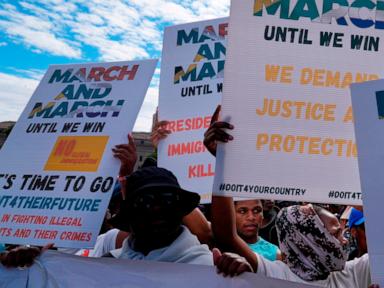
South African President Cyril Ramaphosa faces an unprecedented domestic emergency as a dramatic spike in anti-immigrant protests forces his administration into an aggressive, militarized crackdown on undocumented migration. This shifting political landscape is not merely a localized outburst of frustration; it represents the structural fracturing of Africa's most advanced economy under the weight of fiscal decay, systemic corruption, and regional instability. For decades, Pretoria leaned on the pan-African rhetoric of solidarity to mask a crumbling immigration infrastructure. Now, a potent mix of economic desperation and targeted political mobilization has stripped away that facade, leaving the government scrambling to maintain public order.
The ground reality changed rapidly following major anti-immigrant marches across Johannesburg, Tshwane, and parts of the Western Cape. Newly released data from the Human Sciences Research Council reveals that public hostility toward foreign nationals has climbed to its highest level since tracking began in 2003, with 42 percent of surveyed adults demanding a total ban on immigration.
The Infrastructure of Exclusion
To understand why the state is losing control of the narrative, one must look at the mechanics of the newly established Border Management Authority and the Department of Home Affairs. The creation of a unified border guard was marketed as a definitive solution to porous frontiers. While the agency reports intercepting roughly 450,000 individuals attempting illegal entry over the past fiscal year, the reality on the ground tells a far different story.
The primary failure point is not the physical borderline, but the institutional rot within the processing centers. Decades of systemic bribery have turned legal documents into a highly profitable commodity. Desperate economic migrants from Zimbabwe, Mozambique, and Malawi quickly learned that entry can be bought at informal crossings, bypassing the official asylum system entirely.
By allowing the formal immigration system to decay into an informal tax collection racket for corrupt officials, the state created a massive accountability vacuum. This regulatory collapse directly triggered the explosive growth of citizen-led policing movements. Groups like Operation Dudula and various localized neighborhood coalitions have systematically usurped state functions, conducting illegal property searches and establishing informal checkpoints to demand identification from residents.
The Real Fiscal Scapegoat
The political rhetoric heating up parliament centers heavily on the strain placed on public services. It is an easy political sell. South Africa's public healthcare system is near total collapse, rolling electricity blackouts persist, and the national unemployment rate hovers at a catastrophic 32 percent.
Blaming millions of undocumented migrants for the failure of municipal clinics and schools offers a convenient shield for state incompetence. While it is true that dense urban settlements in Gauteng and KwaZulu-Natal face acute resource shortages, the true driver of this deficit is chronic fiscal mismanagement and municipal corruption, not the presence of foreign nationals.
The labor market reveals a much more complex, predatory dynamic. In the informal trading sector, particularly concerning the registration of local spaza shops, foreign nationals accounted for roughly 37 percent of all recent applications nationwide. Mainstream political narratives frame this as an aggressive corporate takeover of township economies. In reality, it reflects a structural loophole exploited by South African property owners and domestic businesses.
The Employment Services Battleground
Domestic employers routinely weaponize undocumented status to bypass the country’s stringent labor protections. By hiring desperate, undocumented workers in hospitality, agriculture, and construction, businesses can ignore minimum wage mandates, health regulations, and formal contracts. When workers cannot complain to authorities without risking immediate deportation, their labor becomes highly profitable.
The government’s proposed fix is the Employment Services Amendment Bill, alongside a sweeping immigration overhaul codified in the newly approved White Paper on Citizenship, Immigration and Refugee Protection. The legislative strategy aims to pivot away from merely fining non-compliant businesses toward imposing direct criminal liability on executives who exploit undocumented labor. Additionally, Pretoria announced plans to deploy 10,000 labor inspectors to enforce compliance across major industries.
The administrative burden of this plan makes execution highly unlikely. Training, equipping, and deploying an enforcement apparatus of that scale requires billions of Rands that the treasury simply does not have. Passing a law in Cape Town is simple; enforcing it in the informal construction sites of Sandton or the vast commercial farms of Limpopo is a logistical nightmare.
The Regional Fallacy
During a high-level bilateral summit in Pretoria, Kenyan President William Ruto offered the standard diplomatic diagnosis, noting that South Africa’s status as a highly developed economy naturally draws those seeking opportunity, meaning the long-term solution requires shifting focus toward regional development.
This argument relies on a fundamental fallacy. Regional bodies like the Southern African Development Community and the African Union possess neither the financial capital nor the political will to equalize economic development across the continent. Expecting structural economic transformations in collapsing states like Zimbabwe to alleviate migration pressures in Johannesburg within the current decade is pure fantasy.
The political stakes will peak on November 4, 2026, when South Africans head to the polls for critical local government elections. Opposition parties have already recognized that anti-immigrant rhetoric is the fastest way to mobilize an angry, underemployed youth demographic.
By choosing to match this hardline rhetoric with promises of unprecedented workplace crackdowns and mass deportations, the ruling African National Congress has painted itself into a corner. The state has validated the core premise of the populist movements, leaving it with no choice but to deliver visible, aggressive enforcement results in a system that remains profoundly broken.
The administration cannot build fences fast enough to outrun its own systemic economic failures, and the coming months will test whether a state can successfully project sovereign strength at its borders while remaining structurally hollowed out from within.