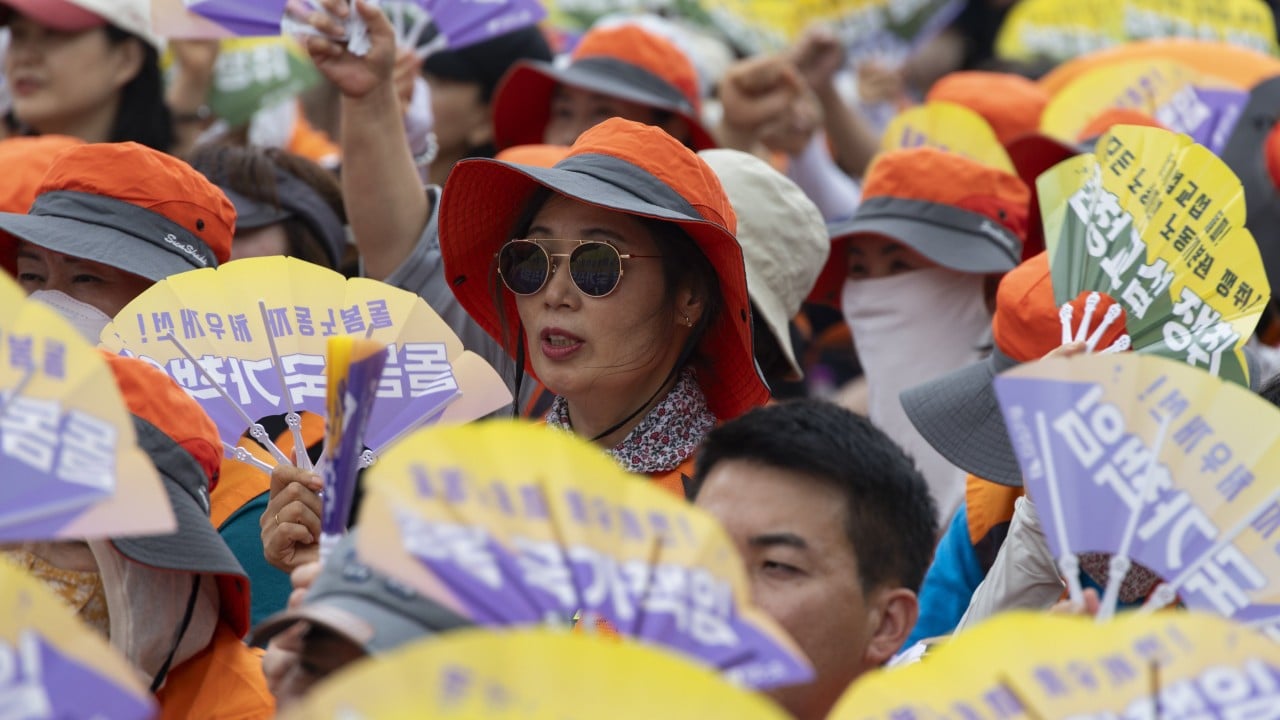
When South Korean lawmakers revised Articles 2 and 3 of the Trade Union and Labor Relations Adjustment Act—popularly dubbed the Yellow Envelope Law—they promised a shield for vulnerable subcontracted labor. What they actually created was a battering ram for the country's most powerful corporate unions. Four months after the law took effect in March 2026, labor unions across South Korea's manufacturing, technology, and semiconductor strongholds are using the new legal framework to demand guaranteed percentages of corporate operating profits as performance bonuses. Organized labor has effectively turned a law meant to curb damage lawsuits into a mechanism for mandatory profit distribution. The fallout is already tearing through boardroom floors and industrial sites nationwide.
The Mechanics of the Yellow Envelope Gamble
The core problem stems from a fateful expansion of legal language. Under previous labor regulations, legitimate grounds for a strike were strictly limited to working conditions such as base wages, safety provisions, and working hours. The revised law broadened that scope to include management decisions that affect working conditions.
Union strategists recognized the loophole instantly. By framing variable performance bonuses as a fundamental component of annual compensation, unions at firms like Samsung Electronics, SK Hynix, Hyundai Motor, and LG U+ reclassified profit allocation from a discretionary managerial judgment into a mandatory bargaining topic.
Strikes cost unions far less now. That structural shift changed everything. Under the updated law, individual liability for damages incurred during industrial action is tightly capped, and courts can no longer issue blanket financial claims against entire strike committees.
Management now bears asymmetric risk. If a union shuts down a semiconductor fabrication line or an assembly plant over profit-sharing disputes, the company faces hundreds of millions of dollars in operational downtime. The union, meanwhile, faces minimal financial exposure even if the strike is eventually judged unlawful by a conservative court.
+-----------------------------------------------------------------------------------+
|                        THE STRUCTURAL RISK SHIFT                                  |
+------------------------------------------------------+----------------------------+
| BEFORE MARCH 2026                                    | AFTER MARCH 2026           |
+------------------------------------------------------+----------------------------+
| * Discretionary bonuses decided by executive boards. | * Unions demand fixed % of |
| * Strikes over managerial decisions ruled illegal.   |   operating profits.       |
| * Massive individual damage liability for strikers.  | * Broad dispute definition |
|                                                      |   covers management.       |
|                                                      | * Strict liability caps    |
|                                                      |   protect union coffers.   |
+------------------------------------------------------+----------------------------+
When Profit-Sharing Becomes an Asymmetric Option
Financial analysts point out that this setup gives labor what amounts to a free financial option. When global demand surges and tech giants post record operating margins, unions demand an immediate, fixed percentage payout. But when chip markets collapse or global shipping routes freeze, workers retain their contractually protected baseline salaries and employment guarantees.
Risk is localized in corporate reserves while rewards are socialized among unionized workforces.
Consider the recent wage talks at Samsung Electronics and SK Hynix. Both companies recently settled intense negotiations by allocating fixed portions of earnings—including agreements setting performance incentives directly against 10 percent thresholds of semiconductor division operating profits.
Shareholders are furious. Investor advocacy groups, led by organizations like the Korea Shareholders Movement Headquarters, have launched aggressive legal countersuits. They have filed formal complaints against top corporate executives for breach of trust, claiming CEOs capitulated to strike threats by surrendering capital that belonged to equity holders. The same activist group even targeted Employment and Labor Minister Kim Young-hoon, accusing the government of improperly intervening to broker settlements that legitimized union demands.
"What the Yellow Envelope Act has produced is a structure in which the strike risk borne by management has grown significantly while the risk borne by unions has shrunk."
— Lee Sang-kyu, Employment & Labor Attorney
The Misalignment with Subcontractor Reality
The bitter irony of this crisis lies in who is actually benefiting. The Yellow Envelope Law was originally drafted to address South Korea's severe dual labor market. For decades, tier-one conglomerates enjoyed ironclad job security and top-tier compensation, while sub-subcontractors and indirect factory floor workers endured precarious contracts with negligible bargaining power.
The new law was supposed to force parent companies to negotiate directly with sub-contractor unions.
Instead, primary beneficiary status has been seized by high-earning union members inside monopoly-adjacent conglomerates. Subcontractors are still struggling to navigate complex legal battles over employer status, as seen in landmark administrative lawsuits filed by industrial shipbuilders like Hanwha Ocean. Meanwhile, enterprise unions at cash-rich tech titans are leveraging the law's ambiguous wording to extract lucrative cash bonuses.
The wealth gap inside the labor force is widening rather than shrinking.
+-----------------------------------------------------------------------------------+
|                   THE INTENDED VS. UNINTENDED OUTCOMES                            |
+-----------------------------------------------------------------------------------+
| INTENDED POLICY GOAL                                                              |
| -> Grant indirect and subcontracted workers bargaining rights with parent companies. |
| -> Prevent ruinous financial lawsuits against precarious workers.                 |
+-----------------------------------------------------------------------------------+
| ACTUAL MARKET REALITY                                                             |
| -> Well-funded enterprise unions use legal cover to extract fixed profit cuts.    |
| -> Subcontractors remain bogged down in protracted administrative lawsuits.        |
+-----------------------------------------------------------------------------------+
Government Backpedaling and the Emergency Ordinance Push
Political leaders are realizing the economic machine is stalling. President Lee Jae-myung made headlines during a Cabinet meeting by openly criticizing the wave of profit-share disputes, stating flatly that demands for fixed operating profit percentages do not constitute legitimate labor disputes.
The administration is now scrambling to issue emergency administrative guidelines and enforcement ordinance revisions to restrict what counts as a strike-worthy dispute.
Labour federation leaders have responded with fury. Both the Federation of Korean Trade Unions and the Korean Confederation of Trade Unions have accused the presidential office of attempting an unconstitutional executive bypass. They argue that restricting dispute definitions via executive decree undermines the legislative mandate passed by the National Assembly.
The political impasse threatens South Korea's competitive edge in strategic sectors. Beyond profit-sharing, unions are deploying their expanded dispute authority to block industrial modernization. At auto manufacturing facilities, labor groups are demanding full union consent before companies can introduce automated robotics, humanoids, or artificial intelligence systems onto assembly lines. In the semiconductor sector, union disputes have stalled worker reassignments necessary for new plant expansions and regional fabrication mega-projects.
A nation built on rapid industrial adaptation now finds its most critical technological transitions subject to labor vetoes. Global investors are taking notice, re-evaluating whether South Korean tech assets carry an unacceptable structural risk discount in an era where speed to market determines survival.
The government can try to patch the Yellow Envelope Law with administrative band-aids and emergency guidelines, but executive decrees cannot override explicit statutory language without triggering years of legal gridlock. Until South Korea's legislature directly addresses the gap between protecting contract workers and enabling profit-confiscation disputes, corporate capital will simply seek safer shores.