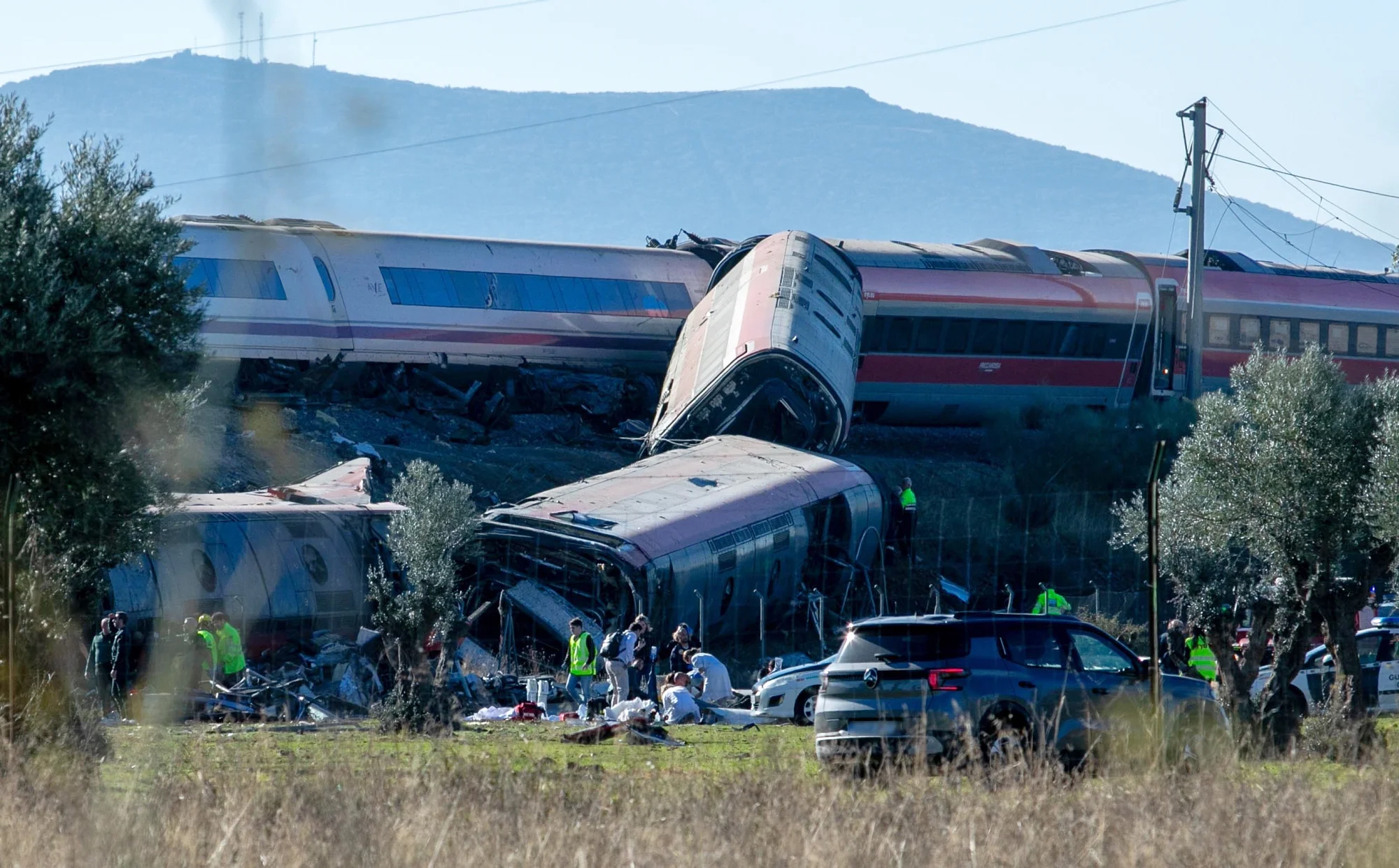
When a high-speed train derails in Spain, leaving dozens dead, the initial headlines always focus on the wreckage, the rescue efforts, and the immediate human toll. Yet the real story of a catastrophic Spanish high-speed rail crash rarely begins at the moment of impact. It starts years earlier in the invisible gaps between rapid infrastructure expansion, legacy signaling transitions, and the brutal physics of moving hundreds of tons of steel at over 250 kilometers per hour.
To understand how a modern European rail network—long held up as the gold standard of transit engineering—suffers a mass-casualty disaster, you have to look past the twisted metal. You have to examine the structural vulnerabilities built into high-speed corridors when political ambition outpaces systemic redundancy.
The Anatomy of Speed and Momentum
Physics does not negotiate. A standard high-speed trainset operating on Spain’s Alta Velocidad Española (AVE) network weighs upwards of 400 metric tons. At cruising speeds of 300 kilometers per hour, that mass carries an astronomical amount of kinetic energy. When everything works, passengers feel nothing more than a gentle hum while sipping coffee in the dining car. When something fails, that kinetic energy has nowhere to go except into the surrounding concrete, ballast, and passenger cabins.
High-speed rail is fundamentally different from conventional rail in how it manages human error. On a traditional commuter line, a driver watches trackside signals and applies brakes manually. At 300 kilometers per hour, human reaction time is functionally useless. A driver cannot see an obstacle, process the threat, and stop a train that requires nearly four kilometers to come to a complete halt.
Because human reflexes are too slow, high-speed networks rely entirely on automated protection systems. In Spain, the primary architecture for modern lines is the European Rail Traffic Management System (ERTMS), alongside the domestic ASFA (Anuncio de Señales y Frenado Automático) system.
Here is where the cracks appear.
The Vulnerability of Transition Zones
Spain boasts the longest high-speed rail network in Europe and the second longest in the world, trailing only China. Over three decades, Madrid poured tens of billions of euros into connecting provincial capitals with gleaming new tracks. The achievement transformed domestic travel, effectively wiping out short-haul air routes between major cities like Madrid, Barcelona, Seville, and Valencia.
However, rapid expansion created a patchwork quilt of rail technology. Not every kilometer of track utilized by high-speed trains is a dedicated, closed-corridor high-speed line. Trains frequently transition from modern ERTMS-equipped tracks onto older, conventional Iberian-gauge approaches near major stations or through complex mountainous terrain.
Consider the mechanics of a transition zone. A train speeds along a dedicated corridor where computers constantly monitor speed, track occupancy, and curve geometry, automatically applying brakes if the driver exceeds the limit by even a few kilometers per hour. Suddenly, the train approaches a junction where the line merges with older infrastructure.
At this exact boundary, the primary automated safety net often hands control back to a legacy system—or directly to the human driver.
History already wrote this warning in blood. During the 2013 Santiago de Compostela disaster, an Alvia train carrying 222 people entered a sharp curve at more than twice the posted speed limit of 80 kilometers per hour. The train derailed, slamming into a concrete wall and killing 79 people. The investigation revealed a glaring systemic flaw: the advanced ERTMS system ended just kilometers before the treacherous A Grandeira curve, dropping protection down to the older ASFA system, which did not automatically enforce speed reductions at that specific curve. The driver, distracted by an onboard phone call, missed the braking point. Because the trackside technology lacked a continuous speed-supervision beacon at the transition, there was nothing to override the human mistake.
When dozens die in a high-speed crash, investigators immediately pull the train's event data recorder—the rail equivalent of an aircraft black box—to see if a similar technological handoff failed.
Infrastructure Fatigue and Climate Stress
Even when automated signaling works without a hitch, the physical reality of the track bed remains a constant vulnerability. High-speed rail demands geometric perfection. A variance of just a few millimeters in rail alignment or track gauge can induce violent lateral oscillations, known as hunting oscillation, which can literally lift a wheel flange over the railhead.
Maintenance crews work exclusively during tight overnight windows when passenger traffic halts. They rely on specialized ultrasonic testing trains and track-geometry cars to detect microscopic fissures, ballast degradation, and rail wear. Yet maintenance budgets face relentless pressure, particularly after the liberalization of Spain's rail market.
Over the past several years, Spain opened its high-speed tracks to fierce competition. State operator Renfe no longer holds a monopoly; private and foreign-backed competitors like Iryo and Ouigo now run frequent, low-cost services along the exact same corridors.
More trains mean cheaper tickets and fuller carriages. They also mean exponentially higher wear and tear on switches, overhead catenary wires, and rail steel.
"Every additional axle passing over a high-speed switch at 300 kilometers per hour accelerates metal fatigue. When you double track utilization without proportionally expanding overnight maintenance windows, you narrow your margin of safety."
Environmental extremes compound this mechanical stress. The Iberian Peninsula experiences brutal temperature swings, from freezing winter nights on the central plateau to summer heatwaves exceeding 40 degrees Celsius. Extreme heat causes continuous welded rail to expand. If the internal stresses exceed the holding capacity of the rail clips and concrete sleepers, the track can suddenly buckle laterally—a phenomenon known as a sun kink. A train hitting a buckled rail at high speed has zero chance of staying upright. Conversely, torrential autumn rains—the destructive DANA weather events common across eastern and southern Spain—can wash out embankments and destabilize the crushed-stone ballast beneath the ties in a matter of hours.
Rolling Stock Crashworthiness and Structural Limits
When a derailment occurs, survival depends heavily on the structural engineering of the passenger coaches. Modern European high-speed trains are built to strict crashworthiness standards, featuring crumple zones at the ends of each car, anti-climbers to prevent one carriage from telescoping over another, and reinforced passenger survival cells.
Yet these engineering marvels have hard physical limits. Crashworthiness standards are typically modeled on collisions at moderate speeds—often around 36 to 50 kilometers per hour against a standardized obstacle—under the assumption that automated braking systems will have already scrubbed off the vast majority of the train's velocity before impact.
If a train leaves the tracks at near-cruising speed due to a catastrophic axle failure, a foreign object on the line, or a sudden switch malfunction, no amount of passive structural reinforcement can fully absorb the energy.
In these violent secondary impacts, unrestrained luggage becomes lethal shrapnel. Carriages jackknife. Power cars, which house heavy transformers and cooling systems, can break free or crush adjacent passenger sections. Even the materials used in interior paneling and seating come under scrutiny by accident investigators, as post-crash fires fueled by electrical arcing or diesel fuel—in the case of dual-mode hybrid trains—can turn a survivable impact into an inescapable trap within minutes.
The Human Factor Under Algorithmic Reliance
There is a well-documented psychological trap in modern transportation known as automation complacency. When train drivers spend 95 percent of their shifts monitoring screens while computers regulate acceleration and braking, their cognitive vigilance naturally dulls.
To counter this, high-speed trains utilize a vigilance control device, commonly called a dead-man's pedal or button. The driver must press or release a pedal or tap a sensor every few seconds to prove consciousness. If they fail to respond, an alarm sounds; seconds later, the emergency brakes engage.
While effective against a driver falling asleep or suffering a medical emergency, a vigilance pedal does nothing to prevent cognitive overload or situational confusion. If an unexpected alarm triggers during a complex section of track, or if an internal radio communication interrupts a driver's mental checklist right before a speed restriction, human attention fractures.
Furthermore, the push for hyper-efficiency in rail operations often leaves little room for error recovery. Tight turnarounds at terminal stations, complex schedules shared among competing operators, and pressure to avoid punctuality penalties create an operational culture where keeping the train moving takes subtle psychological precedence over stopping to investigate an ambiguous warning light.
What Investigators Actually Look For
In the chaotic days following a deadly crash, public speculation inevitably runs wild. Politicians offer condolences and promise swift answers. Union representatives point to staffing levels or maintenance backlogs. Rail operators emphasize their historical safety records.
Meanwhile, technical investigators from Spain's Comisión de Investigación de Accidentes Ferroviarios (CIAF) methodically strip away the noise. Their process follows a rigid, unforgiving logic:
- The Point of Derailment (POD): Investigators walk the track backward from the wreckage, looking for the first scrape mark on a wooden or concrete sleeper, the first sheared bolt, or the exact point where a wheel flange climbed the steel rail.
- Wheelset and Bogie Integrity: Forensics teams examine the train's axles and bearings for signs of overheating, known as a hot box. A seized bearing can melt an axle journal in minutes, causing the wheelset to collapse beneath the train at full speed.
- Signaling Logs: Every track circuit, axle counter, and radio transmission between the train and the Centralized Traffic Control (CTC) center is time-stamped to the millisecond. Investigators cross-reference these logs with the train's black box to determine whether the infrastructure told the train to slow down—and if so, why it didn't.
- Switch Alignment: If the crash occurred near a station or passing loop, investigators inspect the point machines that move the rails. A switch that moves beneath a passing train, or fails to lock completely into position due to debris or mechanical wear, will split a train in two, sending the front cars down one track and the rear cars down another.
The Myth of Zero Risk
High-speed rail remains, statistically, one of the safest forms of mass transit ever devised. Billions of passengers travel on bullet trains across Europe and Asia every year without incident. That overwhelming statistical safety, however, breeds a dangerous institutional hubris.
When a system operates flawlessly for years, organizations begin to treat safety as a permanent condition rather than a fragile, continuous process. Warnings from track inspectors get deferred to the next budget cycle. Known technological seams—like the handoff between advanced digital signaling and legacy trackside beacons—are tolerated because drivers have navigated them thousands of times without a mistake.
A catastrophic crash exposes the lie behind that complacency. It proves that in high-speed transit, safety is never guaranteed by the sophistication of the technology alone, but by how ruthlessly an industry eliminates the single points of failure where human fallibility meets unstoppable momentum.
Until every kilometer of high-speed track operates under continuous, unbroken automated supervision—and until infrastructure maintenance is insulated from the commercial pressures of deregulated rail competition—every passenger boarding a bullet train is trusting that the weakest link in the chain holds for one more journey.