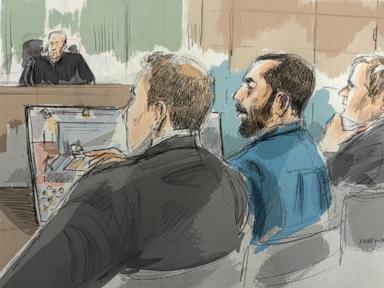
The courtroom fell completely silent when the defense attorney stood, looked toward the bench, and announced that the accused would not take the stand.
In the terrorism trial stemming from the brutal knife attack on author Salman Rushdie, opting out of testimony is a calculated legal gamble. It changes the atmosphere of a federal or state courtroom instantly. Prosecutors want the defendant under oath. Defense attorneys often protect their clients from cross-examination when the evidence wall is insurmountable. Hadi Matar, the man charged with attempted murder and terrorism acts for the August 2022 attack at the Chautauqua Institution, chose silence over explanation. You might also find this similar coverage useful: Why Trump and Netanyahu Need This War to Survive.
That silence speaks volumes about the legal strategy behind high-profile terrorism prosecutions. When a defendant refuses to testify, they deny the prosecution a chance at a televised or recorded cross-examination, but they also surrender the opportunity to present a humanizing narrative directly to the jury. Instead, the case rests entirely on the mountain of physical, digital, and eyewitness evidence accumulated since the blood-soaked morning in Western New York.
For decades, covering violent extremist attacks has taught me one hard truth. Trials involving ideological violence rarely turn on dramatic courtroom confessions. They turn on the cold, unforgiving mechanics of forensic evidence, communications metadata, and the chilling predictability of radicalization pipelines. As discussed in detailed reports by TIME, the results are worth noting.
The Anatomy of the Chautauqua Attack
To understand the weight of a silent defendant, you have to revisit the timeline of August 12, 2022. Salman Rushdie stood on the stage of the Amphitheater at the Chautauqua Institution, preparing to deliver a lecture on the United States as a sanctuary for exiled writers. For over thirty years, a religious fatwa issued by Iran's Ayatollah Ruhollah Khomeini hung over his head, a standing death sentence that had driven him into hiding for years before he eventually integrated into open society.
That security facade shattered in seconds. A man in black clothing and a black face mask rushed the stage, bypassing lax security protocols, and plunged a knife into Rushdie's neck, abdomen, and chest repeatedly before security and audience members subdued him.
Rushdie survived, though the attack cost him the sight in his right eye and the use of one hand. The physical toll was devastating. The cultural toll was seismic, signaling that decades-old fatwas do not expire simply because time passes.
When law enforcement arrested the suspect at the scene, they found a driver's license bearing a fake name associated with a sympathizer of the Islamic Revolutionary Guard Corps. Subsequent digital forensic investigations of his cell phone and social media accounts revealed deep consumption of extremist propaganda, praise for militant groups, and meticulous planning directed toward fulfilling the decades-old directive.
When a defendant faces charges of committing an act of terrorism with intent to provide material support to a designated foreign terrorist organization, the prosecution must prove more than a random assault. They must prove intent, premeditation, and ideological alignment. The defense resting without calling the accused means they chose not to challenge the state's narrative of ideological motivation from the witness box.
Why Defendants Refuse to Testify
To the lay observer, remaining silent looks like an admission of guilt. In the American legal system, however, the Fifth Amendment protects a defendant from self-incrimination, and juries are legally instructed not to draw negative inferences from that silence.
Yet, in practice, juries notice. Defense teams weigh this risk constantly. Why did Hadi Matar decline to testify?
The Cross-Examination Trap
If the accused takes the stand, he opens himself up to federal or state prosecutors who have spent months or years building an airtight file of his digital footprint, encrypted chats, and jailhouse communications. A skilled prosecutor would dismantle any improvised defense in minutes.
Furthermore, prior statements made to law enforcement or media outlets—such as jailhouse interviews boasting about his actions—would be used to shred his credibility. In high-stakes terrorism cases, putting a volatile defendant on the stand is often viewed by defense counsel as handing the prosecution a loaded weapon.
The Absence of a Viable Alternative Defense
What could he possibly say to mitigate the charge? The physical act of rushing a stage and stabbing a man multiple times is captured on video and witnessed by hundreds. Insanity pleas require exhaustive psychiatric evaluations that often fail when premeditation is evident, as prosecutors recovered evidence of advance surveillance of the venue. Without a credible psychiatric defense or an alibi, testifying offers zero upside.
Ceding the Narrative
By remaining silent, the defense concedes the facts of the physical attack. Instead, defense strategies in such trials usually pivot to narrow legal definitions, attempting to argue that the actions did not legally constitute "terrorism" under specific statutory requirements, or that the state failed to prove formal coordination with a foreign terrorist organization. It is a technical defense, not a moral or explanatory one.
The Broader Landscape of Lone Actor Prosecution
The trial highlights a recurring challenge in modern counter-terrorism. How do legal systems handle individuals radicalized online who execute violent attacks without direct, boots-on-the-ground operational orders from a terrorist cell?
In the years following the rise of online extremist forums, law enforcement agencies shifted focus from dismantling hierarchical terror cells to intercepting decentralized, self-radicalizing actors. These individuals consume propaganda via encrypted messaging apps, absorb ideological hatred, and launch attacks independently.
For prosecutors, proving a direct link to a foreign terrorist group can be difficult when there are no wiretaps showing direct orders from overseas commanders. Instead, the legal burden relies on establishing "material support" through ideological alignment, radicalization consumption, and emulation of terrorist tactics.
When a defendant stays silent, they leave the prosecution's digital evidence uncontested from the personal perspective. The state's experts on digital forensics, ideological propaganda, and counter-terrorism take the stand to explain the defendant's mindset, filling the psychological vacuum left by the empty chair.
The Cost of Ideological Violence
The trial in Mayville, New York, is more than a local criminal proceeding. It is a referendum on the safety of free expression and the lingering shadow of transnational threats.
Salman Rushdie spent decades living under threat, eventually stepping back into public life, believing the world had moved past the era of state-sponsored fatwas. The attack proved that hatred does not age out. It waits.
As closing arguments loom, the absence of testimony from the accused leaves the courtroom anchored entirely to the brutal realities of the evidence. There is no closing emotional appeal from the perpetrator, no final attempt to justify the unjustifiable. There is only the record: the digital trails, the blood on the stage, the medical reports detailing a life forever altered, and the chilling silence of a defendant who chose to let the evidence speak for itself because he knew any words of his own would only seal his fate.


