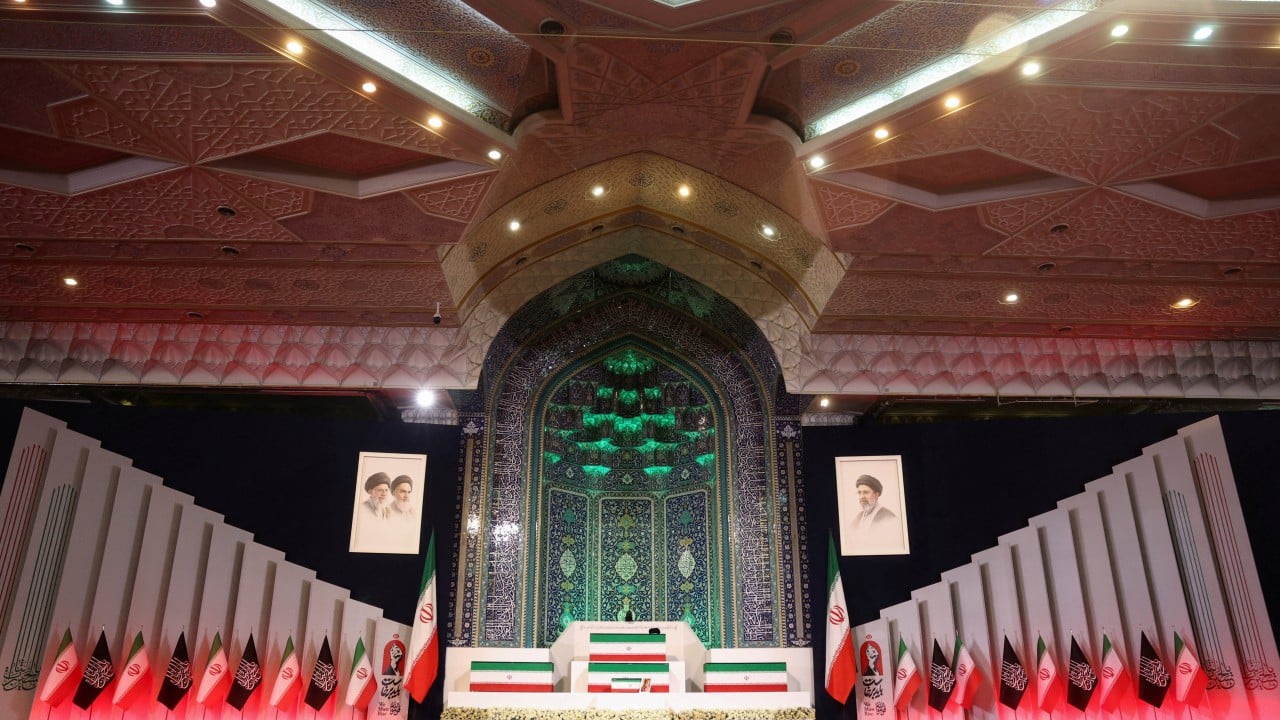
The physical manifestation of Iran’s next political era is now resting inside a heavily fortified religious complex in Tehran. As state media broadcasts wall-to-wall footage of the days-long funeral procession for Supreme Leader Ali Khamenei, the choreographed grief on display masks a profound and volatile instability. Outside the gates, the public mood is a fractured mix of mandatory mourning, quiet anxiety, and under-the-radar celebration. Behind closed doors, the regime is facing its most critical existential hurdle since the 1979 revolution.
The immediate focus for the Islamic Republic is optics. By filling the streets of the capital, the government aims to project total control and continuity to both domestic dissidents and foreign adversaries. Yet, beneath the black banners and rhythmic chanting lies a stark reality. The transition of power in an autocracy is rarely smooth, and Iran’s specific institutional design makes it uniquely vulnerable to a sudden fracture.
The Choreography of State Grief
Mass funerals in Iran are an instrument of statecraft. The regime treats public assembly not just as a memorial, but as a referendum on its own legitimacy.
To achieve the massive crowds seen in Tehran, the government deploys a well-oiled bureaucratic machine. State employees are given mandatory administrative leave, public transit is made entirely free, and security forces bus in loyalists from rural provinces where conservative religious sentiments remain stronger than in the urban centers. This is a logistical feat designed to signal absolute unity.
But numbers do not tell the whole story. While millions may line the streets, the social fabric of Iran has dramatically frayed over the last decade. A succession of economic crises, hyperinflation, and brutal crackdowns on civil liberties have alienated a vast swath of the population, particularly the youth. For every citizen mourning in the streets, there are others watching from their windows in silence, acutely aware that the death of a single man does not automatically dismantle a deeply entrenched security apparatus.
The Three Pillars of the Succession Battle
With the supreme leader gone, the constitutional mechanism for replacing him triggers a complex, opaque process. The Assembly of Experts, a body of 88 clerics, is technically tasked with choosing the successor.
In reality, the decision will not be made in a vacuum of theological debate. It will be hammered out through intense negotiations between three distinct centers of gravity within the Iranian state.
The Islamic Revolutionary Guard Corps
The Islamic Revolutionary Guard Corps (IRGC) is no longer just a military branch. It is a massive economic empire and a political powerhouse. Over the past twenty years, the IRGC has systematically taken over major sectors of the Iranian economy, from telecommunications and construction to oil smuggling and banking.
The guards do not want a supreme leader who will curb their financial dominance or question their regional strategy. They require a figurehead who is either pliable or deeply indebted to their power. The IRGC’s primary goal is survival and the protection of its vast wealth, which means they will likely back a hardline cleric who views the West with deep suspicion and relies heavily on the military to maintain internal order.
The Clerical Establishment in Qom
While Tehran is the political capital, Qom remains the spiritual heart of the regime. The senior marjas—the grand ayatollahs—have watched with growing unease as the IRGC has gradually eclipsed traditional clerical authority.
For the old guard in Qom, the supreme leader must possess genuine theological credentials to maintain the religious legitimacy of the state. They fear that a candidate chosen purely for political or military expediency will reduce the office of the supreme leader to a secular dictatorship with an Islamic veneer. This ideological rift creates a quiet but potent friction between the seminary and the barracks.
The Hereditary Question
For years, rumors have circulated about the political ambitions of Mojtaba Khamenei, the influential son of the late supreme leader. Mojtaba has long operated in the shadows, managing his father’s vast office and maintaining deep ties to the intelligence services and the IRGC’s internal security wings.
A hereditary succession, however, presents a massive ideological problem for the Islamic Republic. The 1979 revolution was explicitly fought to overthrow a hereditary monarchy. Elevating a son to replace his father would alienate traditional republicans within the regime and hand a massive propaganda victory to opposition movements abroad, who would argue that the revolution merely traded one king for another.
Economic Paralysis and the Foreign Policy Vacuum
While the political elite tussles over the throne, the country’s economy remains on life support. Decades of international sanctions, systemic corruption, and economic mismanagement have left the Iranian rial in a state of perpetual collapse.
The immediate danger during this funeral period and the subsequent transition is a complete paralysis of governance. Bureaucrats are hesitant to make decisions without knowing who the next ultimate authority will be. Foreign investors, already few and far between, are completely frozen. The bazaar, historically a barometer of Iranian political stability, is watching closely, with merchants hoarding hard currency and gold in anticipation of civil unrest or a sudden policy shift.
On the geopolitical stage, Iran’s regional proxies are entering an era of uncertainty. Groups across the Middle East rely heavily on Tehran for funding, weaponry, and strategic direction. While the operational command of these groups largely rests within the IRGC's Quds Force, the overarching strategic vision always came from the top. A prolonged or messy succession crisis in Tehran could lead to a temporary pullback or, conversely, erratic behavior by proxies operating without clear red lines from the capital.
The Illusion of Continuity
The regime will do everything in its power to make the transition look seamless. A candidate will eventually be announced, the state media will declare a consensus, and the new supreme leader will take his seat.
But a managed transition does not equal long-term stability. The new leader will inherit a country facing acute ecological crises, widespread economic misery, and a population that has repeatedly demonstrated its willingness to risk everything in anti-government protests. He will lack the revolutionary credentials and the decades-long personal networks that his predecessor used to balance competing factions.
The funeral procession in Tehran is the final act of an old script. The new script has yet to be written, and the actors holding the pens are heavily armed and deeply desperate.


