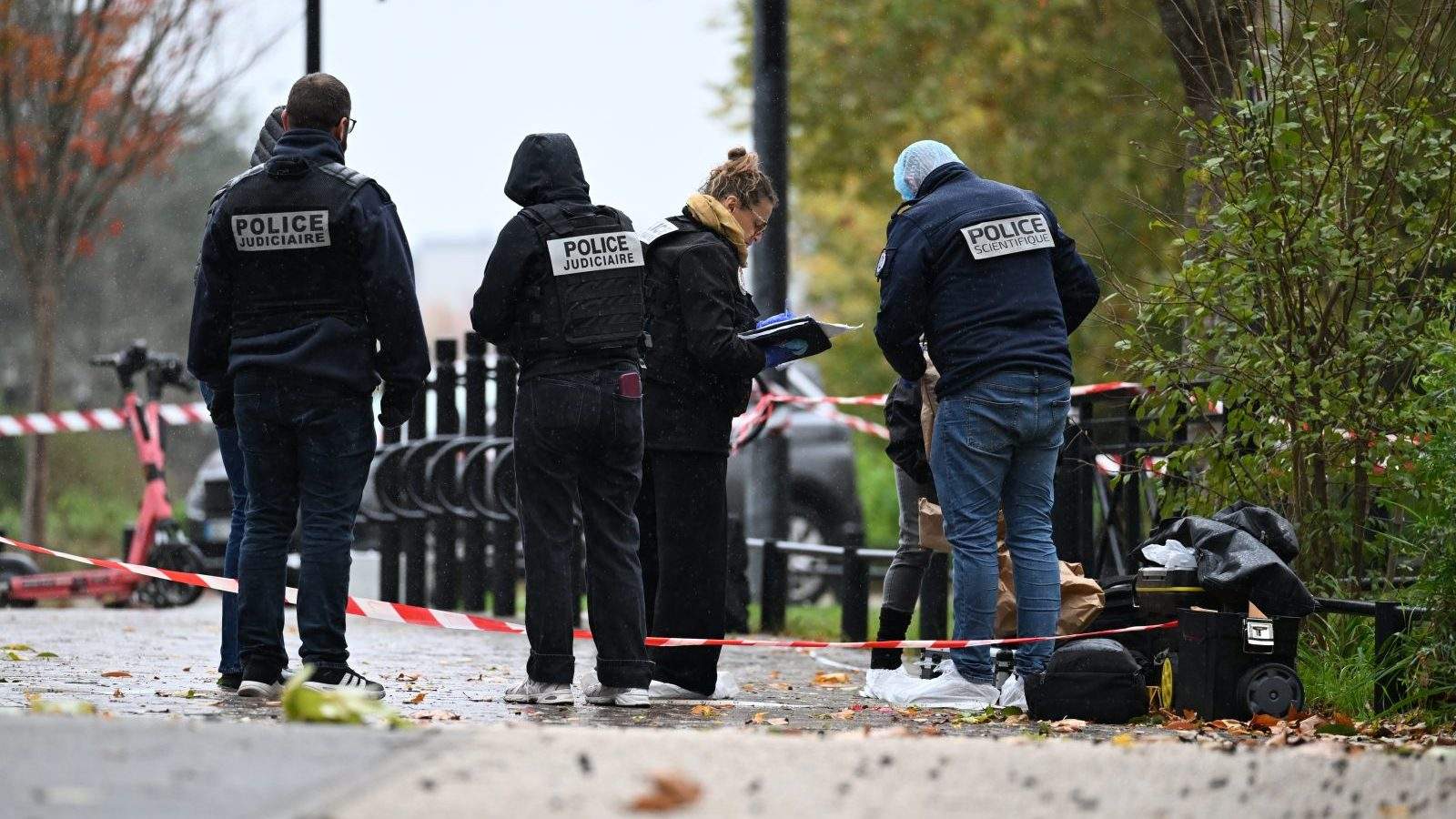
A gunman opened fire across two western Paris suburbs on October 23, 2026, killing 26-year-old mixed martial arts fighter Pengo Bossio Wangi and wounding seven other people before anti-crime officers arrested 39-year-old suspect Kevin T. French counterterrorism prosecutors swiftly classified the spree in Trappes and La Verrière as a terrorist crime driven by racism and likely Islamophobia.
Breaking news wire reports treat that arrest as a neat resolution. A shooter is in custody, detention is extended, political leaders trade condemnations. Anyone who has covered European security crises for decades knows better than to stop when the handcuffs click shut. An arrest closes a street chase, not a systemic vulnerability. The deeper questions sit inside the blind spots between counterterrorism watchlists, expunged criminal records, psychiatric histories, and the feverish media cycles that turn ordinary suburbs into political battlegrounds.
The Anatomy of a Fifteen-Minute Spree
Just after 10:00 a.m. local time on a Friday morning, gunfire erupted from a moving car in Trappes, roughly thirty kilometers west of central Paris. Over roughly fifteen to twenty minutes, the shooter moved through Trappes and neighboring La Verrière, firing at a parked car carrying a mother and child, a medical center, a square near Avenue Salvador-Allende, a petrol station, and streets near a pharmacy.
Wangi, a young athlete of African origin who trained at Atch Academy in Aubervilliers, was fatally shot near Square Louis-Pergaud. Seven others were wounded—four of them seriously—including a 21-year-old man hit near a petrol station and a 12-year-old girl in La Verrière who suffered multiple gunshot wounds and was rushed to Paris's Necker hospital in critical condition. Dozens more were counted by prosecutors as psychological or non-physical victims whose vehicles were struck or who were targeted without being hit.
Five officers from the Anti-Crime Brigade intercepted the suspect around 10:20 a.m. near Coignières along the N10 highway. Inside the vehicle, police recovered a Second World War-era Sten submachine gun and a tear-gas spray canister. Back at the suspect's apartment, investigators found gas bottles and electrical wires rigged to a timer—a booby trap that underscored how much bloodshed had been planned before the pursuit ended.
Quick police intervention almost certainly saved lives. Yet the speed of the arrest should not obscure how easily a decades-old submachine gun, illicit components, and timer-wired gas canisters were assembled without triggering early intervention.
When Counterterrorism Meets Racist Extremism
French authorities did not treat the shootings as ordinary street violence or a random rampage. The National Anti-Terrorism Prosecutor's Office (PNAT) stepped in and pursued charges tied to a terrorist enterprise. Prosecutor Olivier Christen stated that the suspect admitted choosing the area because he viewed it as a "hotbed for Islamists," while telling investigators he felt no regret and claimed he had not intended to kill children, suggesting he might have misjudged size.
That distinction matters for how democracies classify political and ideological violence. For years, security agencies across Western Europe struggled with an institutional habit of treating racist extremism and far-right plots as isolated hate crimes or lone-wolf aberrations, even when the operational pattern mirrors terrorism: targeting civilians to spread fear, select symbolically charged neighborhoods, and terrorize specific minority communities.
Calling the Trappes and La Verrière attack a terrorist crime forces a reckoning with ideological threat assessment. Investigators noted far-right and identitarian leanings in the suspect's background, alongside reported references to unrest that followed nationwide protests on October 17. At the same time, prosecutors noted he was not established as a member of a formal political party.
Here lies a recurring analytical trap. Observers often argue either that an attacker's lack of formal party membership proves he acted alone, or that party rhetoric alone explains every bullet fired. Both claims flatten reality. Modern ideological radicalization rarely requires a membership card. It feeds on online echo chambers, grievance narratives, and cable-news framing that pre-package a neighborhood as a threat long before a single shot is fired.
The Blind Spots of Prior Records and Mental Health
Wangi's family, through their lawyer, demanded answers over whether the shooter had been properly monitored beforehand and called for a full accounting of his path toward radicalization. Those questions hit directly on two chronic friction points in European justice and public health systems.
First, prosecutors disclosed that the suspect had four prior convictions that had all been legally expunged, without immediately detailing what those convictions involved or when they occurred. Expungement exists for a sound legal reason in democratic states: people who serve sentences should have a path back into civic life rather than carrying permanent stigma for minor or old offenses.
Yet expungement creates an intelligence blind spot when a suspect later surfaces in a major violent plot. Investigators and oversight bodies have to ask whether legal erasure also scrubbed context that might have helped connect dots when illegal weapons or extremist materials surfaced. There is no easy balance here. Weakening expungement broadly harms rehabilitation, while keeping old records sealed can deprive analysts of historical patterns. Acknowledging that tension is essential if policy debates are going to move past slogans.
Second, reporting on the suspect's background pointed to severe substance use starting in adolescence and a psychiatric hospitalization at age 25 following acute delusional episodes, alongside reported remarks about trying to avoid prison by feigning madness. Mental illness and extremist ideology are not mutually exclusive. A person experiencing psychosis or personality instability can still absorb hateful narratives, acquire illegal weapons, and act with lethal intent.
Security analysts who reduce every attacker to "pure evil" miss warning signs inside psychiatric and social care systems. Conversely, defense strategies or commentators who blame everything on "madness" risk erasing the deliberate targeting of Black, Arab, and perceived Muslim residents. Courts will eventually weigh criminal responsibility and psychiatric evaluations; the public should resist turning either one into a convenient escape hatch.
Trappes, Media Narratives, and Political Friction
No suburb outside Paris carries more symbolic weight in France's culture wars than Trappes. Over the years, commentators and politicians from across the spectrum have projected their own fears onto the town—some casting it as a symbol of neglect and exclusion, others denouncing it in sweeping terms as a place apart from the Republic.
The shooting landed amid intense national friction. Just days earlier, on October 17, demonstrations and episodes of looting and vandalism had shaken parts of France, prompting heated debates over immigration, policing, and public order. After the gunfire in Trappes and La Verrière, streets filled again with vigils and protests. Mourners honored Wangi and demanded protection against racist violence, while rival political camps traded sharp accusations over rhetoric, security policy, and responsibility.
Consider a hypothetical example to see how media distortion compounds real-world danger. Imagine a prime-time television panel spends three consecutive nights airing dramatic footage of broken storefronts from a protest, while dedicating two minutes to economic context and zero minutes to local community leaders. For someone already nursing grievances at home, that repetition turns a complex civic crisis into a simplified war story. That is a hypothetical illustration of how media framing operates, not a claim about any single broadcast, yet it captures why residents and lawmakers alike argued fiercely over media responsibility in the aftermath of October 23.
Even Wangi's family sought to keep their grief from being hijacked. Ahead of his funeral in early November, relatives emphasized their wish to mourn away from political point-scoring and media spectacle, while his father hoped national recognition would translate into genuine action against racism. That restraint stands in stark contrast to the noise that so often surrounds tragedies in France.
What Investigators and Policymakers Must Fix Next
Catching the gunman within twenty minutes was a tactical success for local officers. Turning that arrest into lasting prevention requires harder institutional work.
- Audit weapons sourcing and precursor items: Authorities must trace how an illegal submachine gun, tactical enhancements, and gas canisters rigged with timers came together without alerting law enforcement or suppliers.
- Establish transparent post-incident reviews: Whenever a suspect with prior criminal history or psychiatric hospitalization commits a terrorist crime, independent oversight should examine information-sharing protocols without compromising ongoing prosecutions.
- Fund local community safety and de-escalation: Suburbs like Trappes and La Verrière do not need to be treated as permanent flashpoints; they need steady policing, youth support, and protection for residents targeted because of their background or faith.
- Lower the rhetorical temperature: Political leaders and media outlets cannot control every unstable mind, yet words spoken during moments of national tension shape what feels permissible to those already on the edge.
A single arrest rarely ends the story of political violence; real accountability begins once the cameras pack up and the court dockets take over.


