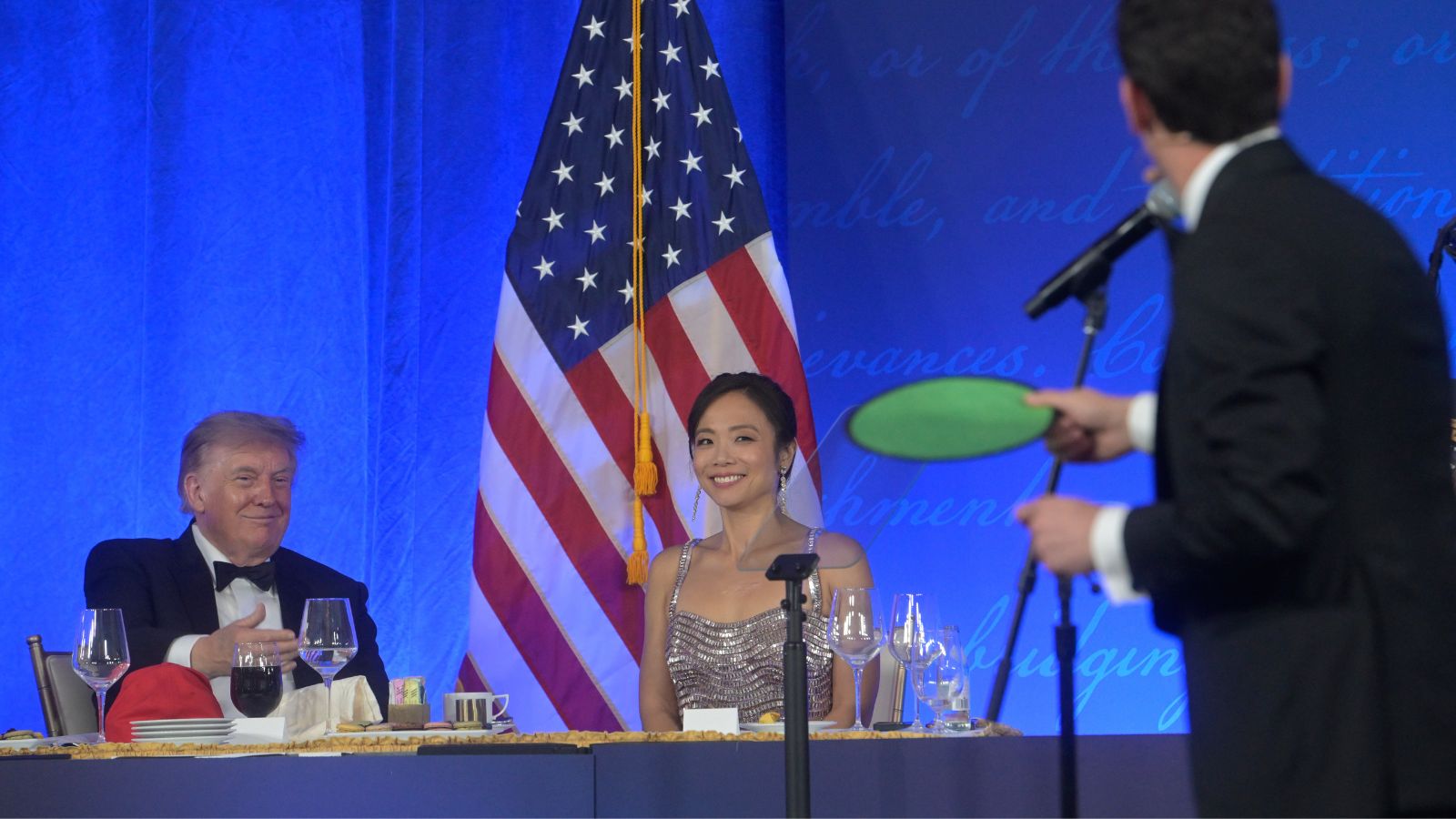
The room air conditioning hummed too loudly at the Waldorf Astoria, masking the quiet friction of an administration cornered by its own paper trail. When Donald Trump stepped to the microphone at the rescheduled White House Correspondents Association dinner and muttered that it had "not been an easy evening," he wasn't just deploying his standard adversarial shtick against the press corps. He was acknowledging a much deeper structural vulnerability. Moments prior, reporters from The Wall Street Journal walked up to collect accolades for pinning down an explosive 2003 birthday message addressed to Jeffrey Epstein.
To understand why that specific moment mattered more than the recycled insults or the predictable standing ovations, you have to look past the superficial theater of Washington galas. You have to look at the mechanics of institutional accountability, the billion-dollar defamation lawsuits crawling through federal dockets, and the way elite political survival depends on managing historical memory.
The Anatomy of a High-Stakes Journalistic Brawl
For decades, the annual correspondents gathering functioned as a predictable ritual of mutual detente. Politicians cracked self-deprecating jokes; reporters laughed just enough to maintain access. But the dynamics shift dramatically when the reporting in question is not about standard policy failures or routine political scandals. It touches directly upon the dark, subterranean network of Jeffrey Epstein—a third rail that no political actor in Washington touches without risking electrocution.
Last year’s explosive report by the Journal detailed a 2003 greeting card and drawing allegedly bearing Trump's signature, referencing shared secrets and addressing Epstein as a pal. The response from the White House was swift, angry, and litigious. A multi-billion-dollar libel suit was filed against the paper's parent company, Rupert Murdoch, and the journalists involved. Yet, months later, federal judges have allowed parts of the underlying scrutiny to persist, refusing to grant easy dismissals under the stringent actual malice standard.
When those exact journalists took the stage to receive honors, Trump sat only feet away, clapping mechanically, offering tight-lipped smirks, and occasionally shrugging. It was a masterclass in enforced restraint. But the forced compliance could not hold. Once the president took the podium, the veneer cracked. The jokes about unhireable reporters and rigged awards betrayed a profound irritation that no amount of spin can fully sanitize.
The Cost of Access Journalism in an Era of Legal Warfare
The broader implications extend far beyond bruised egos at a black-tie banquet. We are watching a collision between aggressive investigative journalism and aggressive lawfare. When a media outlet faces a ten-figure lawsuit for publishing uncomfortable archival discoveries, the economic and psychological pressure on newsrooms is immense.
In private corporate boardrooms across Manhattan and Washington, risk-averse executives often question whether pursuing stories about politically radioactive figures is worth the litigation costs. Every time an investigative team wins an award for uncovering historical ties between power brokers and sex traffickers, it serves as both a shield and a warning. It proves that public interest reporting still functions, but it also highlights the grueling personal and professional toll exacted on reporters who refuse to back down.
Consider the legal architecture of the case. Proving defamation against a public figure requires establishing actual malice—knowing falsity or reckless disregard for the truth. The Journal’s legal defense has consistently relied on the assertion that their evidence is derived from authentic archival records compiled long before these political battles materialized. By honoring this work, the journalism community sent an unmistakable signal: institutional memory will not be rewritten simply because powerful individuals file motions to compel silence.
The Unresolved Horizon
Beneath the polished floorboards of the ballroom lies an awkward truth. The public hunger for transparency regarding Epstein’s associates remains insatiable, yet the mechanisms designed to deliver that transparency are constantly bogged down by partisan warfare and legal intimidation. Every document release, every unearthed birthday card, and every contested signature acts as another fracture in the official narratives maintained by successive establishments.
Trump can mock the journalists, joke about his lack of control over the judging panels, and pivot back to his standard grievance-laden stump delivery once the teleprompter scrolls past the pleasantries. But the awards remain on the mantelpieces, and the legal briefs keep piling up in federal court.
The friction witnessed under the chandeliers of the Waldorf was not an anomaly. It was the sound of a permanent clash between an administration desperate to bury its past and an investigative press corps determined to excavate it.
The Wall Street Journal Wins Award For Epstein Report And Donald Trump's Reaction At WHCA Dinner
This short clip captures the exact moment and visual reaction as the room acknowledged the investigative reporting that dominated the political conversation.
http://googleusercontent.com/youtube_content/1