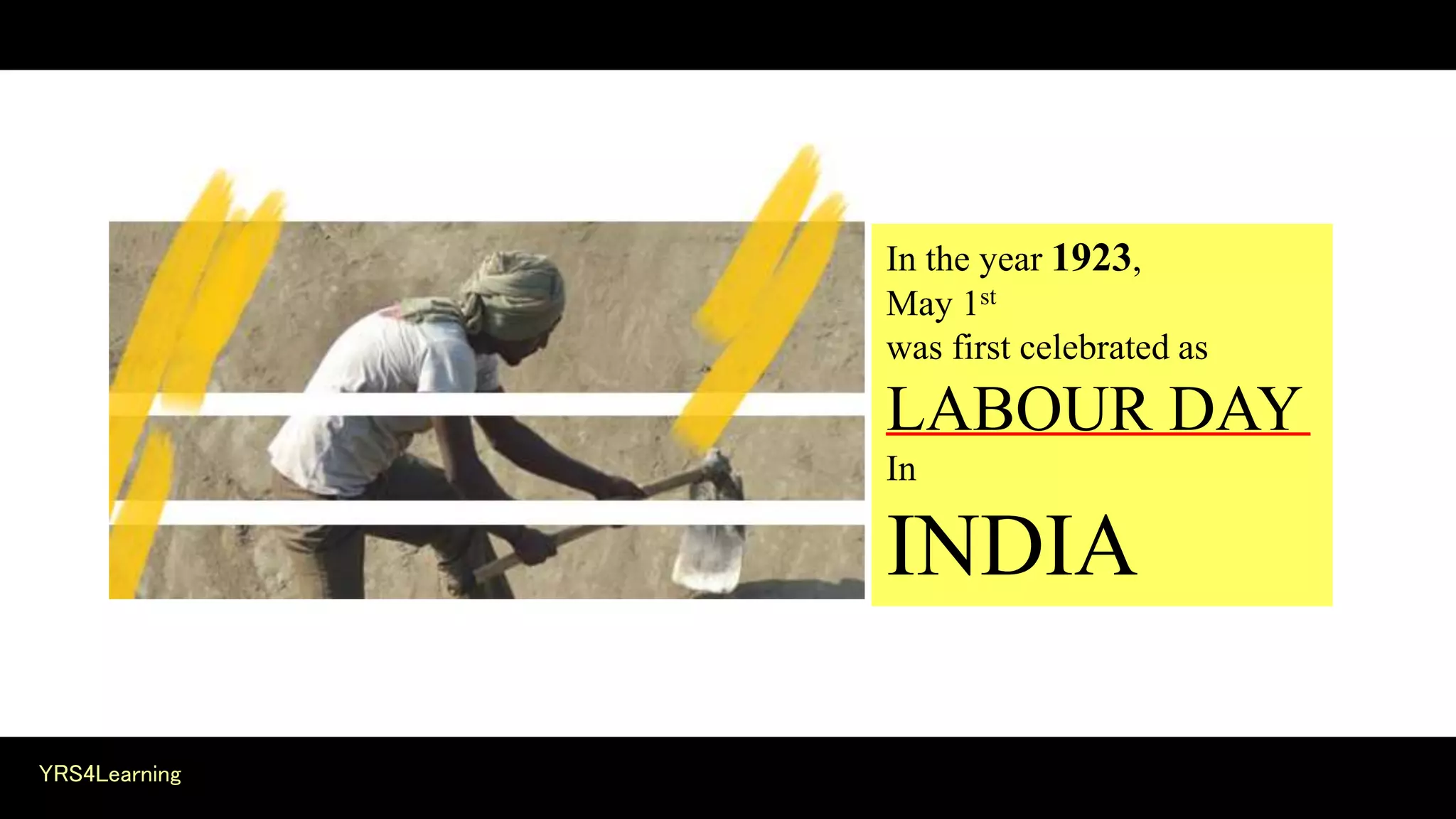
The red flags are flying, the megaphones are screeching, and the streets are clogged with people celebrating a version of work that died forty years ago. Every May 1st, we witness the same tired ritual: a collective celebration of the "worker" as a static, industrial cog demanding more grease for the same old gears.
The media loves it. They paint a picture of a noble struggle against the machine. But here is the cold truth that no union leader or HR "culture warrior" will tell you: International Labour Day has become a funeral for productivity. By clinging to the 19th-century definition of labor, we are actively sabotaging the 21st-century reality of value creation.
If you are still marching for a shorter work week without fundamentally changing how you work, you aren't a revolutionary. You’re a luddite in a better-fitting t-shirt.
The Collective Bargaining Trap
The "lazy consensus" of modern labor movements is that power exists in numbers. In the age of steam and steel, that was true. If you pulled ten thousand men off a factory floor, the owner felt the burn. Today? If you pull ten thousand data entry clerks or mid-level managers off the "floor," half of them will be replaced by a Python script before the sun sets.
The industrial-era mindset views labor as a commodity. Commodities are easily replaced. When you demand "rights" based solely on your existence as a warm body in a chair, you are signaling to the market that you have nothing unique to offer. You are inviting automation to eat your lunch.
I’ve sat in boardrooms where executives watch these protests with a mix of boredom and relief. Why relief? Because as long as the workforce is focused on collective "protections," they aren't focused on individual optionality. They aren't becoming so specialized that the company can't afford to lose them.
The most dangerous thing you can be in the modern economy is "protected." Protection breeds stagnation. Stagnation is a death sentence in a world where the half-life of a technical skill is now roughly five years.
The 40-Hour Week is a Psychological Prison
The biggest lie celebrated on May 1st is the triumph of the 40-hour work week. We treat it like a holy grail. In reality, it is an arbitrary box that forces high-performers to slow down and low-performers to pretend they are busy.
Standardizing time is the enemy of results.
Imagine a scenario where two developers are tasked with building the same API. Developer A does it in four hours of deep, focused flow. Developer B takes forty hours because they spend half their time in "alignment meetings" and the other half wrestling with a messy codebase.
Current labor laws—the ones people are cheering for today—insist that Developer B is the "harder worker." They might even get overtime. Developer A, meanwhile, is penalized for their efficiency or forced to "fill the time" with busywork.
International Labour Day reinforces the idea that we are selling our time rather than our output. This is a loser’s game. Time is finite; output is theoretically infinite. When you sell time, you have a hard ceiling on your earnings and your freedom. When you sell results, you own the leverage.
The Myth of the "Work-Life Balance"
Every Labour Day speech mentions "work-life balance." It’s a term designed to make you feel like a victim of your own career. It suggests that work is a toxic sludge you must carefully balance against the "real" parts of your life.
This binary is a relic of the assembly line. If your work is so soul-crushing that you need a movement to help you escape it for a few hours, the problem isn't the hours. The problem is the work.
The highest earners and the most satisfied people I know don't have "balance." They have integration. They have found a way to align their curiosity with their income. They don't want a strike; they want more autonomy.
The protests we see today aren't asking for autonomy. They are asking for a more comfortable cage. They want better healthcare in exchange for their agency. They want "job security," which is a polite term for a guaranteed paycheck regardless of whether they grow or provide value.
Equity is the Only Real Security
Real labor power doesn't come from a picket line. it comes from equity.
The "us vs. them" narrative of International Labour Day—the workers vs. the owners—is a false dichotomy that keeps you poor. In the modern world, the barrier to becoming an "owner" is lower than it has ever been. You don't need a textile mill. You need a laptop and a specialized skill.
Instead of marching for a 3% raise that gets eaten by inflation before the ink is dry, people should be demanding equity. If you aren't an owner, you are a cost center. And cost centers are meant to be minimized.
I have seen companies lay off thousands of "protected" workers while the engineers and strategists with skin in the game—those with stock options and performance-based upside—walked away with generational wealth. The crowd in the street is fighting for the crumbs while the "insiders" are building the bakery.
The Brutal Truth About "Upskilling"
"People Also Ask": How can labor unions help me in the digital age?
The honest answer? They can't. Not really. They can slow down the inevitable, but they can't stop it.
A union can't negotiate with an AI. It can't strike against a decentralized autonomous organization (DAO) or a global marketplace of freelance talent. Your only defense is a "moat" of personal expertise that is impossible to commoditize.
The Labour Day crowd wants the government to pass laws to keep their jobs relevant. That is a coward’s strategy.
You should be looking for the jobs that cannot be protected by a law. If a bureaucrat can protect your job, a bureaucrat can also destroy it. If your value is based on a specific regulation or a collective agreement, you have zero leverage.
Stop Celebrating, Start Competing
The sentimentality of International Labour Day is a distraction. It’s a Victorian-era solution to a space-age problem. While you are busy celebrating the "power of the masses," the smartest people on the planet are leveraging technology to become an army of one.
We are moving toward a "permissionless" economy. You don't need a union to give you permission to work. You don't need a boss to give you permission to create.
The real "workers' rights" movement isn't happening in the streets. It’s happening in the quiet corners of the internet where people are learning to code, learning to sell, and learning to build systems that work while they sleep.
They aren't asking for a 35-hour work week. They are building a life where "hours" are an irrelevant metric.
The next time you see a Labour Day parade, look closely at the signs. Most of them are asking for things that won't matter in ten years. They are fighting for the right to be a cog.
Don't be a cog. Don't march for the right to be average. Don't settle for the "protections" that actually act as a ceiling on your potential.
The era of the "Labourer" is over. The era of the "Sovereign Individual" is here.
Get off the street. Go back to your desk. Build something that makes the entire concept of a "union" look like a horse and buggy on a highway.
Your leverage is your talent, not your membership card. Your security is your skill, not a contract. Your freedom is your output, not a holiday.
Stop asking for a better master and start becoming your own.