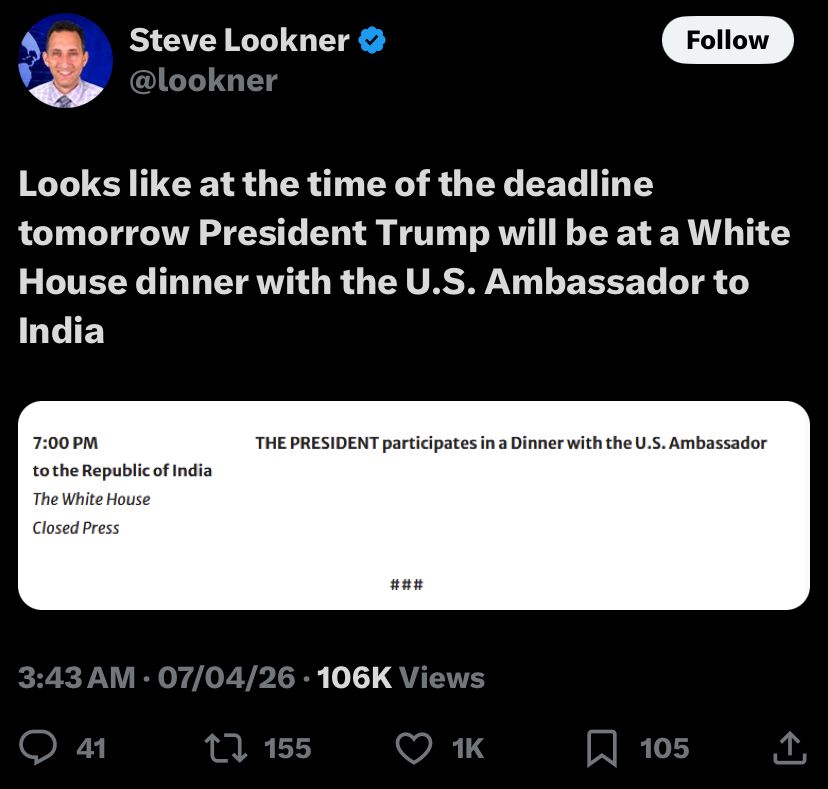
The air in Washington D.C. has a specific weight when the clocks start ticking toward a deadline. It is a humid, pressurized stillness that settles over the sandstone corridors of power. Somewhere in the West Wing, a calendar square is circled in red. It marks the day Donald Trump has decided the world must stop doing business with Iran. But a few doors down, the china is being set for a different kind of conversation.
The diplomats arriving from New Delhi aren't looking at the red circle. They are looking at the menu. They are looking at the trade charts. They are looking at the future of a billion people.
Two massive geopolitical gears are grinding against one another. On one side, the American presidency is pushing a policy of "maximum pressure" to choke off the Iranian economy. On the other, India—a rising titan with an unquenchable thirst for energy—is trying to secure its seat at the global table. The overlap isn't just a scheduling quirk. It is a collision.
The Architect and the Merchant
Consider a hypothetical desk in the State Department. On it sits a map of the Middle East and a ledger of oil tankers. The man behind the desk sees the world in binary. You are either with the sanctions, or you are against them. To him, the Iran deadline is a lever. By cutting off the flow of Iranian crude, he believes he can force a regime to its knees.
Now, fly seven thousand miles east. Imagine a small-scale factory owner in Pune. He doesn't care about the intricacies of the Joint Comprehensive Plan of Action. He cares about the price of the diesel that runs his delivery trucks. He cares about the cost of the electricity that keeps his lights on. For him, Iranian oil isn't a political statement. It is the lifeblood of his family's survival.
When Washington sets a deadline, it isn't just sending a message to Tehran. It is sending a shockwave into the wallet of that man in Pune.
A Dance on a Tightrope
The White House meeting with Indian officials was supposed to be about "strategic partnership." In the language of diplomacy, that usually means selling fighter jets and sharing satellite data. It’s the high-gloss version of international relations. But the shadow of the Iran deadline changed the temperature of the room.
India finds itself in an impossible position. To grow, it needs energy. To get energy cheaply, it needs Iran. But to become a global superpower, it needs the United States.
The tension is visceral. Imagine being invited to a dinner party by your most powerful benefactor, only to realize the main topic of conversation is why you are still friends with their worst enemy. You can’t leave the table, but you can’t finish your meal either.
The United States has offered "carve-outs" and waivers in the past. These are the crumbs of diplomacy—temporary permissions to keep buying oil while slowly weaning off the habit. But the Trump administration’s rhetoric suggests the era of crumbs is over. They want a hard break. They want the taps turned off.
The Silent Third Party
While the Americans and Indians trade talking points about regional security and bilateral trade, there is a ghost in the room.
Tehran knows exactly what is happening in Washington. They know that every barrel of oil India buys is a lungful of air for their economy. For Iran, India is more than a customer; it is a lifeline. If the U.S. successfully forces India to zero out its imports, the "maximum pressure" campaign moves from a slogan to a strangulation.
But India has its own pride. It views its "strategic autonomy" as sacred. The idea that a deadline set in Washington should dictate where a sovereign nation in Asia buys its fuel is a bitter pill to swallow. It feels less like a partnership and more like a mandate.
The Human Cost of High Stakes
We often talk about these events in terms of "geopolitics" and "macroeconomics." Those words are too clean. They hide the grit.
The real story is found in the ports of Mumbai, where dockworkers watch the horizon for tankers that might not come. It’s found in the boardrooms of American defense contractors who worry that if the U.S. pushes India too hard on Iran, the billion-dollar jet deals will evaporate.
There is a ripple effect to every signature on a White House memorandum. If India is forced to buy more expensive oil from elsewhere, inflation in Delhi rises. When inflation rises, the cost of lentils and rice goes up. A policy decision made in a climate-controlled office in D.C. can literally change the nutritional intake of a child in a rural Indian village.
The stakes are not just about who occupies a palace in the Middle East. They are about the stability of the world's largest democracy and its ability to feed its people while keeping its lights on.
The Art of the Impossible
What happens when the deadline hits?
The world expects a binary outcome. Either India obeys, or the U.S. punishes. But the reality of power is rarely that simple. Expect a series of "understandings" that are never quite written down. Expect shipments that are "in transit" for an unusually long time. Expect the kind of creative accounting that only happens when two giants realize they can’t afford to stay angry at each other.
The White House meeting was a theater of necessity. The Americans had to show strength. The Indians had to show resolve. Beneath the handshakes and the press releases, both sides were searching for the same thing: a way to save face without losing their footing.
The Iranian oil deadline isn't just a date on a calendar. It is a test of whether the United States still has the gravity to pull the rest of the world into its orbit, or if the world has become too fragmented, too hungry, and too stubborn to be told when to stop.
As the sun sets over the Potomac, the motorcades carry the diplomats back to their hotels. The red circle on the calendar remains. The deadline is coming. But in the quiet of the night, the ships are still moving across the Indian Ocean, heavy with crude, cutting through the dark water toward a future that refuses to be scheduled.