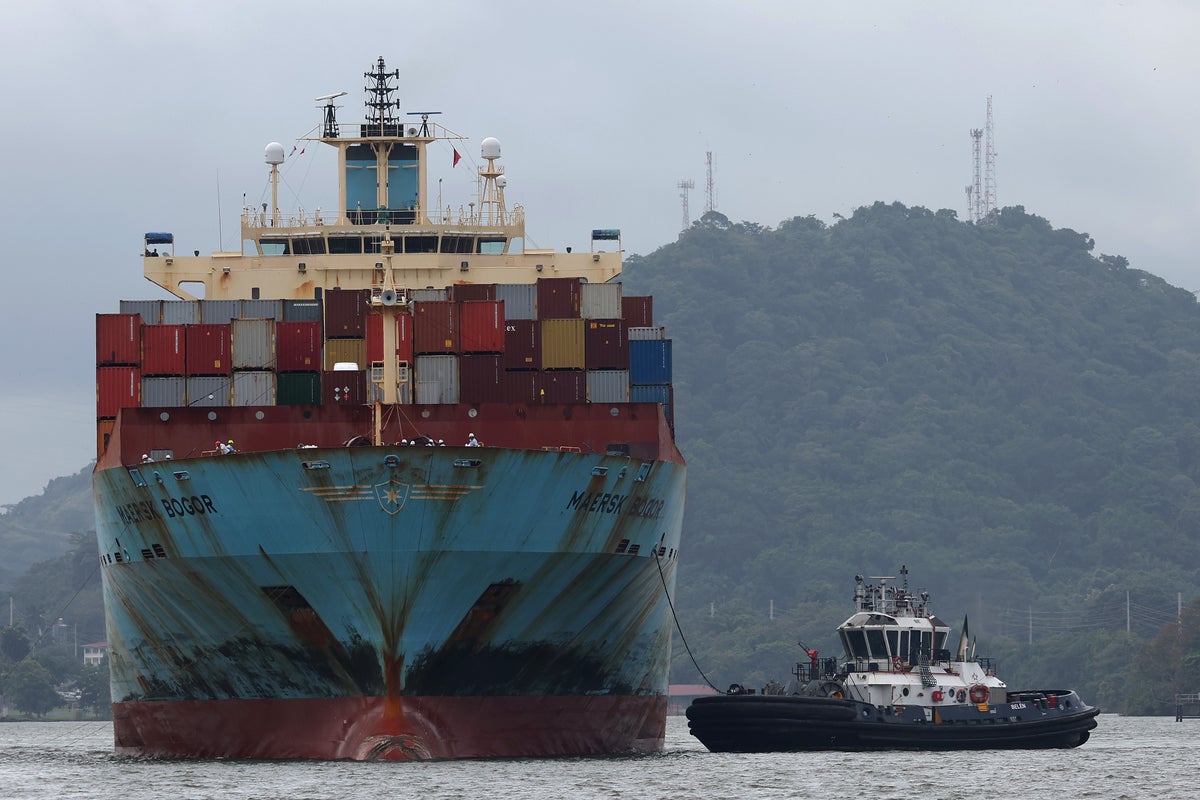
The coffee in your ceramic mug is still steaming, a quiet comfort on a Tuesday morning. You probably didn't think about the steel box that carried those beans across the world. You definitely didn't think about the man standing on the bridge of that box, squinting at a radar screen in the heat of the Red Sea, wondering if the next blip is a wave or a missile.
But the giants of global trade are thinking about it. They are doing more than thinking. They are turning around.
When a shipping behemoth decides to suspend two major routes, it isn't just a corporate press release or a line on a balance sheet. It is a cardiac event for the global economy. Imagine the Earth’s trade routes as a complex network of arteries. Right now, two of the largest vessels in that system have just developed a blockage. The blood—the grain, the fuel, the microchips, the clothes on your back—is being forced to find a longer, more painful way home.
The Strait of Broken Promises
The Bab el-Mandeb Strait is a narrow neck of water between Yemen and northeastern Africa. In Arabic, its name means "The Gate of Tears." It has earned that name a thousand times over in history, but today the tears are for the stability of a world that thought it had mastered the art of the "just-in-time" delivery.
Conflict involving Iran-backed forces has turned this narrow passage into a shooting gallery. For a captain commanding a vessel worth two hundred million dollars, carrying cargo worth five times that, the math is no longer about fuel efficiency. It is about survival.
Consider a hypothetical captain named Elias. He has spent thirty years on the water. He knows the hum of the engine room like his own heartbeat. Usually, his biggest worry is a rogue wave or a mechanical failure in the middle of the Indian Ocean. Now, he has to gather his crew and explain why they are placing extra lookouts to watch for drones that cost less than the digital watch on his wrist but can cripple a 100,000-ton ship.
When the order comes down from headquarters to "suspend operations," Elias doesn't feel relief. He feels the weight of a world rerouted.
The Long Way Round
To understand the scale of this disruption, you have to look at a map. For decades, the Suez Canal has been the shortcut of the gods. It connects the East to the West, shaving weeks off a journey.
When those routes are suspended, the ships don't just wait. They pivot. They head south. They begin the arduous trek around the Cape of Good Hope at the southern tip of Africa.
This isn't a minor detour. It is a 3,500-mile odyssey.
It adds ten to fourteen days to a voyage. Think about the fuel. A large container ship can burn 150 tons of heavy fuel oil per day. Multiply that by two weeks. Then multiply that by hundreds of ships. The carbon footprint of your next pair of sneakers just tripled. The cost of shipping that container just skyrocketed.
But the math is even more brutal than fuel costs. It’s about the "loop."
Shipping is a rhythmic dance. A ship arrives in Rotterdam, unloads, loads, and heads back to Shanghai. If every ship in that dance suddenly takes two weeks longer to finish a step, the entire choreography falls apart. Suddenly, there are no empty containers in China to fill with electronics because those containers are still bobbing off the coast of South Africa.
Empty shelves aren't caused by a lack of goods. They are caused by a lack of time.
The Butterfly in the Strait
We like to think of our lives as independent of global geopolitics. We are wrong.
The suspension of these routes is a butterfly flapping its wings in the Red Sea and causing a hurricane in a suburban big-box store. If you are waiting for a part to fix your dishwasher, it is on one of those ships. If a construction firm is waiting for specialized steel to finish an apartment complex, it is on one of those ships.
The "Iran conflict" mentioned in news tickers sounds distant. It sounds like a problem for diplomats in gray suits. But trade is the most human thing we do. It is the exchange of the fruits of our labor. When that exchange is threatened by missiles and regional posturing, the price is paid by the person at the gas pump and the parent looking at a "backordered" notification on a birthday gift.
We are seeing a reversal of decades of globalization. For years, the goal was to make the world smaller. We wanted everything faster, cheaper, and more accessible. We built a system that assumed peace was the default setting of the oceans.
We were arrogant.
The Ghost in the Machine
There is a psychological cost to this chaos that rarely makes the headlines. It is the erosion of certainty.
Business thrives on predictability. If a retailer knows a shipment will arrive on October 12th, they can plan sales, hire staff, and manage cash flow. When "October 12th" becomes "sometime in November, maybe," the gears of the economy begin to grind and spark.
Insurance companies are the first to feel the heat. War risk premiums for transiting the Red Sea have surged. In some cases, the cost to insure a single voyage has jumped by tens of thousands of dollars. These costs aren't absorbed by the shipping giants. They are passed down.
Like a bucket brigade, each person in the chain hands the cost to the next, until the last person—you—is left holding the bill.
A World Out of Sync
The real danger isn't just the delay. It’s the synchronization.
The global supply chain is currently recovering from years of pandemic-induced trauma. It was just starting to breathe again. Ports were clearing. Freight rates were stabilizing. Then, the "Gate of Tears" began to live up to its name.
This creates a "whiplash effect."
- Initial shock: Routes are suspended, and ships are rerouted.
- The Gap: For two weeks, no ships arrive at the destination ports because they are all busy rounding Africa.
- The Surge: Suddenly, all the rerouted ships arrive at once, overwhelming the cranes and the truckers.
The result is a stagnant pool of cargo. Trucks sit idle for weeks, then work twenty-hour shifts to clear the backlog. Warehouses overflow. Prices spike because the supply is lumpy and unpredictable.
The Human Toll at Sea
While we worry about the price of goods, we should consider the people trapped in the middle of this geopolitical chess game.
Seafarers are the invisible backbone of our civilization. They live in steel cities for months at a time, separated from their families by thousands of miles of salt water. Now, they are being asked to sail through a combat zone or spend an extra month at sea with no shore leave.
Imagine being a deckhand from the Philippines or an engineer from Ukraine. You signed up to move cargo, not to be a target. You watch the news and see your company's name in the headlines. You see the "suspension" of routes and wonder if your ship is the last one through or the first one to turn around.
The mental strain is immense. Fatigue leads to mistakes. Mistakes on a ship carrying hazardous chemicals or thousands of tons of fuel can lead to disasters that make a supply chain delay look like a minor inconvenience.
The End of the Shortcut
We are entering an era where the shortest distance between two points is no longer a straight line. It is the safest line.
This shift changes how companies think about where they make things. If the sea is no longer a reliable highway, "near-shoring" becomes the new obsession. Why build a factory in Vietnam if the route to Europe can be cut off by a handful of militants with a drone? Why rely on a global network that can be paralyzed by a single regional conflict?
The "supply chain chaos" isn't just a temporary glitch. It is a signal. It is the sound of the world re-evaluating the price of distance.
The shipping giants who suspended these routes didn't do it because they wanted to. They did it because the risk-reward ratio of modern civilization has shifted. The invisible lines that connect our lives are more fragile than we ever cared to admit.
Tonight, when you look at the things in your home, try to see the ghosts of the journey they took. See the Cape of Good Hope. See the tired eyes of Captain Elias. See the narrow, dangerous water of the Bab el-Mandeb.
Our world is held together by a thin ribbon of wake behind a ship, and right now, that ribbon is being tied in knots.
The coffee in your mug is a miracle of logistics, a survivor of a global storm. Enjoy it. It took the long way to get to you.