The steel hull of the Stena Impero vibrates with a low, rhythmic thrum that you feel in your teeth before you hear it in your ears. On the bridge, the air is thick with the smell of scorched coffee and the sterile ozone of cooling electronics. Outside, the horizon is a hazy, shimmering line where the Persian Gulf meets a sky the color of bleached bone.
To a casual observer, it is just a ship. To the global economy, it is a floating organ, carrying the lifeblood of modern existence through a passage so narrow it feels like a chokehold.
This is the Strait of Hormuz.
At its tightest point, the shipping lanes are only two miles wide. On one side lies the jagged coast of Oman; on the other, the watchful eyes of Iran’s Revolutionary Guard. Twenty percent of the world’s liquid petroleum passes through this needle’s eye. When the "blood" stops flowing here, the world gets a fever. Gas prices in suburban Ohio spike. Heating bills in Berlin become unpayable. The delicate clockwork of global logistics grinds its gears.
The Weight of the Escort
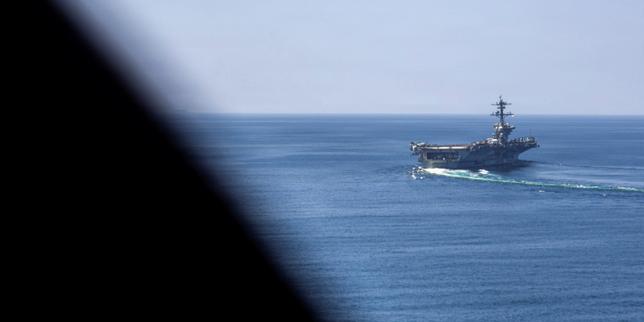
Everything changed this morning. For the first time in this current cycle of tension, a commercial tanker didn't make the transit alone. Looming off its port quarter was the unmistakable silhouette of a U.S. Navy destroyer, a grey ghost slicing through the turquoise water.
There is a specific kind of silence that falls over a crew when they realize they are being hunted—or protected. It is the silence of men who know that their 900-foot vessel, despite its massive bulk, is essentially a giant, slow-moving target filled with highly flammable cargo.
The presence of the American escort is more than just a military maneuver. It is a loud, metallic statement of intent. It says that the "freedom of navigation"—a phrase that sounds like dry legal jargon in a courtroom—is actually a physical reality that must be enforced with cannons and radar-guided missiles.
The Anatomy of a Chokepoint
Why does this specific stretch of water matter so much?
Imagine a massive hourglass. The top bulb is the wealth and production of the Middle East. The bottom bulb is the energy-hungry markets of Asia, Europe, and North America. The Strait of Hormuz is the narrow neck. If you pinch that neck, the entire system fails.
In recent weeks, the "pinch" has become literal. Drone swarms, limpet mines, and fast-attack boats have turned these waters into a chessboard where the pawns are worth hundreds of millions of dollars. The risks aren't just theoretical. When a tanker is seized or damaged, insurance premiums for every other ship in the region skyrocket instantly. Those costs aren't swallowed by the shipping giants; they are passed down to you, reflected in the price of a plastic toy or a gallon of milk.
Consider the physics of the situation.
$F = ma$.
Force equals mass times acceleration. A fully loaded supertanker can weigh over 300,000 tons. It cannot stop quickly. It cannot dodge a fast-moving drone. It is a behemoth of momentum. To protect it, you need more than just armor; you need a perimeter of digital and physical awareness that extends miles beyond the ship's railing.
The Digital Shield
The escort isn't just about the guns you can see. It is about the invisible web of signals you can't.
Modern naval protection involves a constant, high-stakes battle in the electromagnetic spectrum. The destroyer uses Aegis combat systems to track hundreds of targets simultaneously—from a low-flying cruise missile to a small fiberglass boat masquerading as a fishing vessel.
There is a psychological toll on the sailors involved in these transits. On the tanker, the merchant mariners are civilians. They signed up to move cargo, not to be the centerpiece of a geopolitical standoff. On the destroyer, the crew lives in a state of "Condition Zebra," where every bulkhead is sealed, and every sense is tuned to the slightest anomaly on a screen.
They are waiting for a blip. A shadow. A signature that shouldn't be there.
The Ripple Effect
When that first tanker cleared the strait under the watchful eye of the Navy today, a collective breath was held across the financial districts of London and New York.
But this isn't a victory; it's a temporary stabilization. The fundamental problem remains. We live in a world where our comfort is predicated on the stability of a few square miles of water on the other side of the planet. We have built a civilization on "just-in-time" delivery, which assumes that the roads—or in this case, the sea lanes—will always be open.
When they aren't, the facade of our complex modern life begins to crack.
The escort is a band-aid on a deep, structural wound in international relations. It proves that trade can move, but it also proves that trade is no longer free. It is guarded. It is conditional. It is expensive.
As the sun sets over the Gulf, the tanker moves into the open Arabian Sea, finally detaching from its grey shadow. The crew on the bridge might finally pour a fresh pot of coffee. The destroyer turns back, ready to pick up the next ward in this dangerous game of maritime shepherd.
The world keeps turning because the oil keeps moving, but the cost of that movement is written in the wake of warships. We are all passengers on that tanker, whether we realize it or not, staring out at a horizon that feels a little more crowded, and a lot less certain, than it did yesterday.
The grey ghost remains on the line, waiting for the next heartbeat of the global engine to pulse through the strait.