The sea has a way of hiding the world's friction until you run right into it. On a clear Tuesday morning, the English Channel looks less like a geopolitical fault line and more like a vast, glittering highway. For the crew of a small, British-registered pleasure yacht, June 16, 2026, was supposed to be about the simple, rhythmic mechanics of sailing. Blue water. Crisp air. The familiar silhouette of the Isle of Wight slipping away into the midday haze behind them.
Then came the flash. Then the sound.
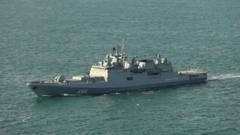
A dull, metallic thud that carries across open water with terrifying clarity. Five hundred yards away—a distance easily covered by a casual runner in less than two minutes—a 400-foot gray wall of steel sat low in the water. It was the Admiral Grigorovich, a heavily armed Russian guided-missile frigate. It had just fired a warning shot.
Imagine the sudden, jarring shift in reality on board that fiberglass yacht. One moment you are checking lines and pouring coffee; the next, you are staring down the barrel of a warship belonging to a nuclear superpower, computing the sheer, terrifying asymmetry of your situation. You have a mainsail and a VHF radio. They have tracking radar, torpedo tubes, and cruise missiles.
The water beneath you is international. The air in your lungs is freezing.
The Geometry of a Near Miss
Maritime law is governed by strict, unspoken geometry. To understand what happened 20 nautical miles south of the Isle of Wight, consider the concept of a "closest point of approach." Warships are inherently paranoid entities. They operate under the assumption that anything approaching them could be a threat, a spy, or a distraction.
According to British defense sources, the civilian yacht had drifted within 500 meters of the Russian frigate around 11:40 a.m. On the open sea, 500 meters is an uncomfortably tight perimeter. The Grigorovich broadcasted a warning over the radio waves, a standard VHF call demanding the smaller vessel alter its course.
The yacht did not respond.
Perhaps the crew was distracted by the wind. Perhaps the radio was crackling, tuned to the wrong channel, or drowned out by the snap of canvas. On a pleasure boat, the ambient noise of survival—the wind in the rigging, the slap of waves against the hull—can easily isolate you from the digital world. But to the Russian watch officers staring through high-powered optics on the bridge of a frigate, silence looks like intent.
The escalation ladder at sea is rigid. First comes the radio call. If silence follows, the next step is visual: a warning shot. It is not meant to hit. It is meant to shatter the illusion of solitude.
It worked.
No fiberglass was splintered. No blood was spilled. The yacht adjusted its helm, catching the breeze, and continued its journey through the rolling swells. But the peace of the afternoon was permanently broken.
Shadows in the Channel
What the civilian sailors likely did not realize as they navigated that stretch of water was that they were sailing through a high-stakes game of hide-and-seek that had been playing out for weeks.
The Admiral Grigorovich is not a stranger to these waters. Belonging to Russia's Black Sea Fleet, the frigate has spent the early summer loitering just outside the UK's 12-mile territorial limit. It has been spotted near offshore wind farms off the coast of Suffolk. It has acted as a heavily armed sheepdog, escorting the "shadow fleet"—the aging, unflagged tankers used by Moscow to smuggle oil past Western sanctions.
And it was not alone.
Even before the warning shot was fired, the Royal Navy was there, watching from the periphery. The offshore patrol vessel HMS Mersey was actively shadowing the Russian warship, tracking its thermal signatures and radar emissions. The moment the incident occurred, the grid went live. A Royal Navy Wildcat helicopter scrambled, its rotors chopping through the coastal air as it tore across the Channel toward the coordinates. Another British patrol ship, HMS Tyne, deployed a rigid-hulled seaboat to intercept the yacht, checking on the rattled crew and piecing together the timeline.
To the casual observer on the beach at Portsmouth, the horizon looks empty. In reality, it is crowded with ghosts.
Consider the timing. Just forty-eight hours earlier, British commandos had conducted a high-risk boarding operation in the very same channel, seizing the Smyrtos, a suspected Russian shadow-fleet tanker. The captain of that tanker—an Indian national caught in the gears of global economics—was sitting in a British jail cell at the exact moment the Grigorovich opened its ammunition lockers.
Military officials insist the two events are entirely separate. They call the warning shot an isolated incident of maritime traffic mismanagement.
But psychology matters. Soldiers, like sailors, do not operate in a vacuum. Tensions do not stay neatly compartmentalized when the geopolitical thermostat is dialed to a boil. When you squeeze a nation's economic lifeline on Sunday, its warships are understandably twitchy on Tuesday.
"Warships, it doesn't matter who you are or where you're from, are entitled to self-defence. If a ship or yacht is approaching, the rules of force escalation will start with a radio warning. If there is no response, the next step is designed to get your attention." — Martin Kelly, Maritime Crisis Advisory Specialist
The Illusion of Distance
We like to think of international conflicts as distant things. We watch them on glowing screens from the safety of our kitchens. We treat the war in Ukraine or the sanctions in Europe as abstract chess games played by people in suits.
Then a civilian pleasure craft gets shot at within sight of the English coast.
The true takeaway of Tuesday's encounter is how incredibly thin the barrier is between civilian normalcy and military reality. The global commons—the oceans we use for trade, travel, and weekends away—are shrinking. The rules that kept the peace for decades are fraying at the edges, worn thin by friction.
The U.K. Ministry of Defence is currently reviewing the logs, the radio transcripts, and the statements from the yacht's crew. They are trying to determine if the Russian frigate was acting out of genuine navigational panic or executing a deliberate act of intimidation. There is even quiet speculation among naval tech analysts that the Grigorovich may have suffered a temporary steering or mechanical failure, making its crew hyper-defensive about any vessel closing the distance.
Ultimately, the technical reason matters less than the emotional reality left in its wake.
The yacht has since vanished into a safe harbor somewhere along the coast. The hull is intact. The sails are packed away. But for those on board, the sea will never quite look the same again. They learned, in the span of a single heartbeat, that you don't have to go looking for history to find it.
Sometimes, it finds you. And sometimes, it doesn't miss by much.