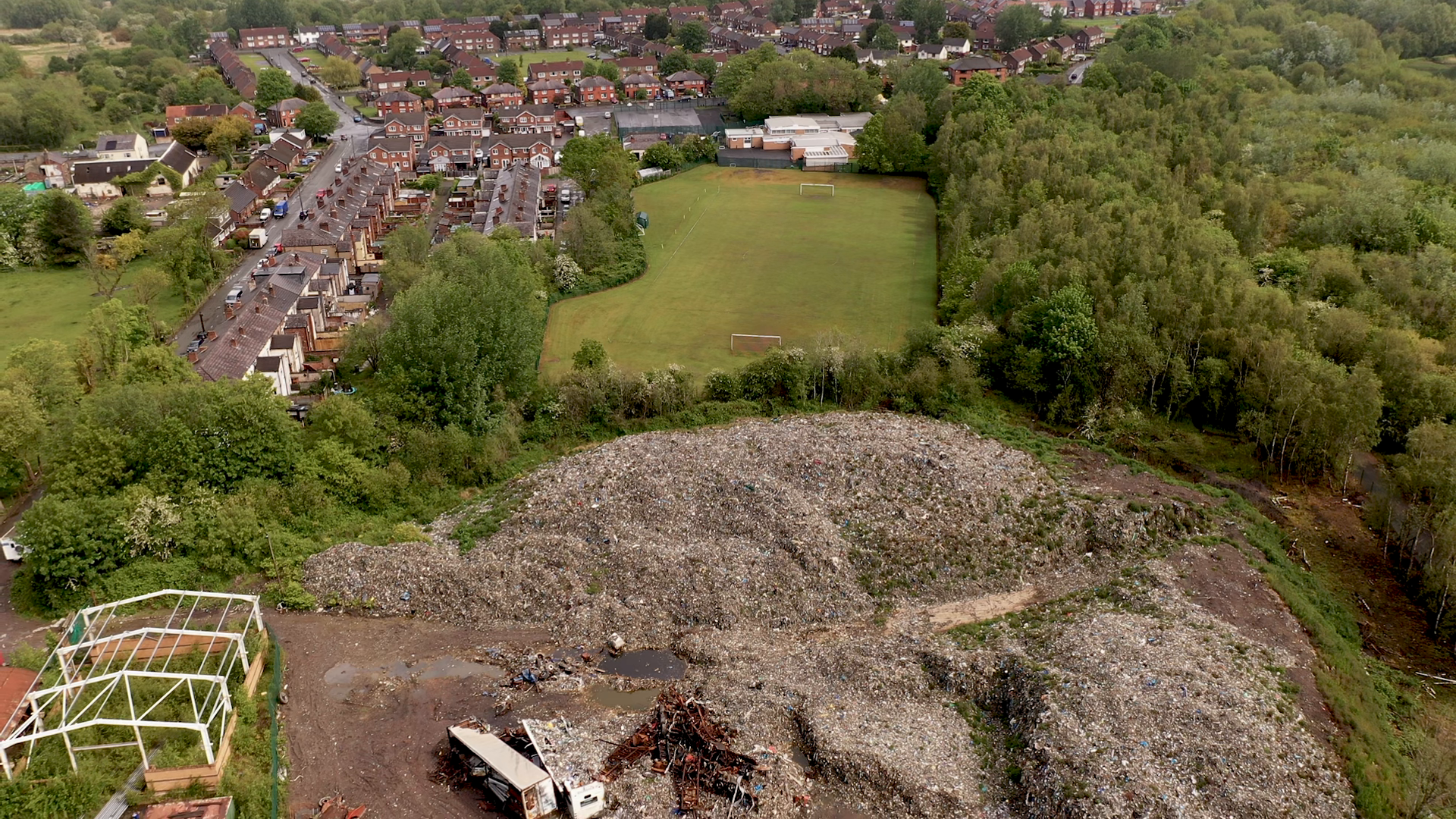
The smell always arrived before the morning kettle boiled.
It did not smell like ordinary household trash—the sour, familiar tang of spoiled milk or damp cardboard you might catch on bin collection day. It was sharper. Metallic. A chemical sweetness that clung to the back of the throat like burnt sugar mixed with rotting eggs, forcing an involuntary cough before your eyes had even adjusted to the grey English dawn.
For years, living beside one of England’s most notorious illegal waste sites meant learning to live with the windows sealed shut in the middle of July. It meant wiping a fine, unidentifiable grey grit off garden furniture every weekend. Mostly, it meant wondering, in the quiet hours between midnight and four in the morning, what exactly was drifting across the boundary fence and settling into the lungs of the people you loved.
Now, the letters have finally started dropping through the letterboxes.
Health checks. Free, localized medical screenings offered to residents living in the shadow of an environmental disaster that took years to build and even longer to acknowledge. On paper, a health check sounds like a triumph of public care. In reality, when a government agency offers to test your blood and listen to your lungs because of the soil a quarter-mile from your kitchen, it does not feel like comfort. It feels like a quiet confession.
The Architecture of a Slow Emergency
To understand why a pop-up clinic in a local community hall carries so much emotional weight, you first have to understand how an illegal dump actually happens. People often picture criminal dumping as a rogue pickup truck backing up to a country lane under the cover of darkness, tipping a load of rubble, and speeding away.
That is fly-tipping. What happens at England’s worst illegal waste sites is industrial, organized, and terrifyingly brazen.
Consider a hypothetical family—let us call them the Millers—who bought a terraced house on the edge of a quiet industrial estate a decade ago. At first, the plot of land down the road was just an empty yard behind a corrugated iron fence. Then came the lorries. Dozens of them every day, rumbling past the primary school gates, carrying shredded plastics, pulverized plasterboard, treated timber, and industrial sludge. The operators had permits for a fraction of what they brought in, or no permits at all. They stacked the waste thirty, forty, fifty feet high until it formed a synthetic mountain range blotting out the horizon.
The Environment Agency calls this large-scale waste crime, an illicit economy that costs England roughly one billion pounds every year. Yet numbers like a billion pounds are too big to feel. They slide right off the human brain.
What you can feel is the heat.
Deep inside a mountain of shredded, unsegregated waste, bacteria go to work. Without oxygen, decomposition generates methane and intense thermal energy. Think of a backyard compost heap on a cold morning, steaming gently when you turn it with a fork. Now multiply that biological engine by fifty thousand tons of mixed plastics, chemicals, and damp gypsum, compressed under its own crushing weight. The core of the pile begins to smolder. Subterranean fires break out, burning invisible and unreachable twenty feet beneath the surface for months at a time.
When plasterboard burns alongside household plastics, the chemistry turns hostile. Hydrogen sulfide gas—the compound responsible for that rotten-egg stench—seeps through the fissures in the mountain. Alongside it come volatile organic compounds, particulate matter so microscopic it bypasses the nose’s natural defenses, and heavy metals carried aloft on plumes of acrid smoke.
For the Millers, the mountain was no longer an eyesore. It had become an active, unregulated chemical reactor operating right next to their children’s bedrooms.
When the Air Turns Against You
Living near a chronic environmental hazard changes your relationship with your own body. Every minor ailment loses its innocence.
A persistent tickle in a toddler's throat is no longer just a winter cold picked up at nursery; it becomes a terrifying question mark. A sudden migraine on a humid Tuesday afternoon makes you check the wind direction before you reach for the paracetamol. You begin keeping a mental ledger of symptoms—nosebleeds, itchy eyes, an unexplained tightness across the ribs when walking up the stairs—while simultaneously talking yourself out of sounding hysterical.
Doctors and public health officials operate on a completely different clock than frightened residents.
Epidemiology, the science of tracking disease patterns across populations, requires vast amounts of data and years of observation before it can declare absolute proof of cause and effect. A local general practitioner seeing ten patients with adult-onset asthma in a single postcode cannot legally or scientifically point a finger at a nearby waste site without rigorous toxicology reports. The burden of proof is agonizingly high.
Historically, communities living near severe industrial pollution—from the valleys of South Wales to the outskirts of major landfills across the Midlands and the North—have faced the exact same wall of bureaucratic caution. Agencies issue statements reminding the public that odors, while unpleasant, do not automatically equate to long-term physical harm. The air quality monitors, often placed miles away or calibrated to measure standard traffic pollution rather than complex industrial off-gassing, frequently return readings deemed within acceptable limits.
Yet human biology does not wait for a five-year peer-reviewed study.
Long-term exposure to elevated levels of fine particulate matter, known as PM2.5, is well-documented by the World Health Organization as a driver of cardiovascular stress and respiratory inflammation. Hydrogen sulfide, even at low concentrations that merely trigger a foul smell, can irritate the mucous membranes, trigger nausea, and exacerbate pre-existing conditions like chronic obstructive pulmonary disease. When stress is added to the equation—the relentless, grinding anxiety of feeling trapped in a home you can no longer sell because no mortgage lender will touch a property next to a toxic site—the physical toll compounds. Cortisol floods the bloodstream. Sleep fractures. The immune system frays.
Inside the Clinic Room
Which brings us back to those letters arriving on doormats across the affected neighborhoods.
When local health authorities finally mobilize to offer targeted health checks near a major illegal waste site, it marks a profound shift in posture. It is an admission that the environmental breach has crossed the threshold from a regulatory headache into a potential public health crisis.
If you walk into one of these community screening clinics, the atmosphere is stripped of political drama and reduced to quiet, clinical intimacy. There are no shouting matches with council leaders here. There is only a nurse with a blood pressure cuff, a clipboard, and a series of carefully worded questions.
What do these checks actually look for? To understand their purpose, imagine a mechanic inspecting a car after it has been driven through a severe dust storm. The mechanic cannot easily undo the miles already driven, nor can they always pinpoint which single grain of sand scratched an engine cylinder. Instead, they check the filters, measure the fluid levels, and establish a clear record of how the engine is running right now so they can spot any rapid deterioration six months down the line.
In human terms, the screening focuses heavily on the frontline defenses of the body:
- Respiratory function: Patients blow hard into a spirometer, measuring how much air their lungs can hold and how quickly they can force it out. This detects early narrowing of the airways long before a person might notice they are short of breath.
- Cardiovascular baselines: Blood pressure, pulse rhythm, and cholesterol markers are recorded, recognizing that chronic exposure to airborne particulates places quiet, continuous strain on the heart and blood vessels.
- Symptom mapping and exposure history: Clinicians document precisely when headaches occur, how often inhalers are used, and whether symptoms vanish when a resident goes away on holiday for a week—one of the clearest real-world indicators of a localized environmental trigger.
The truth, uncomfortable as it is, must be stated plainly. A routine blood test or a lung capacity check cannot always detect trace exposure to every synthetic compound hiding inside an illegal dump. Toxicology is notoriously complex; many chemicals pass through the human body within days, leaving behind cellular irritation without leaving a neat chemical fingerprint in a vial of blood.
I remember sitting in a sterile examination room myself years ago, watching a technician label tubes after an industrial leak near my own street, feeling a strange collision of gratitude and dread. You want the test to come back completely clean because you want to be healthy. At the exact same time, a tiny, desperate part of you wonders: If the test says I am fine, will they stop trying to clean up the mess outside?
That is the unspoken paradox every resident carries into the clinic.
The Economics of Impunity
To focus solely on the medical clinics, however, is to look at the bandages while ignoring the person still swinging the hammer.
Why are England’s regulatory bodies constantly playing catch-up with illegal waste sites? The answer lies in a broken financial equation that organized crime groups have exploited with ruthless efficiency.
Disposing of waste legally in the United Kingdom is expensive, and deliberately so. The Landfill Tax was designed to encourage recycling and penalize companies for burying trash in the ground. By 2026, standard landfill tax rates have climbed well past a hundred pounds per ton. If a rogue operator takes five thousand lorry loads of construction and commercial waste, collects a cash fee slightly below market rate from builders who ask no questions, and simply dumps it on a rented field or inside an abandoned warehouse, the profit margins rival narcotics trafficking—with a fraction of the prison sentences.
By the time the Environment Agency gathers enough evidence to prosecute, secure a court injunction, and revoke permits, the shell company listed on the paperwork has usually been dissolved. The directors have vanished. The cash has been laundered through legitimate-looking haulage firms.
Left behind is a towering, unstable monument of hazardous debris, a landowner who claims they were duped by their tenants, and a local council that does not have the thirty million pounds required to excavate and safely dispose of the mountain.
So the pile sits. Rainwater filters through the layers of crushed electronics, old paint tins, and treated wood, brewing a toxic liquid known as leachate that threatens to seep down into the local water table. The wind continues to blow across the summit. And the people living three hundred yards away are told to keep a symptom diary and book an appointment for a free blood pressure check.
Reclaiming the Breath
Yet something shifts when a community moves from isolated suffering to collective documentation.
In neighborhoods scarred by illegal dumping, the arrival of public health teams often becomes the catalyst that finally breaks the paralysis. Individual complaints logged on a council helpline can be dismissed as anecdotal. Hundreds of standardized medical assessments, gathered under clinical supervision and analyzed by public health directors, create an undeniable, permanent record.
Data, when gathered with rigor, becomes armor.
When local doctors begin seeing a statistically significant cluster of reduced lung function or heightened respiratory distress within a specific radius of a waste site, the conversation changes overnight. Environmental enforcement stops being treated as a budget-constrained nuisance and becomes an urgent matter of safeguarding human life. It forces emergency funding for site clearance. It pressures magistrates to hand down custodial sentences rather than paltry fines. It compels legislators to close the loopholes in waste carrier licensing that allow criminals to register a haulage company online in fifteen minutes with minimal background checks.
For the residents walking out of those community clinics today, clutching a folded slip of paper with their peak-flow numbers and blood pressure readings, the immediate relief is modest. A checkup does not clear the mountain on the horizon. It does not instantly erase the memory of sleeping with wet towels stuffed under the bedroom door to keep out the fumes.
What it offers is validation. For the first time, the institutions tasked with protecting them are looking directly at their lungs, listening to their breathing, and acknowledging that what happens on the other side of that corrugated fence lives inside them too.
Tonight, when the sun drops behind the treeline and the evening damp settles over the neighborhood, someone will stand at their kitchen sink, gaze out toward the dark silhouette of the dump, and place a hand flat against their chest just to feel the simple, quiet rise and fall of a breath they no longer take for granted.