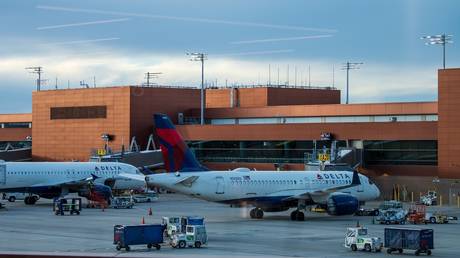
Silence.
Not the peaceful quiet of a Sunday morning, nor the hushed reverence of a library, but the heavy, suffocating stillness of Gate B14 at Hartsfield-Jackson Atlanta International Airport when the departure board freezes, the gate agent stops typing, and three hundred strangers simultaneously realize they are going nowhere.
If you have ever stood in that terminal clutching a lukewarm cup of coffee while a thunderstorm rolls across the Georgia tarmac, you know the specific, low-grade panic of a weather delay. You can look out the panoramic glass and see the enemy. Lightning forks against bruised purple clouds; rain lashes the fuselage of a Boeing 737. Mother Nature is a visible, indisputable tyrant, and while you might grumble about your missed connection in Chicago, you accept the truce. Nobody wants to fly through a hurricane.
But what happens when the sky is cloudless, the mechanics have signed off on the engines, the pilots are seated in the cockpit, and the plane still cannot move an inch?
Consider a hypothetical traveler—let’s call her Elena—sitting three rows back from the boarding door on a crisp Tuesday morning. Elena is a surgical nurse flying to Minneapolis for her father’s bypass operation. Her bag is packed with three days of scrubs, a paperback thriller she won't read, and a laminated checklist of post-op questions for the cardiologist. Outside her window, the tarmac shimmers under a bright, indifferent sun. Inside, the cabin air conditioning hums softly. Then comes the chime. The captain’s voice, usually oiled with practiced, velvety reassurance, carries a tight, metallic edge as he explains that Delta Air Lines has experienced a nationwide systems failure, and the Federal Aviation Administration has issued a ground stop.
No storm. No mechanical leak. Just a silent, invisible fracture in the digital nervous system that keeps modern aviation airborne.
The Illusion of the Steel Bird
We tend to think of airplanes as triumphs of heavy metallurgy and raw thrust. We marvel at the wingspan, the roar of the turbofans, the sheer physical audacity of lifting four hundred tons of aluminum and jet fuel into the stratosphere. Yet in the twenty-first century, an airliner does not fly on jet fuel alone. It flies on data.
To understand why a computer glitch in a windowless server room can paralyze an entire continent’s airspace, imagine a world-class symphony orchestra where every musician is blindfolded and locked in a separate soundproof booth. They can still play their instruments flawlessly. The violins are tuned; the brass is polished. The only thing keeping them from producing a deafening wall of cacophony is the single wire feeding the conductor’s tempo into their earpieces. Cut that wire, and the music stops instantly—not because the instruments broke, but because coordination died.
Aviation operates on that exact razor’s edge. Before a single wheel rolls backward from the jet bridge, a breathtakingly complex choreography of digital handshakes must occur. Weight-and-balance calculations—determining precisely how the cargo in the belly offsets the passengers in row twenty-two—must be computed and transmitted to the flight deck. Dispatchers must file flight plans with the FAA, routing the aircraft around military airspace, upper-atmosphere wind shear, and converging traffic corridors. Crew scheduling databases must verify that the first officer hasn't exceeded federal rest mandates by a single minute.
When the FAA confirms that a carrier’s internal systems have failed, the agency isn't being bureaucratic. It is pulling the emergency brake on a high-speed train whose signaling lights just went dark. Without automated dispatch, weight verification, and crew tracking, putting thousands of aircraft into the sky becomes an exercise in analog guesswork. And in commercial aviation, guesswork is the one luxury nobody can afford.
Anatomy of a Digital Standstill
News headlines reduce these moments to sterile, bloodless metrics. Delta Flights Hit With Delays Nationwide Over Systems Failure, FAA Says. The phrasing is clinical, designed to be skimmed over morning toast before flipping to the sports page. It tells you what happened, who confirmed it, and where it occurred, while stripping away every ounce of what it actually feels like to live inside the fallout.
I remember being trapped in a similar operational meltdown two winters ago—not on Delta, though the livery on the tail hardly matters when the screens go blank. What stays with you isn't the anger; anger requires energy, and airport terminals bleed you dry of stamina within four hours. What stays with you is the surreal, slow-motion unraveling of order.
First, the mobile apps lie to you. Because the central database is choking, your phone still insists your flight is "On Time" even as the departure time ticks past into the past tense. You refresh the screen with a desperate thumb, hoping the algorithm will take pity on you. Next, the customer service lines begin to snake outward from the desks like widening cracks in a windshield, curling past duty-free perfume shops and charging stations where people sit cross-legged on the carpet, guarding wall outlets like medieval fortresses.
Within six hours, the crisis stops being technological and becomes deeply biological.
Think about the cascading domino effect triggered by a three-hour ground stop. Aviation runs on tight, interlocking loops. The aircraft sitting idle on the tarmac in Atlanta isn't just missing its morning hop to Minneapolis; it is also missing its afternoon leg from Minneapolis to Seattle, its evening turnaround to Salt Lake City, and its red-eye back to the East Coast. Meanwhile, the flight attendants aboard that plane are watching their legal duty clocks tick down. Federal aviation regulations strictly limit how many hours a crew can remain on duty—a vital safety guardrail designed to prevent fatigue-induced errors. When a systems outage traps a crew on the ground for four hours, they "time out" before they even reach cruising altitude.
Even after engineers reboot the servers, patch the corrupted code, or reroute traffic around a severed fiber-optic line, the airline cannot simply flip a switch and resume normal operations. You now have hundreds of aircraft parked in the wrong cities, thousands of flight attendants stranded in hotel lobbies without room assignments, and tens of thousands of passengers whose itineraries have been shredded into confetti.
Why Modern Airlines Are Both Stronger and More Fragile
It is tempting to look at a nationwide outage and assume the airlines are running their empires on duct tape and outdated floppy disks. The reality is far more nuanced, and honestly, a little unsettling.
Over the past three decades, major carriers like Delta have built some of the most sophisticated logistics networks on Earth. During normal operations, these systems are nothing short of miraculous. They allow a global airline to move hundreds of thousands of people every single day with an astonishing safety record, dynamically rerouting planes around severe weather, predicting mechanical wear before a part fails, and squeezing fuel efficiency out of every nautical mile.
But efficiency and resilience are natural enemies.
In economics and systems engineering, there is a well-documented trade-off: the more tightly you optimize a network to eliminate waste, the less slack remains in the rope when something pulls unexpectedly. Thirty years ago, airlines kept spare aircraft sitting at major hubs and maintained reserve crews on standby, baking massive buffers into their schedules. Tickets were drastically more expensive, flights were less frequent, and the system absorbed shocks like a heavy mattress.
Today, driven by fierce competition and razor-thin profit margins, airlines operate like Formula One engines tuned to the absolute limit of their tolerances. Planes spend upward of twelve hours a day in the air. Turnaround times between landing and takeoff are compressed into frantic forty-minute windows. The software orchestrating this ballet isn't a single, clean program written from scratch; it is often a towering, multi-layered architecture where sleek modern cloud interfaces sit atop decades-old legacy mainframes that still handle core reservation and dispatch logic.
When everything talks to everything else in real time, a single corrupted data packet, a botched software update, or a third-party cloud outage doesn't stay contained in one department. It ripples outward at the speed of light, locking doors across all fifty states simultaneously.
What You Actually Owe Yourself When the Board Turns Red
If you are reading this while sitting on a terminal floor, listening to the automated voice announce another thirty-minute delay, panic won't fix the server rack. Knowledge, however, gives you leverage.
Most travelers surrender their agency the moment a systems failure hits, standing passively in a two-hundred-person queue while their best rebooking options evaporate in real time. The secret to surviving an airline tech meltdown is understanding how the system prioritizes survival once the computers come back online.
When a carrier suffers a nationwide ground stop caused by its own systems failure, the Department of Transportation classifies the disruption as "controllable." Unlike a blizzard or an air traffic control strike, an internal IT failure puts specific obligations on the airline's shoulders. Under federal passenger protection commitments, major U.S. carriers—including Delta—have pledged to rebook you on their next available flight at no additional cost, provide meal vouchers when a controllable delay stretches past three hours, and cover hotel accommodations plus ground transportation if the outage strands you overnight.
Never wait in the physical line alone. The moment the FAA announces a ground stop or an airline acknowledges a systems issue, treat it like a race against scarcity.
- Work three channels at once. Get in the physical gate line, dial the airline's reservation desk on your phone (if domestic wait times exceed an hour, call the carrier’s international support number—those agents access the exact same rebooking terminal), and open the airline’s messaging chat inside their app.
- Look at nearby airports, not just your exact route. If you are stuck trying to reach Washington, D.C., don't just ask for Reagan National; tell the agent you will take Dulles or Baltimore. Automated rebooking tools look for exact city-pair matches, leaving seats on neighboring routes untouched for passengers smart enough to ask for them.
- Screenshot everything. During a systems failure, digital records flicker and vanish. Capture your original boarding pass, the delay notifications on the airport monitors, and every receipt for food or lodging you are forced to pay out of pocket if the airline’s voucher system is also down.
The Human Cost of the Invisible
Let’s go back to Elena at Gate B14.
Three hours after the chime first sounded, the gate agent’s printer suddenly whirs back to life, spitting out a continuous ribbon of thermal paper. A collective exhale sweeps through the boarding area. Phones buzz with updated departure alerts. Across the country, dispatchers are manually clearing the backlog, flight by flight, hub by hub, coaxing the frozen giant back into motion.
Elena will make it to Minneapolis. She will miss the pre-op briefing with the surgeon, catching the tail end of the conversation over speakerphone from the backseat of a taxi speeding down Interstate 35W, but she will be there when her father wakes up in recovery. She is one of the lucky ones. Two rows behind her, a college student missed the only audition of the year for a conservatory fellowship; across the aisle, a freelance contractor lost a day of billable wages he cannot recover.
We live in an era where the most critical infrastructure in our lives has become completely invisible. We don't see the undersea cables carrying our bank transfers, the load-balancing algorithms keeping our electrical grids from brownouts, or the flight-dispatch databases holding thirty thousand aluminum tubes safely apart in the clouds. We only notice them in the exact second they break.
Next time you buckle your seatbelt, pull down the window shade, and feel the sudden, thrilling push of the engines spooling up for takeoff, take a second to appreciate the quiet miracle happening beneath your feet. It isn't just aerodynamics lifting you off the ground. It is millions of lines of code, whispering back and forth in the dark, holding the sky together so you don't have to think about how far down it is.