In a small brick house in Columbus, Ohio, Mary doesn’t think about the Strait of Hormuz. She doesn't track the movements of the Iranian Navy or the precision of drone strikes in the Middle East. When she turns the dial on her stove to simmer a pot of soup, she expects a blue flame. She expects that flame to cost roughly what it cost last month.
Across the Atlantic, in a flat in Düsseldorf, Klaus is doing the same thing. But his hand trembles slightly when he looks at his utility bill. For Klaus, the flame is a luxury, a fragile connection to a global market that can be severed by a single missile in a desert thousands of miles away. You might also find this similar coverage insightful: The Middle Power Myth and Why Mark Carney Is Chasing Ghosts in Asia.
The difference between Mary and Klaus isn’t just geography. It is the story of a massive, invisible wall that has risen around the American energy market. While the world watches the escalating conflict involving Iran with bated breath, fearing a global energy spike that could cripple economies, the United States is sitting in a pocket of strange, quiet stability.
The Geography of a Shield
For decades, the American energy story was one of vulnerability. We were tethered to the whims of distant cartels. If a tanker was harassed in the Persian Gulf, gas lines formed in New Jersey. That reality has shifted so fundamentally that we often miss the significance of the change. As extensively documented in recent reports by CNBC, the effects are worth noting.
The United States is now the largest producer of natural gas on the planet. This isn't just a statistic; it is a physical reality that changes the chemistry of our daily lives. Think of the global gas market like a massive, interconnected series of swimming pools. Most countries are in the same deep end, where a splash in one area creates waves that hit everyone else.
The U.S., however, has built its own private reservoir.
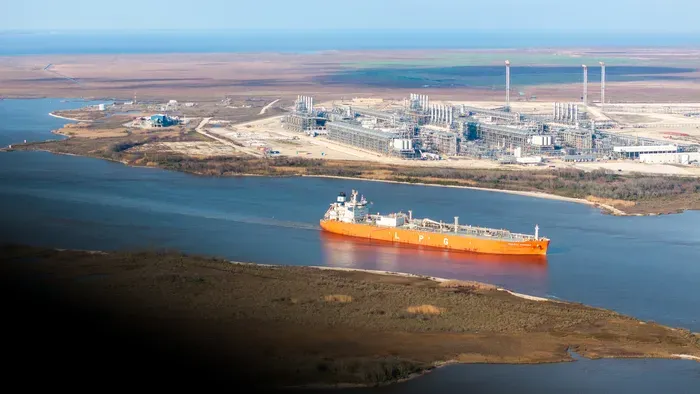
Because natural gas is difficult to move—it requires massive liquification plants and specialized tankers to cross oceans—the vast majority of what we produce stays right here. We produce more than we can possibly export. This "trapped" supply acts as a buffer. Even as war drums beat in the Middle East and global prices for Liquified Natural Gas (LNG) skyrocket, the price in the American heartland remains anchored to the ground.
When the Strait Closes
To understand the stakes, we have to look at the map. The Strait of Hormuz is a narrow chink in the world’s armor. Roughly one-fifth of the world’s total oil and gas consumption passes through that tiny stretch of water. If Iran follows through on its periodic threats to shut it down, the global supply doesn't just dip; it vanishes.
In such a scenario, the "global price" of gas becomes a vertical line on a chart. It becomes a panic.
But Mary in Columbus is protected by the Appalachian Basin and the Permian. The gas fueling her stove traveled through a pipeline from a few states away, not across a contested ocean. The physical infrastructure of the United States—the millions of miles of steel pipe buried under our feet—serves as a domestic vacuum. It keeps our resources here, shielded from the chaos of international maritime routes.
This isn't to say we are totally immune. Economics is a web, not a series of silos. If global prices triple, American producers will naturally want to sell as much as they can to Europe and Asia to chase those higher profits. This is where the export terminals come in. These massive facilities on the Gulf Coast are the only "doors" through which American gas can leave.
Currently, those doors are narrow. We can only send out so much at a time. The rest? It stays in the domestic pool, keeping prices low for the American manufacturer and the American homeowner. We are, quite literally, limited by our own plumbing, and for once, that limitation is a massive advantage for the consumer.
The Human Cost of Energy Independence
The phrase "energy independence" is often tossed around by politicians like a shiny coin. In reality, it is a gritty, complex, and often controversial industry. It’s the sound of trucks in North Dakota. It’s the sight of engineers in Houston staring at seismic data until their eyes burn.
For the person working in a glass factory in Ohio, this insulation is the difference between a steady paycheck and a "temporary layoff." Energy is the primary input for almost everything we touch. When the cost of gas stays low, the cost of making glass, steel, fertilizer, and bread stays manageable.
Consider the "Invisible Stake." If a conflict with Iran drives global energy prices to record highs, countries like Japan or Germany face an existential crisis. Their industries may become uncompetitive overnight. They may have to ration heat in the winter.
In the U.S., the conversation is different. We debate the environmental impacts of extraction and the pace of the green transition. These are vital, necessary debates. But we have the luxury of having them because we aren't currently wondering if we can afford to turn on the lights. Our "problem" is an abundance of supply—a predicament most nations would trade their entire treasuries to possess.
The Fragility of the Bubble
It would be a mistake to become arrogant. The wall is high, but it isn't impenetrable.
If a war in the Middle East lasts for years, the global pressure to open more "doors"—to build more export terminals—will become overwhelming. Our allies will beg for our gas to replace what they can no longer get from the Gulf. Over time, the domestic price and the global price will begin to merge. The reservoir will drain into the larger pool.
Furthermore, the psychological impact of war ripples through the stock market regardless of physical supply. Energy companies are global entities. Their stock prices, their ability to borrow money, and their future investments are all tied to a world that feels increasingly unstable.
There is also the matter of the "Power Grid Paradox." While we have plenty of gas, our ability to turn that gas into electricity and move it to where it's needed is under strain. An aging grid doesn't care how cheap the fuel is if the wires are down or the transformers are fried.
The Silent Simmer
We live in a time of incredible noise. Headlines scream about the latest escalation, the newest weapon, the most recent threat. It is easy to feel like the world is spinning out of control.
But tonight, millions of Americans will go home and perform a small, mundane miracle. They will click a button or turn a knob. A spark will catch. A blue flame will appear.
That flame represents a triumph of geography and infrastructure. It is the end result of a massive, silent shield that stands between the American kitchen and the fires of a distant war. We are living inside a bubble of stability that the rest of the world views with a mix of envy and disbelief.
It is a reminder that the most important stories aren't always the ones where things go wrong. Sometimes, the real story is why, despite the chaos across the sea, the pot of soup on Mary’s stove continues to simmer, steady and undisturbed, while the world outside is coming to a boil.
The blue flame is quiet. It doesn't shout. It just stays lit.