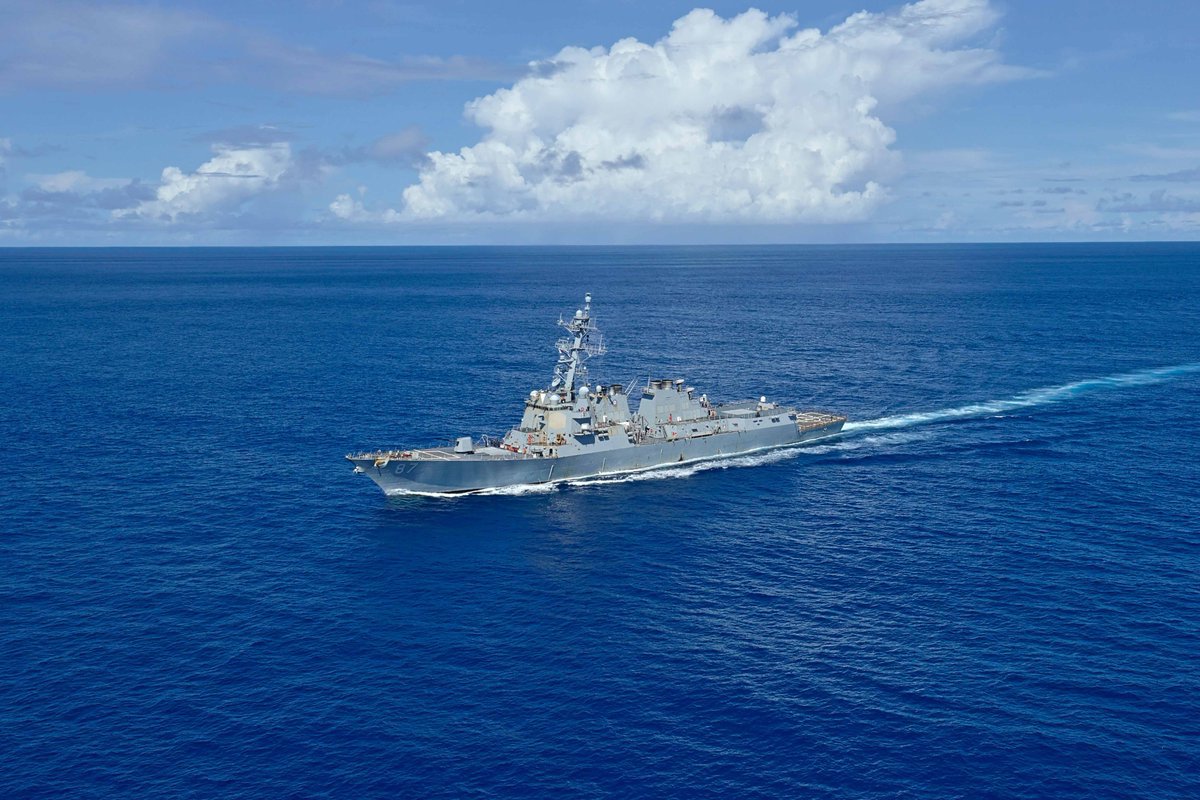
The Pentagon’s immediate dismissal of Iranian claims regarding a successful strike on a US Navy vessel follows a predictable pattern of 21st-century shadow warfare. This is not merely a dispute over a missed missile or a successful interception; it is a sophisticated struggle over the narrative of American naval supremacy. When Tehran broadcasts claims of a hit, and Washington issues a flat denial, the truth often sits behind layers of classified sensor data and electronic warfare logs that the public will never see. The objective for Iran is rarely the total destruction of a multi-billion-dollar destroyer. Instead, the goal is the erosion of the perceived invincibility of the United States military in the eyes of regional allies and domestic audiences.
The Anatomy of the Denied Strike
Modern naval engagements happen in milliseconds and are often fought entirely through invisible frequencies. When a vessel like an Arleigh Burke-class destroyer operates in the high-tension corridors of the Red Sea or the Persian Gulf, it exists within a bubble of Aegis combat systems designed to neutralize threats before they are even visible to the naked eye. The US military’s rejection of these claims is grounded in the technical reality of these defensive layers.
Standard procedure for a "hard kill" involves the physical destruction of an incoming projectile, usually via an SM-2 or SM-6 interceptor. However, "soft kills"—the use of electronic countermeasures to confuse a missile's seeker head—are becoming the preferred method of defense. These engagements leave no fireball and no debris field. This creates a strategic vacuum. Because there is no physical evidence of a "miss," Iranian propaganda outlets find ample room to claim a "hit," banking on the fact that the US Navy will not release sensitive radar telemetry to prove otherwise.
The official stance from Central Command is clear. No ships were damaged. No personnel were injured. Yet, the frequency of these claims suggests that the Iranian Revolutionary Guard Corps (IRGC) is testing a specific theory: that repeated assertions of success, even if false, will eventually force a change in American risk assessment.
Why Technical Denials Often Fall on Deaf Ears
We live in an era where a grainy, zoomed-in video of a generic explosion posted on Telegram carries more weight with certain populations than a press release from a four-star general. The US military relies on its reputation for factual accuracy, but that reputation is being weaponized against it. By remaining silent on the specific "near misses" to protect operational security, the Navy allows the opposition to fill the silence with a tailored version of events.
Consider the physics of a modern anti-ship cruise missile (ASCM) or a one-way attack drone. These systems are cheap, plentiful, and increasingly accurate. If Iran launches ten drones and nine are intercepted while one splashes harmlessly five hundred yards from the hull, the US Navy technically reports "no damage." Iran, however, records the launch and the eventual loss of signal as a "strike." This discrepancy is the engine of the current disinformation cycle.
The Navy’s reluctance to engage in a tit-for-tat media war is a matter of doctrine. They believe that providing evidence of a miss reveals too much about the effectiveness of their jamming suites and radar sensitivity. This is a classic intelligence trade-off. Is it better to look weak in the media to keep your electronic warfare capabilities secret, or should you prove your strength and risk giving the enemy the data they need to bypass your defenses next time?
The High Cost of the Defensive Shield
The math of this conflict is brutal. An Iranian-made drone might cost $20,000 to manufacture. The interceptor missile used to down it costs upwards of $2 million. This is the "cost-imposition" strategy in its purest form. Even when the US military successfully rejects every claim of a hit, they are losing the economic battle of attrition.
The Interceptor Dilemma
- Inventory Depletion: Every successful defense in the Red Sea draws down global stocks of critical munitions.
- Sensor Fatigue: Continuous high-alert operations place immense strain on both the hardware and the crews operating them.
- Strategic Distraction: Resources diverted to protect shipping lanes are resources not available for potential conflicts in the Pacific.
The "success" of the US Navy is currently defined by the absence of a disaster. It is a grueling, thankless task that requires 100% perfection. The adversary only needs to be lucky—or loud—once. When the military rejects a claim of a strike, they are telling the truth about the physical state of the ship, but they are often downplaying the psychological toll of the constant barrage.
Choke Points and Shadow Tactics
The geography of the region dictates the nature of these encounters. The Bab al-Mandab Strait is a bottleneck where the distance between the shore and a passing vessel is minimal. This proximity allows Iran-backed forces to utilize land-based radar and visual spotters to coordinate attacks. It also allows them to film these launches for immediate distribution.
The "strike" claims are often timed to coincide with diplomatic shifts or domestic unrest within Iran. They serve as a distraction and a demonstration of reach. By claiming to have hit a US vessel, the IRGC signals to its proxies—from Hezbollah to the Houthis—that the American "shield" is permeable. The denial from the Pentagon, while factually correct, rarely travels as far or as fast as the initial lie.
The Failure of Traditional Deterrence
For decades, the presence of a US Carrier Strike Group was enough to quiet a region. That era is over. The proliferation of precision-guided munitions has democratized the ability to threaten major naval assets. While a destroyer can still defend itself, the political cost of being "under fire" has risen.
The military’s rejection of these claims highlights a significant shift in how we must define "victory." In the past, victory meant sinking the enemy fleet. Today, victory means maintaining the flow of global commerce while under constant, low-level harassment without escalating into a full-scale regional war. This requires a level of restraint that is often misinterpreted as weakness by those looking to challenge the status quo.
The Information Gap and the Future of Naval Warfare
As we move further into this period of sustained maritime friction, the US military will likely need to rethink its communication strategy. Purely reactive denials are insufficient in an age of deepfakes and instant social media propagation. We are seeing the rise of "verification warfare," where the ability to prove what didn't happen is just as important as the ability to strike a target.
The hardware on these ships is designed for a kinetic war that hasn't fully materialized. Instead, the crews are fighting a ghost war of electronic blips and social media posts. The rejection of the Iranian claims is a necessary part of this war, but it is a defensive move. To regain the initiative, the Navy must find ways to demonstrate its dominance that don't involve simply saying "no, they didn't."
The reality of the situation is that the US Navy is currently the only force capable of keeping these lanes open, and they are doing so under conditions that would have been unthinkable twenty years ago. Every time a claim is rejected, it is a testament to the technical superiority of the Aegis system, but it is also a reminder of how precarious the situation has become.
The focus must remain on the long-term sustainability of this defensive posture. The Pentagon can deny a strike today, tomorrow, and the day after. But the cumulative pressure of these encounters is the real story. The ship may be untouched, but the geopolitical environment is being reshaped by the mere attempt.
The most effective weapon in the Iranian arsenal isn't a missile. It is the ability to make the world question whether the American shield still holds. As long as the US military relies on standard press releases to counter sophisticated information operations, they will remain on the back foot in the war for public perception. The ships are safe, for now, but the narrative is leaking.
The next phase of this conflict will not be won by a better interceptor. It will be won by the side that can most effectively verify reality in real-time. Until the US military can bridge the gap between technical success and public proof, every denied strike will simply be the opening salvo of the next round of digital rumors. The armor is holding, but the friction is starting to show.