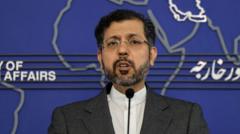
The Middle East sits on a knife-edge and Tehran just sharpened the blade. When the Iranian Foreign Minister Abbas Araghchi sat down with the BBC, he didn't just give an interview. He delivered a blunt ultimatum to the West. He says the United States is standing at a fork in the road where one path leads to a regional inferno and the other leads to a shaky, much-needed peace. There is no middle ground left.
You've probably heard the diplomatic dance before. Usually, it's all about "de-escalation" and "restraint." Araghchi threw those scripts out. He made it clear that Iran views the current conflict in Gaza and Lebanon as a direct result of American policy. Without the U.S. acting as a shield for Israel, he argues, the fighting would have stopped months ago. It’s a high-stakes gamble. By framing the situation as a binary choice between total war and a ceasefire, Iran is trying to force Washington's hand before the situation spirals beyond anyone’s control. Read more on a similar topic: this related article.
Why the White House Can No Longer Sit Out
Washington wants to believe it can manage the tension. They send a few more interceptors, issue a stern press release, and hope the weekend passes without a regional blow-up. Araghchi’s message is that those days are over. He's pointing at the wreckage in Beirut and the humanitarian disaster in Gaza as proof that the "management" strategy has failed.
The Iranian position is simple. If the U.S. continues to provide the munitions and the political cover for Israeli operations, Iran will view that as a choice for war. It’s not just rhetoric. We’ve seen the missile exchanges. We’ve seen the drone swarms. These aren't warnings anymore; they’re rehearsals. Further journalism by TIME highlights comparable perspectives on this issue.
Critics will say Iran is the one fueling the fire through its proxies. Groups like Hezbollah and the Houthis don't act in a vacuum. But from Tehran's perspective, they’re responding to a shift in the regional balance that threatens their very survival. Araghchi’s interview was a way to put the ball back in Biden’s court. He’s telling the world that if the bombs keep falling, the blame lies in the Oval Office, not just the Kirya in Tel Aviv.
The Hezbollah Factor and the Red Lines in Lebanon
Lebanon is the new flashpoint that has everyone terrified. For years, the border between Israel and Lebanon was a place of "tense quiet." That quiet is gone. Israel has moved aggressively against Hezbollah’s leadership, and the group has fired back with depth and frequency we haven't seen since 2006.
Araghchi was specific about this. He suggests that Lebanon is the point of no return. If the conflict there expands into a full-scale ground invasion or a total decapitation of Hezbollah’s political wing, Iran feels it has no choice but to step in directly. This isn't just about "supporting the resistance." It’s about maintaining a deterrent that has kept Iran safe from direct attack for decades.
The risk here is a miscalculation. Both sides think they know where the other's red line is. History shows us that leaders are usually wrong about that. Iran thinks the U.S. is too tired of "forever wars" to get involved. The U.S. thinks Iran is too economically fragile to risk a direct hit on its oil infrastructure. When both sides believe the other is bluffing, that’s when the first real shot of a world-altering war gets fired.
Breaking Down the Ceasefire Mechanics
What does a ceasefire actually look like in this context? It’s not just a pause in the shooting. Araghchi implies it requires a fundamental shift in how the U.S. approaches Israel’s security.
- Immediate halt to Gaza operations: This remains the non-negotiable starting point for every group in the "Axis of Resistance."
- Withdrawal from Southern Lebanon: Restoration of the status quo that keeps Israeli towns safe while allowing Hezbollah to remain a political force.
- A "Grand Bargain" on regional security: This is the long shot. It’s the idea that Iran, the U.S., and regional powers can actually agree on who owns what space.
It sounds impossible. Honestly, it probably is. But the alternative Araghchi describes is a war that would make the last twenty years in the Middle East look like a warmup. We are talking about the closure of the Strait of Hormuz, skyrocketing global energy prices, and a refugee crisis that would dwarf anything Europe has seen recently.
The Economic Reality Behind the Rhetoric
Don't let the talk of "martyrdom" and "resistance" fool you. Economics are driving this just as much as ideology. Iran’s economy is struggling. Sanctions have bitten hard. They don't want a war that levels their remaining refineries. But Araghchi is betting that the U.S. wants a war even less.
The U.S. is in an election cycle. High gas prices at the pump are political suicide. A new war in the Middle East is an admission of diplomatic failure. Iran knows this. They’re using the BBC—a platform that reaches the global elite and the Western public—to bypass official channels and speak directly to the people who would have to pay for a war.
It’s a classic "madman" strategy mixed with cold, hard realism. By appearing ready for the worst-case scenario, Iran hopes to secure the best-case scenario: a ceasefire that leaves their influence intact.
The Reality of Direct Confrontation
We already got a glimpse of what "war" looks like during the April and October missile exchanges. For the first time, the "shadow war" stepped into the light. Hundreds of projectiles flying across sovereign borders. It was a terrifying spectacle that showed the limitations of missile defense. Even with a high interception rate, it only takes one or two hits on a sensitive site to change the narrative.
Araghchi’s interview confirms that the era of proxies might be fading in favor of direct state-to-state confrontation. That’s a massive escalation. When Hezbollah fights Israel, there’s a layer of separation. When Iran fires at Israel, and the U.S. helps shoot those missiles down, we’re one mistake away from a global conflict.
The Iranian minister isn't just talking to the BBC. He’s talking to the American voters and the European diplomats who are tired of the chaos. He’s asking them if they’re ready to see their sons and daughters back in the desert. It's a brutal question, but it's the one that defines the current moment.
How to Track the Real Escalation
Forget the public statements for a second. If you want to know which way the wind is blowing, watch the shipping lanes and the diplomatic backchannels in Oman.
Keep an eye on these three indicators:
- Omani Mediation: Watch for "technical delegations" traveling between Muscat, Tehran, and Washington. If those stop, the chance of war jumps by 50%.
- Carrier Group Movements: When the U.S. moves its naval assets, it’s not just for show. It’s about the logistical reality of what Araghchi warned about.
- Oil Market Volatility: The markets are smarter than the pundits. If Brent Crude starts spiking on "rumors," the big players are betting that a ceasefire isn't coming.
The "choice" Araghchi presented isn't a suggestion. It's a countdown. Either the diplomatic machinery finds a way to stop the bleeding in Gaza and Lebanon, or the regional powers will find a way to make everyone bleed. It’s a grim outlook, but pretending there’s a third option is just wishful thinking.
The next move belongs to Washington. They have to decide if the cost of a ceasefire is higher than the cost of a war that would reshape the map of the world for the next century. Watch the headlines, but more importantly, watch the silence between them. That’s where the real decisions are being made.



