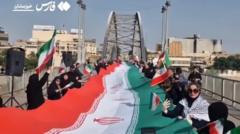
The images coming out of Iran right now aren't your typical street protests. You've probably seen the footage of people standing shoulder-to-shoulder on bridges and near power plants. It’s quiet. It’s deliberate. Iranians are forming human chains to protect the very things that keep their country running, and the message is clear. They aren't just fighting for a regime change anymore; they’re fighting to keep their nation from falling into total ruin.
When you look at these crowds, you see a cross-section of society that most Western media misses. These aren't just students or activists. You’ll find grandmothers, engineers, and shopkeepers. They're standing in front of critical infrastructure because they know that once these assets are gone, they aren't coming back anytime soon. It’s a desperate, physical attempt to say that the people own this land, not the bureaucrats or the military.
The strategic shift in Iranian street tactics
Protesting in Iran has always been a dangerous game. For years, the pattern was predictable. People would gather in squares, shout slogans, and face down security forces. But things changed. The movement shifted from loud, localized outbursts to something more systemic. Forming human chains at bridges and power plants is a brilliant, if terrifying, evolution of dissent.
By surrounding a power plant, protesters create a massive headache for the government. If the state uses force to clear them, they risk damaging the facility or causing a blackout that affects millions. If they do nothing, the protesters stay. It’s a checkmate move that uses the state’s own infrastructure as a shield. You’re seeing a population that has learned exactly how to poke the dragon where it hurts most without firing a single shot.
This isn't just about optics. It’s about physical presence. When Iranians line up across a bridge, they're effectively seizing control of the country's arteries. They’re showing that the government's authority only exists as long as the people allow it to function. It’s a powerful psychological blow to a regime that prides itself on total control.
Why infrastructure is the new frontline
You might wonder why someone would risk their life to stand near a transformer station. The answer lies in the sheer level of neglect Iran’s infrastructure has faced. Decades of sanctions, combined with internal corruption, have left the power grid and water systems on life support. The people know that if these systems fail or get sabotaged in a crackdown, the country enters a dark age. Literally.
Protecting these sites isn't just a protest against the current leadership. It’s an act of preservation. Iranians are looking at what happened in neighboring countries where civil unrest led to the complete collapse of basic services. They don't want that. They want a new government, sure, but they want a country that still has lights and running water when the dust settles.
Real stories from the bridges
I've followed reports from local journalists and seen the raw clips that don't make the nightly news. In Isfahan, the human chains around the historic bridges weren't just about politics. They were about identity. For the locals, those bridges represent the soul of the city. When they stand there, they’re telling the world that they won't let their heritage be used as a battlefield.
One video showed a group of men in Ahvaz standing in a line near a regional power hub. They weren't chanting. They were just looking at the police. That kind of silent defiance is harder to break than a loud riot. It’s unsettling for the security forces. How do you justify beating a man who is just standing there, guarding a piece of his own town? You can't, at least not without looking like a complete monster to the rest of the world.
These moments of "quiet" protest are often more effective than the loud ones. They force the people in uniform to look their neighbors in the eye. It breaks the "us vs. them" narrative that the state tries so hard to build. When a soldier sees his own uncle or a former teacher in that chain, the gear starts to grind.
The role of the Iranian diaspora
While the people on the ground are doing the heavy lifting, the global Iranian community is making sure these images don't vanish. They're the ones bypassing the internet blackouts to get these videos onto your feed. Without this digital bridge, the human chains would be invisible.
The coordination is impressive. Using encrypted apps and old-school word of mouth, protesters know exactly where to meet and how to form these lines quickly before the riot police can deploy. It’s a game of cat and mouse played out across thousands of miles. The tech-savvy youth are basically the command center for a movement that is increasingly decentralized.
What this means for the global energy market
If you think this is just a local issue, you’re wrong. Iran sits on some of the world's largest energy reserves. Any instability near their power plants or oil refineries sends ripples through the global economy. Investors hate uncertainty. When the public starts surrounding the very places that produce and transport energy, the markets get twitchy.
The Iranian government is in a bind. They need the oil and power sectors to keep the economy from completely flatlining. But they also can't easily disperse these crowds without risking a catastrophic PR disaster or physical damage to the plants. It’s a high-stakes standoff that affects gas prices in Europe and beyond. Every day those chains stay in place, the pressure on the regime's wallet increases.
The risks of silent standing
Don't think for a second that these protesters are safe just because they aren't throwing rocks. The Iranian security apparatus, specifically the Basij militia, has shown they'll use extreme measures to break any form of dissent. There are reports of "snatch and grab" operations where plainclothes officers pull individuals out of the chain and disappear them.
The psychological toll is massive. Standing there, waiting for a blow that could come at any second, requires a level of bravery that most of us can't even imagine. It’s one thing to run through the streets in a crowd. It’s another thing entirely to stand still while a line of armed men stares you down. This isn't a hobby for these people. It’s their last stand.
Misconceptions about the movement
People often think these protests are only about the hijab or specific social laws. While those were the spark, the fire is fueled by years of economic mismanagement and a total lack of transparency. When Iranians form chains at power plants, they’re highlighting the fact that the government has failed to provide the basics.
You'll hear some analysts say this is just a phase. They’re wrong. This is a fundamental shift in how the Iranian public views its relationship with the state. They no longer see the government as a provider, but as an obstacle to their survival. This change in mindset is permanent. You can't put that genie back in the bottle.
Tracking the impact of civil disobedience
So, does it work? Historically, non-violent civil disobedience has a better track record of creating lasting change than armed rebellion. By sticking to human chains and infrastructure protection, the Iranian people are keeping the moral high ground. They make it impossible for the state to paint them as "terrorists" or "foreign agents" to anyone with eyes.
The government's response has been erratic. One day they try to ignore it, the next they cut the internet and send in the heavies. This inconsistency shows they’re rattled. They don't have a playbook for people who are willing to stand quietly in front of a dam or a bridge.
If you want to keep up with what's happening, stop looking at the state-run media. Follow the independent journalists who are verifying these clips. Look for the specific hashtags used by the activists. The situation moves fast, and the real story is often found in the margins of the official reports.
Pay attention to the locations. These aren't random. If a chain forms at the Khuzestan water works, it's because that region is dying of thirst. If it's a bridge in Isfahan, it's about the heritage and the history. Every location tells a story of what the people are most afraid of losing.
If you're following this from abroad, the best thing you can do is keep the spotlight on these specific acts of bravery. Share the videos. Talk about the "why" behind the chains. The more the world watches, the harder it is for the regime to do its work in the dark.
The next few weeks will be telling. Watch if the chains grow or if the state manages to scare people back inside. My bet is on the people. You don't stand in front of a power plant unless you've already lost your fear. And once a population loses its fear, the government is already on borrowed time.