Heavy metal does not whisper. It announces itself through the asphalt, a low, tectonic vibration that rattles coffee cups on pavement tables before the shape even breaks the horizon.
Picture the street outside a hotel in lower Manhattan. The gray dampness of an autumn morning hangs thick, blurring the sharp edges of yellow cabs and the neon glow of morning bodegas. Pedestrians move in hurried, gray clusters, heads down against the drizzle. Then, the rhythm of the city shifts. A dozen blocks away, a distinct rumble rolls down the corridor of skyscrapers. Traffic parts. Sirens begin to stitch a jagged line across the low-hanging clouds.
And then they appear.
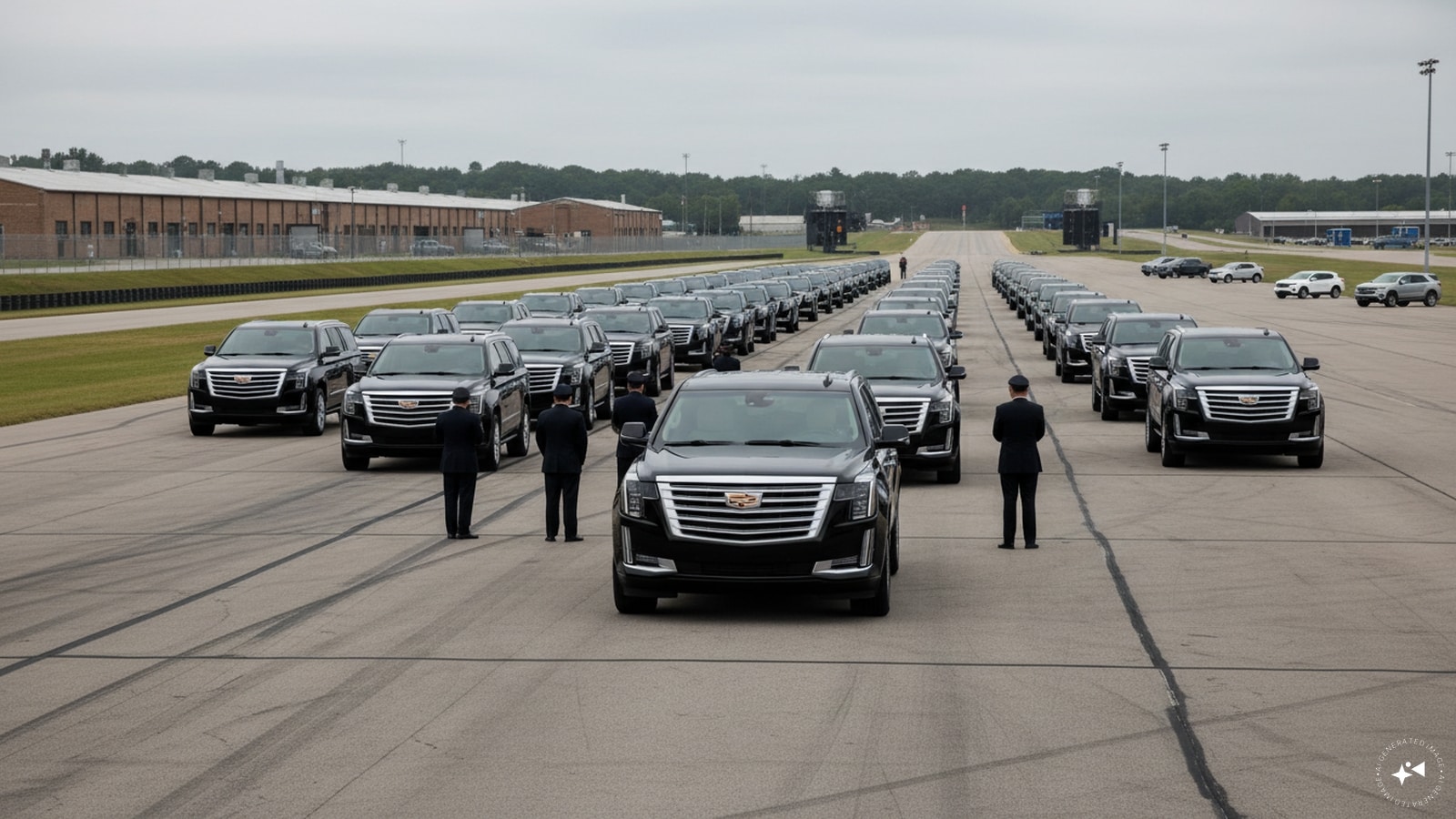
Not one sleek sedan, but an echelon of midnight-black monoliths. Two hundred and fifty thousand pounds of American steel, glass, and specialized armor moving with the predatory grace of an armored division.
When Donald Trump stood before a crowd and casually dropped the number into the air—two hundred and fifty Cadillac Escalades ordered for the presidential motorcade—the internet did what it always does. It blinked, calculated the math of astronomical price tags, and spun up a cycle of outrage and confusion. Two hundred and fifty? Is the entire cabinet commuting together? Are they filming a high-budget action sequel on the taxpayers' dime?
To understand that number, you have to strip away the partisan noise and look at what a presidential motorcade actually is. It is not just transportation. It is a mobile fortress, a sovereign patch of American territory moved across foreign capitals and domestic highways at a moment's notice.
Think about the sheer logistical weight of the modern presidency. When the leader of the free world moves, they do not simply jump into the passenger seat of a nice car. They bring an entire ecosystem of security, communication, logistics, and medical support. The Secret Service does not roll light. They roll absolute.
Imagine standing on a tarmac in Brussels or Tokyo. You watch the primary limousine—the Beast—roll down the ramp of a C-17 Globemaster. But the Beast is only the tip of the spear. Flanking it are electronic countermeasure vehicles, hazardous materials detection units, press vans, decoy vehicles designed to confuse thermal imaging and radar, and an entire platoon of heavily armed tactical suburban utility vehicles.
For decades, the standard-bearer for that secondary tier of muscle has been the General Motors SUV. They are ubiquitous. They are built on truck frames that can absorb incredible shocks, modified with run-flat tires, reinforced chassis, and layers of ballistic plating that turn the cabin into a safe room.
Yet, two hundred and fifty sounds excessive. It sounds like a typo born from a political rally where numbers stretch for dramatic effect.
Consider what happens next: the procurement cycle.
Government fleets do not work like a consumer walking onto a dealership lot on a Saturday afternoon. The United States government maintains a massive, rotating inventory of protected vehicles scattered across domestic field offices, military bases, secure transit hubs, and international embassies worldwide. A single presidential foreign trip requires pre-positioned motorcades in multiple cities, sometimes simultaneously. Vehicles are constantly cycling through maintenance, armoring upgrades, electronic overhauls, and eventual retirement after enduring grueling abuse.
When the Secret Service or military transport commands put in an acquisition request, they are planning for years of global deployments, sudden geopolitical crises, and routine rotations. A bulk order of two hundred and fifty units is not meant for a single driveway outside the West Wing. It is the lifeblood of a sprawling, invisible logistics network that operates twenty-four hours a day, three hundred and sixty-five days a year, across every time zone on Earth.
There is a distinct human cost to this machinery, and it is rarely talked about.
Behind the tinted glass of those black Escalades sit men and women who have spent months away from their families, running advance routes in unfamiliar cities, testing radio frequencies, mapping emergency extraction tunnels, and memorizing every hospital trauma bay within a fifty-mile radius. They are mechanics, intelligence analysts, drivers, and tacticians. To them, the vehicle is not a political statement. It is an office. It is a shield. It is the difference between coming home to an empty house or a folded flag.
When a politician weaponizes that fleet size in a speech, turning a logistical necessity into a rhetorical talking point about government excess, the nuance evaporates. The public hears a number and feels a prickle of resentment. Why so many? Why the luxury brand? Why the sheer size?
The answer is brutally pragmatic. In the architecture of modern statecraft, image and impenetrability are welded together. The Cadillac badge on the grille is a deliberate American export. It says industrial might. It says technological dominance. Whether parked outside the United Nations or navigating the narrow, cobblestone alleys of a European capital, those vehicles project a very specific kind of unyielding gravity.
We live in an era where every detail of governance is scrubbed for irony, hypocrisy, or waste. Every dollar spent on state security is weighed against public infrastructure, social programs, and economic anxiety. That tension is real. It is healthy to question the immense apparatus of power that surrounds our elected officials.
But reducing a global security fleet to a punchline misses the darker, more complicated reality of the world we have built. Leaders do not move through a peaceful garden. They move through a landscape of persistent, calculated threats, where drone technology, explosive devices, and civil unrest are constant variables. The margin between safety and catastrophe is terrifyingly thin. It is measured in millimeters of hardened steel, layers of ballistic glass, and the split-second reflexes of drivers trained to push a heavy SUV through a wall of fire if the worst comes to pass.
So the motorcade rolls on.
Down Pennsylvania Avenue, past the concrete barriers and the stoic tourists holding cheap umbrellas. The engines hum with a deep, muffled authority. Inside, screens flicker with encrypted data, radios crackle with code words, and human beings sit in absolute silence, waiting for the world to change its mind.
The heavy iron carriages of power do not care about the political debate swirling around their price tag or their fuel consumption. They only have one job.
To absorb the blow when the world finally stops pretending to be safe.