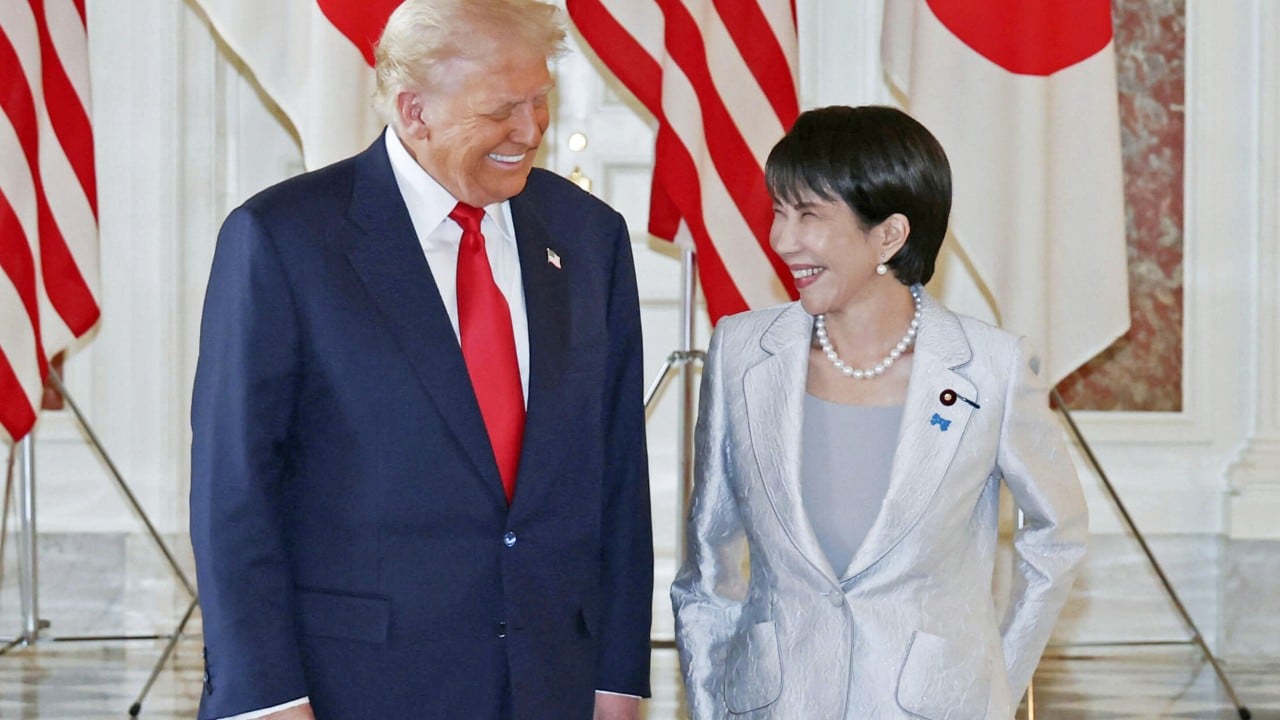
The coffee in the secure briefing room of the Prime Minister’s residence was cooling, untouched, forming a skin across the surface of the porcelain. Sanae Takaichi did not look at her cup. She looked across the polished mahogany at the man whose shadow stretched across the entire Pacific.
Washington was thousands of miles away, but Donald Trump filled the room. His presence was not merely physical; it was an atmospheric pressure drop. Every diplomat, advisor, and trade representative in Tokyo knew the stakes of this meeting. They also knew that a few time zones away, in Beijing, another leader was watching every flicker of movement, every tightened jaw, and every carefully chosen word.
Xi Jinping did not need to be in the room to dictate its temperature. His silhouette hung over the negotiations like a cold front over the East China Sea.
To understand why a bilateral meeting between Washington and Tokyo can make the global economy hold its collective breath, you have to look past the press releases and the handshakes on the tarmac. You have to look at the map.
Imagine sitting in a cramped maritime patrol vessel rocking violently in the freezing swells just outside the Senkaku Islands. The salt spray crusts the windshield. The radar screen blinks a relentless green pulse. Out there, in the dark, gray-hulled coast guard cutters bearing red stars sit just beyond the horizon, waiting. They do not fire shots. They do not need to. Their mere presence is an ongoing question: How long can you afford to stand alone?
For decades, Japan operated under a quiet, comfortable assumption. The security umbrella of the United States was infinite, unconditional, and weightless. Tokyo focused on economic miracles, rebuilding cities, manufacturing precision electronics, and engineering bullet trains that ran to the second. Defense was an afterthought, outsourced to an ally across the ocean.
Then the world changed its mind.
When Donald Trump took the reins of American foreign policy with his doctrine of transactional power, the old certainties evaporated overnight. Allies were no longer treated as permanent family members; they were clients expected to balance their ledger sheets, pay their security premiums, and prove their worth in direct, measurable returns.
Sanae Takaichi stepped into this arena not as a traditional, cautious bureaucrat, but as a conviction politician steeped in the unyielding defense orthodoxy of the late Shinzo Abe. She understood the American president's language. He respects strength. He respects leverage. Above all, he respects someone who refuses to flinch.
Yet, flinching was easy when you felt the twin pressures of American demands for trade concessions and Beijing's unyielding territorial ambitions.
Consider the economic reality facing Japanese manufacturers. For thirty years, supply chains wound their way through Chinese factories. Rare earths, microchips, refined lithium, and basic steel components flowed like lifeblood from the mainland into Japanese assembly lines. It was efficient. It was profitable. It was also a gilded trap.
When Beijing wanted to punish Tokyo for a diplomatic dispute, the rare earth taps turned off overnight. Factories stalled. Workers stood around idle lines. The vulnerability was absolute.
Now, Trump was sitting across the table demanding answers on trade imbalances, currency valuations, and shared defense burdens, while the specter of Xi loomed large. If Tokyo leaned too hard into Washington's demands—if they alienated their giant neighbor too abruptly without adequate domestic industrial backup—the economic retaliation would be swift and devastating. But if they hedged, if they tried to play a delicate diplomatic game of appeasement to keep Beijing calm, Trump would walk away, leaving them exposed to the rising tide of Chinese maritime dominance.
There is a moment in high-stakes negotiation where all the spreadsheets disappear. The GDP projections, the tariff rates, the naval tonnage comparisons—they all fade into white noise. What remains is human psychology.
Takaichi understood this. She knew that Trump views international relations through the lens of personal rapport and perceived toughness. She did not arrive in Washington armed with dry, bureaucratic talking points drafted by a committee of timid foreign ministry officials. She came prepared to talk about sovereignty, about the shared defense of the first island chain, and about the brutal economic realities of a world where globalization is dead and hard power is king.
Behind closed doors, the conversation was reportedly blunt. Trump pressed hard on trade deficits. He wanted numbers. He wanted commitments. He wanted to know why American cars were not crowding the streets of Tokyo in the same volume that Japanese sedans filled the highways of California.
It is a classic opening gambit. But Takaichi pivoted. She did not argue about auto parts. She pulled the conversation back to the horizon.
She laid out the map of the East China Sea. She asked the American president to consider what happens to American technological dominance—to semiconductor supply chains, to Taiwan, to the entire Pacific posture—if Japan falls into a sphere of economic coercion. She argued that security and trade are not separate ledgers. They are the exact same weapon.
And then, the ghost in the room shifted.
Xi Jinping was not idle while Washington and Tokyo haggled. Beijing’s diplomatic machine was working overtime, whispering alternatives into the ears of Japanese business leaders, dangling market access like a carrot, and hinting at severe consequences if Tokyo hitched its wagon too tightly to an unpredictable American administration.
This is the tightrope walk of modern Asian geopolitics. You cannot decouple from China overnight without shattering your own economy. You cannot rely on the United States without risking sudden abandonment if domestic political winds in Washington shift.
To watch this dance from the outside is to watch a masterclass in high-wire survival. Japan is no longer the quiet economic giant of the nineteen-eighties that could afford to hide behind a pacifist constitution and let America handle the guns. The constitution is being reinterpreted. Defense budgets are climbing toward two percent of GDP. New munitions are being bought. Shipyards are humming with the construction of multi-role destroyer vessels that look suspiciously like aircraft carriers.
The Japanese public, traditionally deeply skeptical of military entanglements, has watched the skies over Taiwan and the disputed rocks of the Senkakus with growing unease. They see the Chinese coast guard ships lingering on their maritime doorstep. They read the news about cyberattacks on critical infrastructure.
Fear is a powerful motivator. It cuts through decades of political complacency.
When Takaichi emerged from her meetings with the American delegation, there were no grand, sweeping treaties announced to the world. There were no immediate declarations of a new utopian era in bilateral relations. Diplomacy at this level is rarely about cinematic happy endings. It is about holding the line.
She secured assurances. She signaled strength. She proved to Washington that Tokyo was no longer a liability, but an active, hardened partner willing to shoulder the heavy iron of regional defense.
Yet, as the flashes of the press cameras faded and the motorcades rolled away from the White House, the fundamental reality of the Pacific had not changed by a single millimeter.
Back in Beijing, the lights in the Zhongnanhai compound burned late. The maps were updated. The strategic assessments were filed. The dragon does not sleep; it simply blinks, waiting for the next tremor in the alliance, watching to see which partner will crack first under the weight of the new century.
The coffee in the briefing room had long since gone cold. But the fire underneath the table was only just beginning to spread.