Dirt does not care about your grandfathers.
It does not remember the sweat soaked into the plow handle in nineteen-fifty-something, nor does it care about the promissory note currently sitting in the top drawer of the county bank, circled in red ink by a loan officer whose ancestors probably traded beaver pelts in the same valley. Dirt is silica, clay, organic matter, and stubbornness. It sits there under the western Nebraska sky, dry as a bone in August and heavy as lead in April, waiting to see what you are going to bleed for it this year.
For generations, the bargain was simple, brutal, and largely non-negotiable. You woke up before the sun. You fed the diesel engine. You prayed for four inches of rain spread out across June, and you hoped to God that the Chicago commodity board did not decide on a Tuesday morning in October that a bushel of yellow corn was suddenly worth less than the fuel it took to combine it.
Every farmer knows the smell of dry dirt blowing across a two-lane highway on a windy Tuesday. It smells like desperation. It smells like a thirty-thousand-dollar fertilizer bill due on the first of the month against a crop that just got hammered by a hailstorm the size of a pigeon egg.
Then came the white towers.
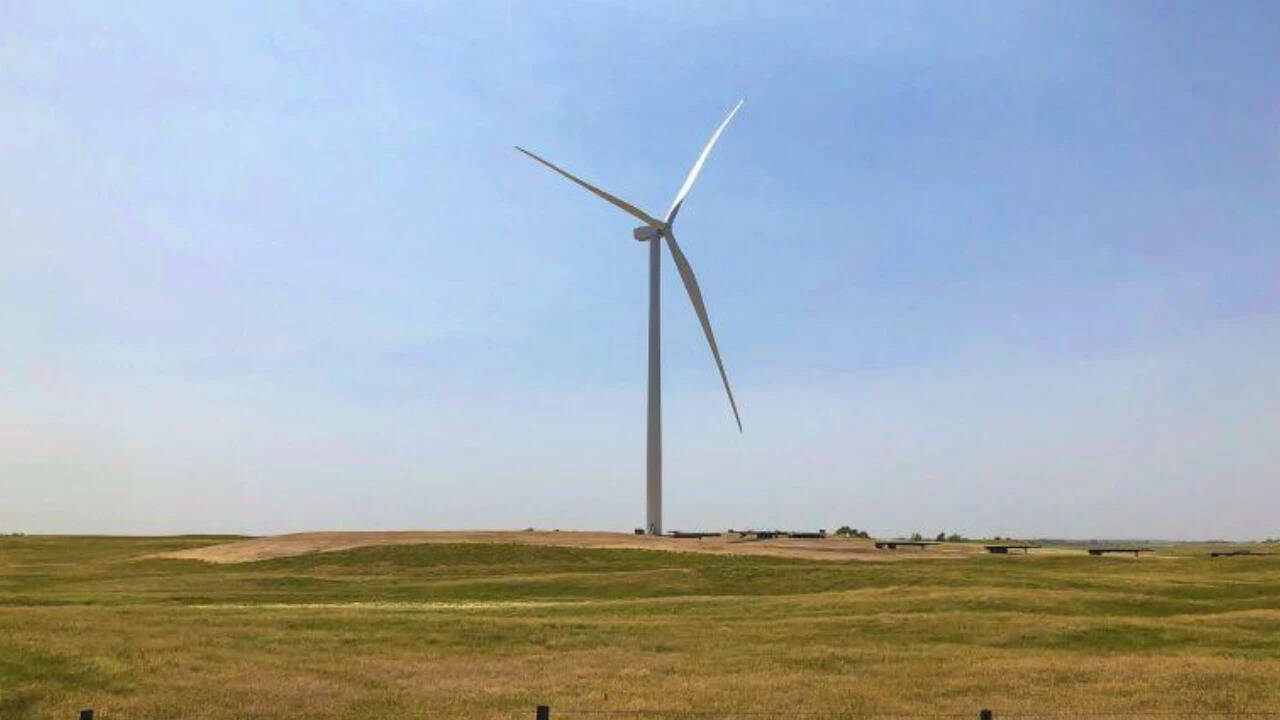
They arrived on the back of sixteen-axle transport trucks that required state troopers to shut down the state highways at midnight. They rose section by section, bolted together with high-tensile steel and brute engineering, until their fiberglass blades pierced the relentless prairie wind three hundred feet above the stubble.
To the casual driver on Interstate 80, flashing past at seventy-five miles per hour toward Denver or Chicago, the wind turbines are just kinetic sculptures on the horizon—white modern crosses spinning lazily against a pale sky. To the man standing in the middle of that cornfield, watching his soil blow away, they are something else entirely.
They are an anchor.
Consider a hypothetical landowner—let's call him Thomas—whose family has worked six hundred acres of rolling Loess Hills land for eighty years. Thomas knows every gully where the water pools after a cloudburst and every patch of sandy loam where the corn fires up first when the July heat sets in. He knows the math of farming down to the decimal point. Seed, chemical, insurance, diesel, equipment depreciation, land tax. When you add it all up in a normal year, after months of seventy-hour weeks and worrying over radar apps on a cracked smartphone, the net profit per acre on traditional corn production can hover around a razor-thin margin. Some years, you clear fifty dollars an acre. Other years, the market drops, the drought hits, and you write a check to the bank just for the privilege of having worked yourself into exhaustion.
Now, picture the small footprint of a modern utility-scale wind turbine. It occupies maybe half an acre of actual ground space—barely enough room to park a couple of combines.
Around that solitary concrete base, the corn still grows. The planter goes right up to the yellow caution tape of the foundation. The combine snorts past the turbine tower, shaving off rows just like it has since the Eisenhower administration.
The difference isn't in what grows out of the dirt. The difference is what comes in the mail.
Instead of six hundred dollars a year in net yield from that half-acre patch—subject to the violent whims of weather and global grain cartels—a lease agreement with a renewable energy developer can push upwards of twelve thousand five hundred dollars annually for that exact same parcel.
Read that again. Twelve thousand five hundred dollars. For a patch of earth that used to yield less than a decent used pickup truck's worth of corn.
Multiply that across a couple of turbines on a multi-generational spread, and the math stops being a matter of survival and starts looking suspiciously like breathing room. It is the kind of money that lets a family replace a combine auger before it snaps in the middle of harvest. It is the fund that sends a kid to Lincoln or Omaha for college without taking on crushing student debt. It is the buffer that keeps a century-old farm from being carved up into five-acre hobby lots for retirees from the city.
There is a strange, quiet dignity in watching a machine powered entirely by a force you cannot see pay off the mortgage your grandfather signed with a handshake and a prayer.
Yet, change on the Great Plains is never baptized without a fight.
Drive twenty miles down the gravel road to the local diner in the county seat, where the coffee is hot, bitter, and served in heavy ceramic mugs that have seen twenty presidential administrations come and go. Sit at the counter at 6:00 AM when the men in grease-stained Carhartt jackets are nursing their caffeine and talking weather.
You will hear the debate.
There are those who look at the horizon and see progress, salvation, and the only way to keep the kids from packing up for Denver or Kansas City. They see the lease payments as drought insurance—a steady, guaranteed check that arrives regardless of whether the clouds drop rain or pass over like empty promises.
And there are those who look at the same horizon and feel a cold knot in their chest. They talk about the blinking red lights at night ruining the absolute, ink-black dark of the prairie sky. They talk about the shadow flicker sliding across a farmhouse window when the sun dips low in the winter. They talk about outsiders—corporations with headquarters in Houston or Copenhagen—coming into the county with slick PowerPoint presentations and corporate lawyers, changing the skyline forever.
They are both right. That is the tragedy of it.
You cannot string high-voltage transmission lines across the Sandhills or drop three-hundred-foot steel monopoles into a pasture without altering something fundamental. The landscape changes. The rhythm changes. The unspoken contract between a farmer and the literal dirt beneath his fingernails shifts from an intimate, fragile dance with nature to something resembling an industrial partnership.
The purists will tell you that farming is supposed to be hard. They whisper tales of the thirties, of grasshoppers stripping paint off barns, of dust storms turning noon into midnight. They act as though suffering is a necessary ingredient for agricultural authenticity.
Thomas doesn't buy it. Thomas spent thirty years watching his father cough up black lung dust and worry himself into an early grave over a thirty-cent drop in corn futures. When Thomas signed his land lease, he didn't feel like he was selling out. He felt like he was beating the house for the first time in his family's history.
The wind does not care about our nostalgia. It blows across the high plains whether we are there to catch it or not. It sweeps down from the Rockies, cold and fierce, screaming over the flatlands, carrying the scent of pine and snow all the way to the Missouri River. For ten thousand years, it has done nothing but blow—shaping the dunes, bending the bluestem grass, howling through the eaves of abandoned homesteads where dreams went to die during the Depression.
For the first time, we have figured out how to make it stay.
We have learned how to anchor the invisible. We have learned how to turn a howling nuisance into a stable foundation.
Out past the county line, right now, the blades are turning. They sweep the air in slow, hypnotic circles, whispering a low, rhythmic thrum that you can feel in your chest before you can hear it with your ears. Down below, in the shadow of the steel tower, the winter wheat is starting to green up in the pale Nebraska sun. The tractor is parked in the shed, its engine cold, waiting for morning. The check is in the bank. And for the first time in a very long time, the wind is blowing in the right direction.