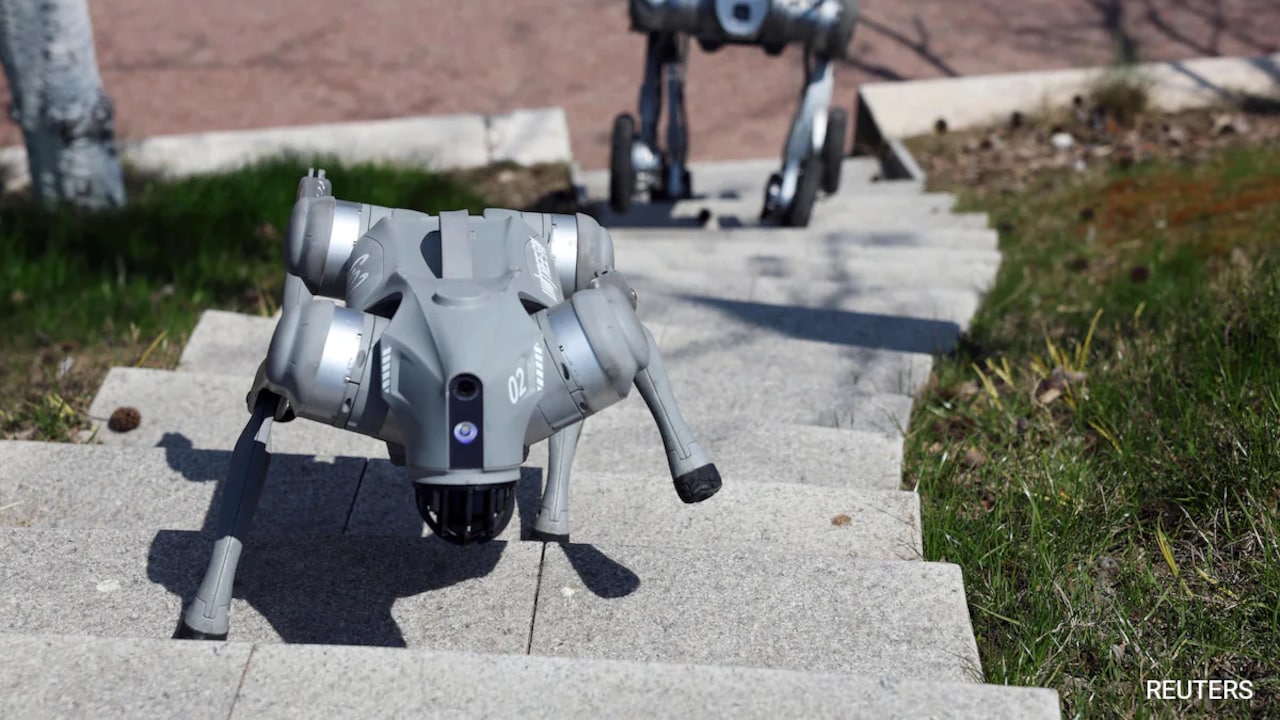
The concrete floor of the laboratory vibrates before you hear a thing. It is a low, rhythmic thrum—not unlike the pulse of a large animal waking from a deep sleep. Then comes the sound. The sharp, mechanical click of carbon-fiber joints locking into place. The whine of high-torque brushless motors spinning up to thirty thousand revolutions per minute.
A shadow falls across the fluorescent lights. Four legs, each jointed backward like the limbs of a hunting hound, step forward with impossible balance. The machine tilts its head. It scans the room with stereo cameras and spinning lidar beams, processing a million data points a second. It does not blink. It does not hesitate. When someone kicks it with a heavy steel-toed boot, the quadruped stumbles, its internal gyroscopes screaming to correct its center of gravity. Within a fraction of a second, it catches itself. It stands tall. It waits for the next command.
This is not a creature born in a dark shed in Shenzhen. This machine, and the multi-billion-dollar empire standing behind it, traces its lineage directly back to suburban Boston, to federal research grants, and to American ingenuity that gave away its crown jewels for pennies on the dollar.
To understand how a nine-billion-dollar quadruped industry shifted its epicenter across the Pacific, we have to look past the spreadsheets and examine the human moments of quiet complacency. We have to look at how brilliance is funded, how bureaucracy works, and how ambition eventually outruns patience.
The Seed in the Laboratory
Picture a small workshop in the early 2000s. The air smells of hot solder and ozone. Engineers huddle around a monstrosity of aluminum, hydraulic lines, and tangled cables. They call it Big Dog. It walks on four legs over ice, mud, and rubble, reacting to shoves with the terrifying grace of a mule.
That machine was built with money from the Defense Advanced Research Projects Agency. American taxpayers funded the foundational research. Universities and private labs in the United States spent decades solving the nightmare equations of dynamic locomotion, balancing algorithms, and spatial awareness. The goal was simple: protect soldiers by sending mechanical pack-mules into hostile terrain.
But science fiction is expensive. Hardware is brutal. Building a quadruped that can survive a roadside bomb or a trek through Afghan mountains requires an enormous amount of capital, patience, and stomach for failure.
For years, the American ecosystem treated these mechanical dogs as laboratory curiosities or high-priced tactical toys. They were showcased in viral videos, admired for their engineering marvels, but relegated to niche defense contracts and academic showcases. The commercial market seemed too distant. The cost per unit was too high. The manufacturing infrastructure was simply not built for mass production at consumer prices.
While Western boardrooms debated profit margins and risk profiles, a different philosophy was taking root overseas.
The Pivot Eastward
Across the globe, the appetite for heavy industrial automation was insatiable. Factories needed eyes in hazardous environments. Construction sites needed autonomous inspectors. Security firms wanted tireless night patrols.
Enter the Chinese robotics ecosystem, moving with a speed that startled traditional venture capitalists. Companies like Unitree Robotics did not spend thirty years inventing the wheel. They took the foundational physics, the open-source control algorithms, and the global supply chain, and they accelerated.
Consider what happens when a manufacturing hub meets aggressive venture capital and state-backed incentives. Costs collapse. Component manufacturing, from high-grade carbon fiber to specialized actuators, clusters within a fifty-mile radius. Where an American startup might wait three weeks for a custom-machined gear to clear customs, a Shenzhen engineer walks down the street and picks up five prototypes by lunchtime.
The price tag plummeted from six figures down to the cost of a high-end consumer drone. Suddenly, a quadruped was no longer an exclusive asset for elite military units or billionaire research universities. It became accessible to university labs in Berlin, factory floors in Detroit, and security agencies in Tokyo.
The financial math shifted with brutal efficiency. By the time Western observers realized what was happening, the market valuation for these robotic canines had swelled past nine billion dollars. The funding loop had closed. The investment had returned multiplied, but the flag flying over the triumph was different.
The Cost of Short-Term Vision
We love a good underdog story in technology. We celebrate the scrappy startup that disrupts an industry. But this was something else. This was a structural displacement born of a fundamental mismatch in how different economic systems view risk.
The American system excels at zero-to-one breakthroughs. We invent the internet. We map the genome. We teach machines how to walk on four legs over uneven gravel. But our financial structures are notoriously impatient. Public markets demand quarterly earnings growth. Venture capitalists look for software-like margins in hardware businesses. When a hardware company struggles to find immediate mass-market monetization, capital dries up.
Contrast that with a system capable of sustaining long-term, state-directed industrial strategy. When an entire supply chain is mobilized toward a singular national goal—dominating robotics—individual quarterly losses do not trigger panic. They are treated as the cost of doing business.
The iron hounds running through our streets and factories today are monuments to this shift. They carry cameras, thermal sensors, and robotic arms. They inspect nuclear power plants, patrol corporate campuses, and entertain millions on social media feeds with synchronized dance routines.
Every time one of those mechanical limbs snaps forward with terrifying agility, it tells a dual story. One of brilliant human engineering that dared to conquer gravity and balance. And another of institutional myopia, where the creators of the technology stood by while the commercial empire was built elsewhere.
The Final Step
Step back into that laboratory for a moment. Watch the mechanical dog plant its foot on the smooth floor. Listen to the whir of the motors cooling down after a test run.
The machine is neutral. It does not care who funded its ancestors or who claims its patents. It only executes the code written for it by human hands.
The real question is not how the market reached nine billion dollars. The real question is what happens to the next breakthrough while we are busy counting the profits of the last one. The hounds are already running. They are faster, cheaper, and smarter than they were yesterday. And the horizon ahead belongs entirely to those who know how to keep up.


