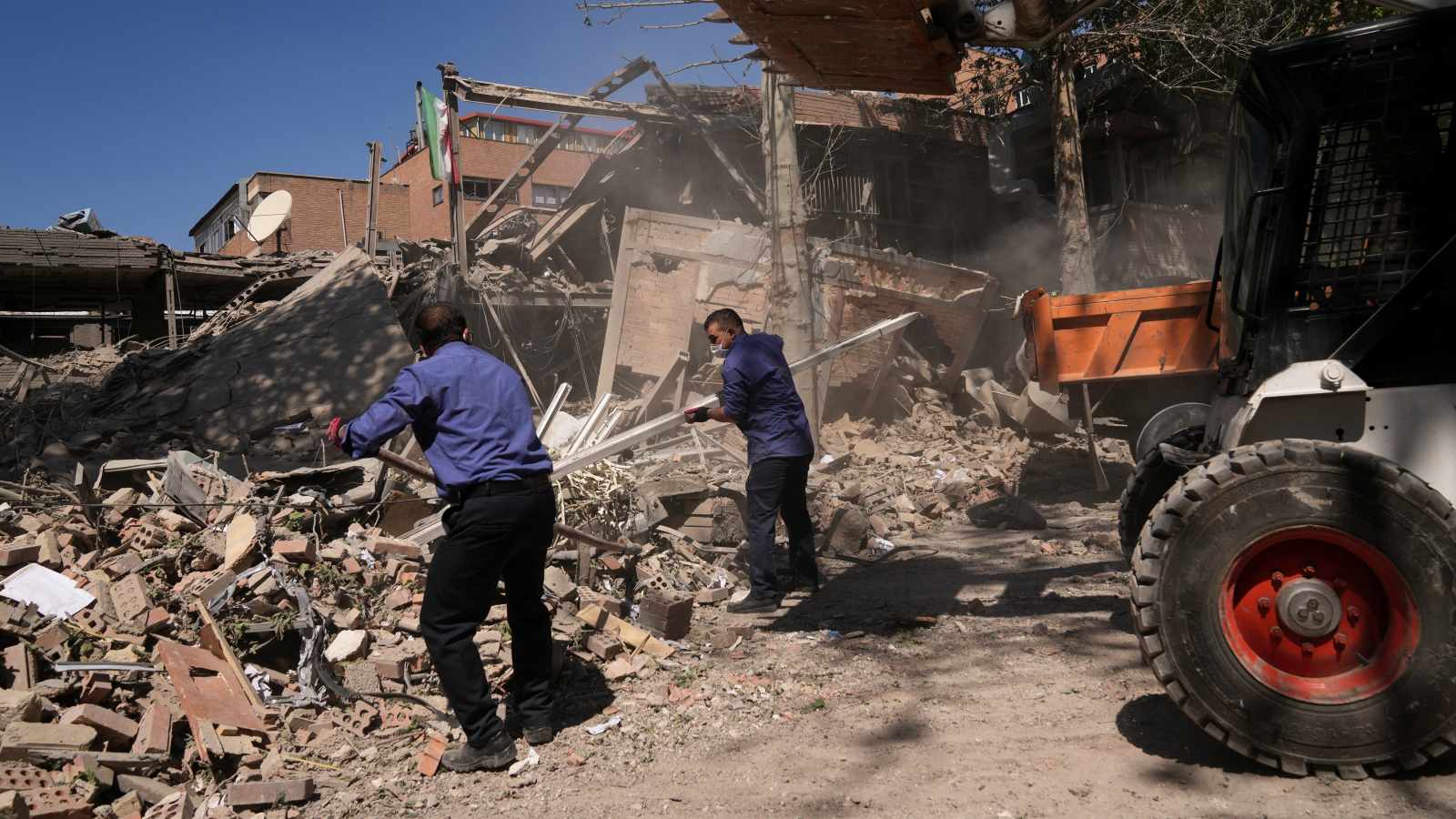
The headlines are shouting about physical danger. They want you to believe that a train ticket in Iran is a death warrant. Israel’s recent warning to Iranian citizens—claiming that their own rail infrastructure is a "life-threatening" trap—is being treated by mainstream outlets as a simple humanitarian alert.
They are wrong. They are missing the entire architecture of modern shadow play.
This isn’t about a bridge collapsing or a faulty engine. This is a deliberate, high-stakes experiment in cognitive infrastructure disruption. When a state actor warns another nation’s civilians about their own public utilities, they aren't trying to save lives. They are trying to crash a system without firing a single shot.
The Myth of the Structural Failure
The competitor narrative suggests that the Iranian rail system is a crumbling relic, so poorly maintained that it has become a spontaneous combustion hazard. This is a lazy reading of the situation.
Iran’s rail network is actually a strategic centerpiece of their regional trade ambitions. They’ve spent the last decade pouring capital into the International North-South Transport Corridor (INSTC). You don't build a 7,000-kilometer trade route if your tracks are made of cardboard.
The warning isn't a commentary on bolts and steel. It is a psychological exploit targeting the trust layer of the state. If you can convince a population that their most basic logistical arteries are unsafe, you achieve three things simultaneously:
- You force the state to divert massive resources into redundant security audits.
- You trigger a "slowdown" in the movement of goods and labor.
- You create a persistent background radiation of anxiety.
In cybersecurity, we call this "FUD" (Fear, Uncertainty, Doubt). In geopolitics, it’s a denial-of-service attack on the public psyche.
Logistical Sabotage via Social Engineering
Let’s look at the mechanics. Most people think sabotage requires a bomb or a line of malicious code. That’s old-school thinking.
Modern sabotage is purely informational. By issuing a specific, high-profile warning about trains, Israel is effectively "tagging" every rail station in Iran as a potential site of conflict. It creates a self-fulfilling prophecy.
Imagine a scenario where a routine maintenance delay happens on a Tehran-Mashhad line. In a vacuum, it’s just a delay. After a global warning from a sophisticated intelligence apparatus, that same delay becomes a "near-miss" or evidence of "sabotage." The delay itself becomes a weapon.
I have watched logistics firms in the private sector go bankrupt because of "perceived risk" rather than actual loss. Once the risk profile of an asset—like a train line—is artificially inflated, the cost of operating that asset skyrockets. Insurance premiums climb. Specialized staff quit. The system grinds to a halt not because the trains broke, but because the people did.
The "Invisible Strike" Reality
The warning likely points toward a very real capability: the ability to manipulate SCADA (Supervisory Control and Data Acquisition) systems.
In 2021, the Iranian rail system was hit by a massive cyberattack that didn't just delay trains—it displayed the Supreme Leader’s phone number on station screens, telling passengers to call for information. That wasn't a glitch; it was a demonstration of total environmental control.
The current warning is the sequel. It’s the "pre-reveal." By telling people to stay off the trains, the messenger is signaling that they have already compromised the digital nervous system of the tracks.
The technical reality of rail safety in the digital age relies on $PLC$ (Programmable Logic Controller) integrity. If an adversary can manipulate the signaling logic, they can create collisions or emergency stops at will.
$$Safety = \frac{Mechanical Integrity + Digital Trust}{Adversarial Intent}$$
When the denominator (Adversarial Intent) is publicized, the safety value drops to zero regardless of how many new tracks are laid.
Why the "Humanitarian" Angle is a Lie
Mainstream media loves the "Israel warns civilians to save lives" angle. It’s clean. It fits the hero-villain binary.
But if you want to save lives, you don't issue a vague public warning that causes mass panic. You use backchannels, or you target the specific infrastructure nodes without involving the public.
Involving the public is a tactical choice to create friction.
Friction is the enemy of any developing economy. Every Iranian citizen who decides to drive a car instead of taking the train adds to fuel consumption, increases road congestion, and lowers the overall efficiency of the state. This is economic warfare disguised as a safety tip. It’s brilliant, it’s brutal, and it’s being ignored by every journalist who thinks this is just a story about "scary trains."
The Brutal Truth of Infrastructure
We live in an era where the "physicality" of a thing—a train, a bridge, a power plant—is secondary to the data stream that manages it.
The warning issued to Iranians is a reminder that in 2026, you don't need to blow up a bridge to make it impassable. You just need to blow up the idea of the bridge.
If you are following the "official" news on this, you are looking at the smoke and ignoring the mirror. The real story isn't that trains are dangerous. The real story is that "safety" is now a software-defined variable that can be edited by your enemies from a thousand miles away.
Stop looking for the derailment in the physical world. The derailment has already happened in the minds of every commuter who looked at their ticket today and hesitated.
That hesitation is the win.


