The wind in Rarotonga does not care about geopolitics. It smells of wet hibiscus, salt spray, and the charcoal smoke of evening fires lit beneath ironwood trees. It sweeps down from the volcanic interior, rolls across the narrow coastal flatlands, and breaks against the turquoise rim of the lagoon as it has for millennia.
Yet, beneath that ancient wind, something fragile has shifted.
Imagine standing on the dock in Avatiu Harbor just as the diesel hum of a returning fishing skiff cuts through the dusk. The crates coming ashore are heavy with mahi-mahi, but the real weight in the air is invisible. It is the weight of great powers looking across vast blue emptiness and seeing chess squares. On one side sits Wellington, an old friend whose currency fills local pockets and whose passports have long been the gateway to the wider world. On the other side stands Beijing, offering towering piers, gleaming asphalt, and the seductive promise of rapid economic acceleration without the bureaucratic lectures of traditional western donors.
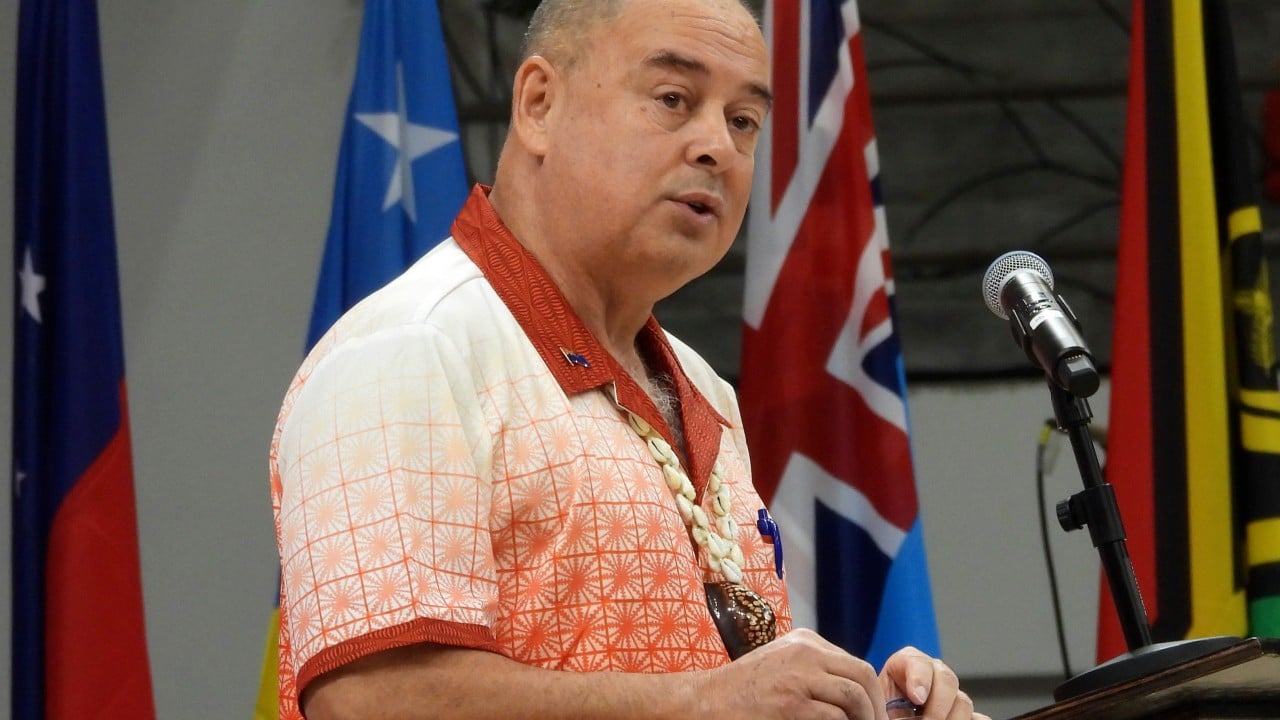
For Mark Brown, the small-island prime minister who just fought his way through a bruising political gauntlet to secure re-election, this tension is not an abstraction on a briefing sheet. It is the daily temperature of survival.
To understand how Brown managed to hold onto power despite a storm of controversy surrounding his government's growing economic ties with China, you have to understand the geography of isolation. The Cook Islands are self-governing in free association with New Zealand. That technical phrase carries heavy emotional machinery. It means Wellington handles defense and foreign affairs, while the islands manage everything else. But when your local budget relies on tourism that flatlined during a global pandemic, and your infrastructure requires millions of dollars just to keep the sea walls from collapsing into people's living rooms, historical loyalty begins to run up against hard arithmetic.
Brown is a man who knows how to hold his ground. Broad-shouldered, direct, and possessing the weary patience of someone who has spent decades navigating the intricate family politics of a tight-knit Polynesian community, he didn't blink when critics accused him of trading sovereignty for concrete.
"We are friends to all and enemies to none," he has repeated like an incantation.
But neutrality in the modern Pacific is a myth.
Consider the quiet village of Titikaveka on a Sunday morning. The coral-stone church echoes with four-part harmonies that can bring a stranger to tears. Families gather on the lawns under the shade of breadfruit trees, sharing plates of raw fish marinated in coconut lime. Talk inevitably turns to the price of imported fuel, the cost of flying a sick child to Auckland for specialized surgery, and the new Chinese-funded harbor upgrades that promise to make shipping container costs manageable for local merchants.
To a visiting diplomat in Washington or Canberra, these projects look like strategic pawns. To a shopkeeper in Titikaveka, they look like cheaper flour and a chance to keep a family store open for another year.
That disconnect is where elections are won and lost.
When the opposition parties mounted their campaigns, they hammered relentlessly on the China factor. They warned of debt traps, of shadowy agreements, of slipping away from the democratic orbit that has anchored the Cook Islands since self-governing status was achieved in 1965. They argued that Brown was moving too fast, cozying up to a superpower whose ambitions dwarf the entire population of the archipelago—fewer than twenty thousand souls scattered across fifteen specks of land.
The criticism was fierce. It was broadcast across social media feeds and argued over morning cups of instant coffee at local markets.
Yet, when the ballots were tallied, the people chose continuity.
Why? Because fear of the future often outweighs fear of the unknown.
Brown's campaign understood a fundamental truth about island life: people do not eat geopolitics. They eat reef fish, taro, and imported rice. When a government delivers improved water systems, upgrades roads, and keeps the lights on through turbulent global economic tides, voters tend to forgive or overlook the diplomatic turbulence humming in the background.
Step back for a moment and look at the broader canvas. The Pacific is no longer a quiet pond at the edge of the world. It is the central stage of the twenty-first century. Every container port, every undersea internet cable, every diplomatic handshake in Honiara, Suva, or Avarua sends shockwaves through chancelleries thousands of miles away.
Small nations are suddenly courted with an intensity that borders on dizzying. Delegations arrive with briefcases full of grants and memorandums of understanding. They smile for the cameras, cut ribbons, and whisper about regional security.
Mark Brown stood in the eye of that storm and refused to be swept away.
His victory is a masterclass in pragmatic survivalism. He did not reject New Zealand, nor did he slam the door in China's face. Instead, he walked a razor-thin line between traditional obligations and modern economic desperation. It is a tightrope walk that every small island state in Oceania is now forced to perform.
The sun dips below the horizon in Rarotonga, painting the clouds in shades of bruised purple and burning gold. The streetlights flicker on along Marine Drive. Tomorrow, the emails will arrive from Wellington asking for clarifications. Tomorrow, the diplomatic cables will hum between Beijing and the capital. Tomorrow, the sea will continue to rise incrementally against the outer reefs, whispering its ancient warning about the fragility of this paradise.
Mark Brown will wake up, put on his shirt, and walk back into the office. The election is over. The mandate is secured. But the tide is still coming in.