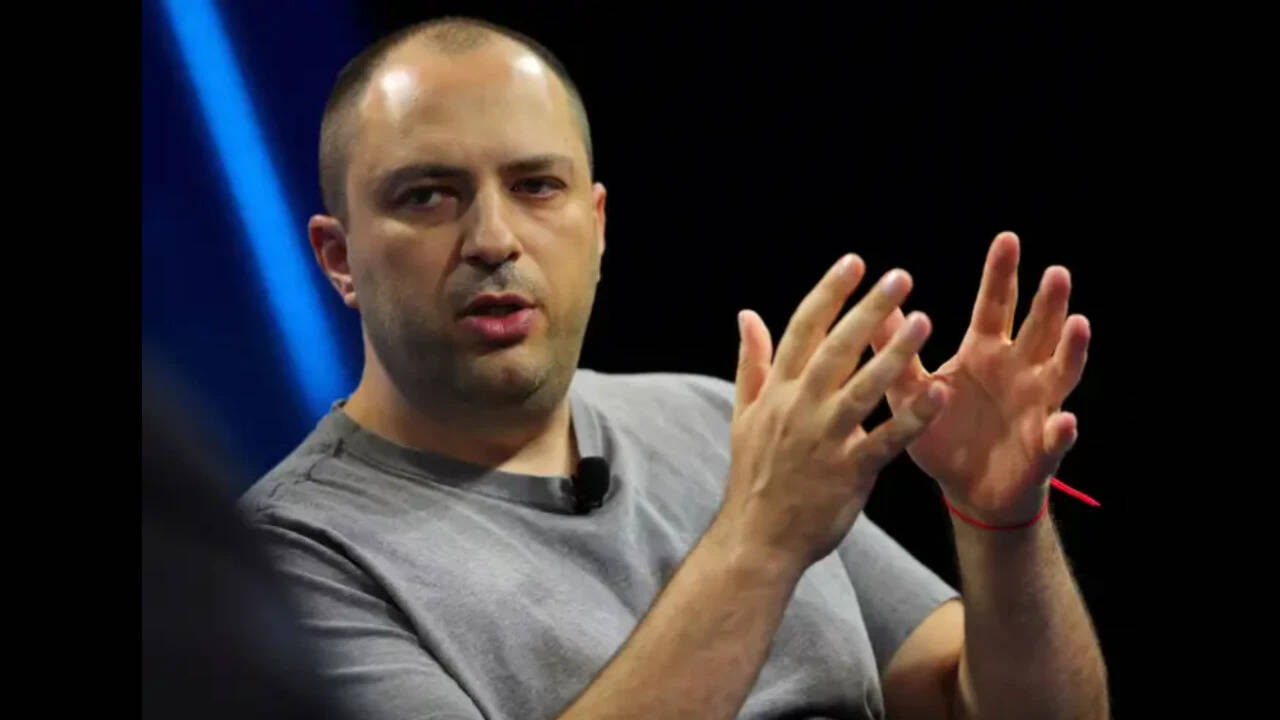
Most tech billionaires write checks to Ivy League endowments or splashy AI research labs so they can get their names etched onto glass buildings. WhatsApp co-founder Jan Koum took a wildly different route in Los Angeles. He quietly handed over $36 million to expand a Jewish day school.
It wasn't a vanity play. Honestly, if you know anything about Koum's background, it makes complete sense.
In November 2022, the Koum Family Foundation committed $36 million to Harkham Hillel Hebrew Academy in Beverly Hills, California. That single gift—structured around the Hebrew number chai (18, representing life, doubled to 36)—didn't just patch up a leaky roof or buy a few new laptops. It financed a massive physical transformation of the campus, including the purchase of adjacent properties to dramatically expand student capacity and modernize facilities.
When a notoriously private billionaire drops eight figures on a K-8 school, people notice. They also get a lot of details wrong.
What the $36 Million Actually Bought
Let's clear up the immediate misconception. People hear "$36 million donation" and assume the school just threw the cash into an investment account to sit there forever.
That isn't what happened here.
Harkham Hillel Hebrew Academy, founded in 1948, had been bursting at the seams for years. Los Angeles has one of the largest Jewish populations in the United States, and demand for Orthodox and traditional Jewish day school education in the Beverly Hills and Pico-Robertson neighborhoods consistently outpaces available classroom seats. Real estate in Beverly Hills isn't exactly cheap, either. You can't just casually buy the lot next door when commercial and residential square footage trades at a massive premium.
Koum's $36 million gift gave the school the immediate financial muscle to acquire neighboring real estate along Olympic Boulevard and expand its footprint. The expansion plan centered on building out new classrooms, upgrading security infrastructure, creating dedicated STEM and arts spaces, and making room for hundreds of additional students.
Big money solves real estate bottlenecks. Without a donor willing to absorb the massive upfront capital cost of Beverly Hills land acquisition, a tuition-driven K-8 school simply couldn't pull off that kind of physical growth on its own.
Why the Number 36 Matters
If you aren't familiar with Jewish traditions around charitable giving, the number $36 million might seem random. Why not $35 million? Why not $40 million?
In Hebrew gematria—a traditional system where letters correspond to numerical values—the word chai (חי), which means "life," adds up to 18. Because of that, Jewish charitable donations are almost always given in multiples of 18. You'll see $18, $180, $1,800, or, if you sold your messaging app to Facebook for $19 billion, $36 million.
Double chai. It's an intentional nod to continuity, survival, and building for the next generation. Koum doesn't do splashy press conferences, so the number itself did most of the talking.
Who Is Jan Koum and Why Does He Give Like This
To understand why a Silicon Valley titan cares so deeply about a Jewish day school in Southern California, you have to look at where he came from. Koum didn't grow up in a gated community in Palo Alto.
Born in Kyiv, Ukraine, in 1976, Koum grew up under Soviet rule in an environment where antisemitism was systemic and open Jewish practice was suppressed. When he was 16, he and his mother emigrated to Mountain View, California. They lived on food stamps. His mother worked as a babysitter, and Koum swept floors at a local grocery store to help pay the bills.
He taught himself computer networking by buying manuals from a used bookstore and returning them when he was done reading. Later, after a stint at Yahoo, he teamed up with Brian Acton to build WhatsApp in 2009. They had a simple obsession: no ads, no games, no gimmicks, and strict end-to-end encryption. When Facebook acquired WhatsApp in 2014, Koum walked away with a personal fortune worth billions.
Since leaving Facebook in 2018 over disagreements regarding user privacy and data monetization, Koum has largely vanished from public view. He rarely gives interviews. He doesn't post hot takes on social media.
Instead, he runs the Koum Family Foundation, which has quietly become one of the most aggressive philanthropic forces in the Jewish world. Tax filings and public records show that Koum has directed hundreds of millions of dollars toward Jewish causes, Holocaust education, and community infrastructure across the United States, Israel, and Eastern Europe.
The Pattern Behind the Koum Family Foundation
If you track the foundation's IRS Form 990 filings over the past several years, a crystal-clear strategy emerges. Koum isn't spreading peanut butter thin across five hundred different micro-charities. He makes massive, concentrated bets on institutions that build long-term Jewish identity and security.
Look at his track record:
- Educational infrastructure: Beyond Harkham Hillel in Los Angeles, Koum has funded major expansions for Jewish schools and youth organizations across North America.
- Historical preservation: He has poured millions into organizations documenting the Holocaust and supporting survivors, particularly in Eastern Europe where his own family suffered under totalitarian rule.
- Crisis response: Following the outbreak of war in Ukraine in 2022, Koum's foundation stepped in with tens of millions of dollars in humanitarian aid to help evacuate and support Ukrainian refugees and Jewish communities on the ground.
He doesn't care about naming rights. Most of the buildings and programs he funds don't have "Jan Koum" plastered across the front entrance in ten-foot letters. In fact, many recipients only confirm his involvement because tax disclosures eventually make the grants public record.
The Bigger Problem Facing Private Jewish Education
You can't look at Koum's $36 million gift in a vacuum. It sits right at the center of a massive economic crisis in American Jewish life: the soaring cost of day school tuition.
In major metro areas like Los Angeles, New York, and Miami, annual tuition at a Jewish day school easily runs between $20,000 and $40,000 per child. If a middle-class family has three or four kids, they're staring down a six-figure annual education bill before they even pay their mortgage or buy groceries.
Schools get squeezed from both sides.
On one side, parents are maxed out. Tuition increases of 4% to 6% every year are pushing middle-income families out of the system entirely. On the other side, schools face skyrocketing operational expenses—teacher salaries, healthcare benefits, facility maintenance, and, increasingly, armed security.
Since the surge in global antisemitism over the last few years, security isn't an optional line item for Jewish schools anymore. It's a massive fixed cost. Schools in Los Angeles have had to hire full-time armed guards, install blast-resistant glass, upgrade perimeter fencing, and coordinate directly with local law enforcement. Government grants like the FEMA Nonprofit Security Grant Program help, sure, but they barely scratch the surface of ongoing payroll costs for trained security personnel.
When a school has to spend millions just to keep its doors open and its students safe, capital expansion becomes impossible. You can't raise tuition another $5,000 per kid to pay for a new wing.
That's where mega-donors like Koum completely alter the math. By covering the massive capital expenditure of buying land and constructing new facilities, a $36 million gift relieves the operational budget. It allows the school to grow its enrollment—bringing in more tuition revenue at scale—without passing the construction debt onto parents.
Why Beverly Hills and Pico-Robertson Matter So Much
Los Angeles isn't just another city on the map for Jewish philanthropy. The corridor stretching from Beverly Hills through Pico-Robertson and into the Fairfax district is the heartbeat of observant Jewish life on the West Coast.
Over the past decade, housing prices in this pocket of Los Angeles have exploded. A modest single-family home in Pico-Robertson routinely sells for well over $2 million. Young families moving to the area are already stretching every dollar just to live within walking distance of synagogues and schools.
Harkham Hillel Hebrew Academy serves as a primary anchor for these families. If the school runs out of seats, families either have to leave the neighborhood or compromise on the education they want for their kids.
By funding the campus expansion right in Beverly Hills, Koum didn't just help one school's balance sheet. He stabilized the real estate and demographic future of an entire community. When a flagship school has room to grow, young families stay, local businesses thrive, and the neighborhood keeps its momentum.
What Other Tech Philanthropists Get Wrong
Compare Koum's approach to the standard Silicon Valley playbook.
Over the past fifteen years, we've watched tech founders launch massive philanthropic LLCs with glossy websites, 50-page mission statements, and armies of McKinsey-style consultants. They talk endlessly about "disrupting education" or "reimagining public systems." Millions of dollars vanish into administrative overhead, feasibility studies, and pilot programs that quietly shut down three years later when the founder gets bored and moves on to longevity research or space travel.
Koum bypassed the entire consultant-industrial complex.
Instead of trying to invent a brand-new educational model from scratch, he looked at an institution that had already been succeeding since 1948, identified its biggest physical bottleneck, and wrote a check big enough to clear it.
There's a brutal efficiency to that. Bricks, mortar, classrooms, and security gates are tangible. Ten years from now, hundreds of kids will still be walking through those doors every morning. You don't need a white paper to measure the return on investment when you can literally see the extra classrooms filled with students.
The Ripple Effect on Local Fundraising
There's an unspoken rule in major-gift fundraising: big money attracts more money, provided the school handles it right.
When a school receives a $36 million windfall, the biggest danger is donor fatigue among everyone else. Smaller donors—the parents giving $1,800 a year, the grandparents giving $10,000—might look at a billionaire's gift and think, "Great, they don't need my money anymore."
If that happens, a mega-gift can actually hurt a school's annual operating fund.
Smart school boards avoid this trap by walling off capital gifts from annual scholarship funds. Capital money goes strictly into dirt, concrete, and steel. Meanwhile, the school uses the momentum of the mega-gift to challenge the broader community to match funds for tuition assistance and teacher retention.
For Harkham Hillel, expanding capacity only works if middle-class families can actually afford the new seats. Adding 200 spots doesn't mean much if nobody in the neighborhood can pay the tuition. The real test over the next decade is how aggressively the school pairs this physical expansion with endowment growth dedicated strictly to financial aid.
How to Evaluate Major Philanthropic Gifts Like a Pro
Whether you're a parent looking at private schools, a board member at a local nonprofit, or just someone trying to separate real impact from billionaire PR, you can use a few practical filters to see if a massive donation actually moves the needle:
- Check the restriction type. Unrestricted cash and capital expansion grants solve immediate structural problems. Pledges stretched over 15 years with heavy naming conditions often create more headaches for nonprofits than they solve.
- Look at the IRS Form 990. If you want to know what a billionaire or foundation actually cares about, ignore their press releases and pull their public 990 tax filings on ProPublica's Nonprofit Explorer. You'll see exact dollar amounts, recipient organizations, and multi-year trends without any PR spin.
- Watch the operating budget. A healthy school or nonprofit uses a massive capital gift to lower its long-term debt service, freeing up annual tuition or donor dollars to pay teachers better and fund scholarships. If tuition still spikes 8% the year after a $36 million gift, ask the board where the operating money is going.
- Verify local zoning and timelines. In cities like Los Angeles, buying land is only half the battle. Conditional use permits, traffic studies, and neighborhood hearings can delay physical construction for years. Real progress shows up in city planning approvals, not just initial announcements.
Jan Koum didn't try to reinvent education, and he didn't ask for a statue in the courtyard. He saw a thriving school boxed in by Beverly Hills real estate prices, dropped $36 million to knock down the walls, and went back to keeping his mouth shut. More billionaires should take notes.