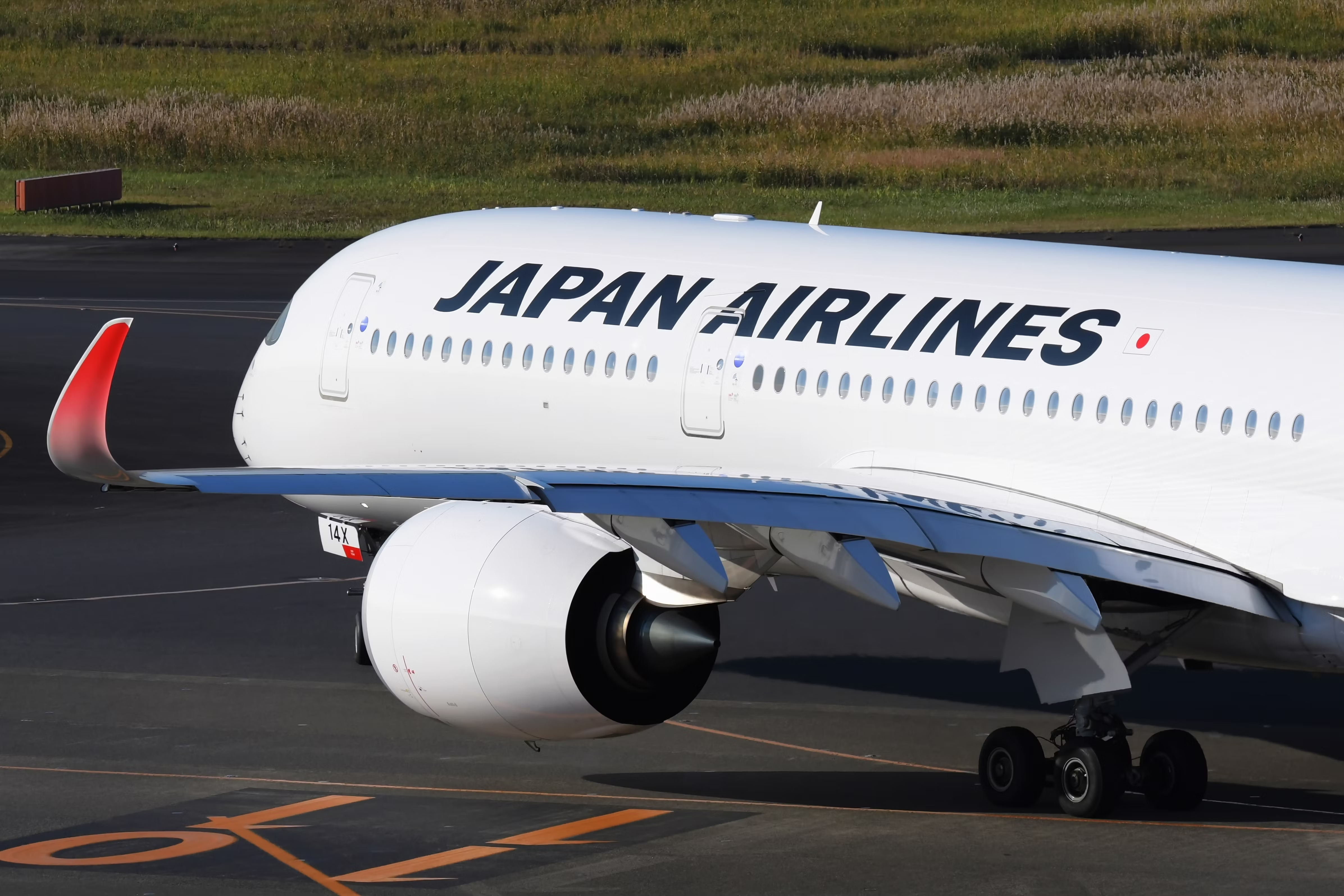
The press release from Japan Airlines (JAL) reads like a science fiction fever dream. They are trialing humanoid robots at Tokyo’s Haneda airport to "solve labor shortages." It’s a convenient narrative. It’s also a total lie.
For years, the aviation sector has hid behind the "labor shortage" curtain to mask a much grimmer reality: the industry is suffering from a massive failure in systems design. Dropping a bipedal robot—a machine that mimics the most inefficient form factor for movement on a flat floor—into a crowded terminal isn't a solution. It’s theater.
If you want to solve the labor crisis at Haneda, you don't build a robot that looks like a person. You build an airport that doesn’t need people.
The Humanoid Fallacy
Every time a CEO poses next to a shiny white robot with blinking LED eyes, an engineer somewhere loses their mind. Humanoids are the most difficult, expensive, and fragile way to automate any task.
Humans are biological miracles of balance and versatility. Replicating that in carbon fiber and actuators just to have a machine point a passenger toward Terminal 3 is an insult to robotics.
Look at the physics. A humanoid robot has a high center of gravity. It requires immense processing power just to keep from falling over when a toddler bumps into it. It moves at a fraction of human walking speed. It cannot navigate stairs as well as a person, and it certainly cannot handle the unpredictable chaos of a security line.
JAL isn't trying to replace workers. They are trying to distract you from the fact that their baggage systems, check-in software, and gate logistics are still running on logic from the 1990s.
The High Cost of Cute
I have spent decades watching corporations burn through R&D budgets on "innovation" that provides zero ROI. These trials are expensive. Between the maintenance, the specialized technicians required to babysit the robots, and the initial acquisition cost, JAL is spending more per "robot-hour" than they would pay for three highly skilled human supervisors.
The industry insists that people don't want to work at airports anymore. That’s a half-truth. People don't want to work jobs that are soul-crushingly repetitive and physically draining for low pay.
Instead of investing $500,000 in a single humanoid that can barely say "hello," that money should be diverted into:
- Fully Automated Baggage Injection: Systems where the passenger drops a bag, and it is scanned, weighed, and routed without a single human touch-point.
- Biometric Flow Control: Gates that use facial recognition to eliminate the need for ticket-scanning staff entirely.
- Predictive Staffing Algorithms: Real-time data that moves the existing human staff to where they are actually needed, rather than having them stand around empty gates.
The Haneda Bottleneck
Haneda is one of the most efficient airports in the world, which makes this stunt even more egregious. The "labor shortage" in Japan is a demographic reality—the population is shrinking. You cannot fix a demographic collapse with a gimmick.
When JAL claims these robots will assist with "customer service," they are ignoring what passengers actually want. No traveler in the history of flight has ever thought, "I hope a slow-moving robot explains the flight delay to me." They want an app that works. They want clear signage. They want a boarding process that doesn't feel like a cattle drive.
The obsession with humanoids is a psychological safety blanket for executives who are afraid of true automation. True automation is invisible. It’s the Amazon warehouse model where the floor moves and the shelves come to the picker. It’s the self-driving shuttle that doesn't have a face because it doesn't need one.
The Hidden Risk of "Social Robots"
There is a dark side to these trials that the JAL PR team won't mention: the "uncanny valley" liability. When you give a machine a face and a voice, users expect human-level intelligence. When that machine inevitably fails to understand a complex question about a missed connection or a lost passport, the frustration is doubled.
A kiosk is a tool. A humanoid is a promise. And in the high-stress environment of an international airport, breaking a promise to a frustrated traveler is a recipe for a brand disaster.
Moreover, these machines are a nightmare for terminal flow. In an airport, "throughput" is the only metric that matters. Every second a group of tourists stops to take a selfie with a JAL robot is a second the hallway is blocked for the 200 people behind them trying to catch their flight.
Stop Automating Tasks, Start Automating Systems
The "People Also Ask" sections of the internet are filled with queries like "Will robots take airport jobs?" The answer is: not these robots.
The jobs being "taken" are being absorbed by better software, not metal men. If you are a worker at Haneda, don't fear the humanoid. Fear the QR code. Fear the sensor in the floor. Fear the API that connects your passport to the security gate. Those are the technologies that actually work.
JAL's trial is a symptom of "Innovation Theater"—the act of appearing tech-forward without actually doing the hard work of infrastructure overhaul. It’s easier to buy a robot than it is to rewrite the legacy code of a global reservation system. It’s sexier to show a robot on the news than it is to explain why you’ve optimized the luggage carousel belt speed by 12%.
The Contrarian Mandate
If we want to fix the aviation labor crisis, we have to stop trying to make machines act like people. We need to make airports act like machines.
Imagine a scenario where you walk into Haneda, your phone verifies your identity via Bluetooth, your bag is whisked away by a floor-level conveyor, and you walk straight to your seat. No lines. No "customer service" desks. No humanoid robots waving at you.
That is the future of travel. It is efficient, it is cold, and it is highly profitable.
JAL’s humanoid is a toy. It’s a mascot with a battery pack. Until the industry stops treating automation like a theme park attraction, the labor shortage will continue to bite, and passengers will continue to pay for the privilege of watching a $100,000 machine struggle to do what a $10 sign could do better.
Fix the system. Stop the circus.